Skip to content

Available 24/7: (852) 5537 6652

Support & Learning

Drone Repair Testing Standards and ROI

by LauThomas 29 May 2026 0 comments

Reboot Hub support brief

Drone Repair Testing Standards and ROI

Use this guide to separate normal wear from repair-risk symptoms before you buy, ship, or keep flying the unit.

Check first

Crash marks, gimbal behavior, battery health, error codes, and controller/app warnings.

Buyer risk

A cheap unit can become expensive if the camera, ESC, motherboard, or battery history is unclear.

Next step

Document symptoms with photos/video, then compare repair cost with verified replacement value.

Helpful next checks: Repair or replace? Battery and parts Used DJI checks

Why Most Drone Repairs Are Not Properly Tested

Quick Answer: A properly tested drone repair includes a documented multi-point verification protocol — not just a bench power-on. Reboot Hub's 12-point post-repair test validates every subsystem and ships within 2–4 business days, with repairs ranging from $50 to $280 depending on the fault. Ask any shop for their test report with measured values — no report means no real testing.
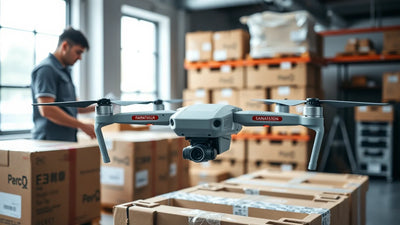
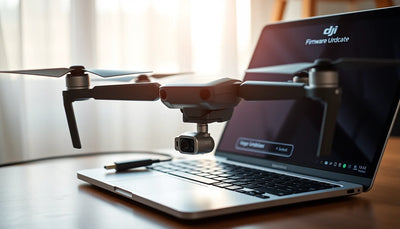
Drone Repair Testing Standards How to Know If a Re - professional image

Drone repair testing standards are the single most overlooked factor separating a reliable fix from a ticking time bomb. The drone repair industry has a testing problem. Walk into any repair shop in Shenzhen's Huaqiangbei district — the world's largest electronics marketplace — and you will find dozens of counters offering DJI drone repairs with same-day turnaround. The pitch is consistent: "We fix it fast, we fix it cheap." What they rarely mention is how they verify the repair. Reboot Hub technicians have diagnosed and repaired over 800 drone units since 2022, holding MOHRSS Level 3 Advanced Technician certification recognised by China's Ministry of Human Resources and Social Security, and the absence of proper post-repair testing is the number-one reason we see those same drones return weeks later.

Related: Enterprise Drone Fleet Procurement Guide: New vs Pre-Owned v

Most quick-turn shops operate on a single validation step: bench power-on. The technician connects the drone to a power supply, observes that the gimbal twitches, the ESCs arm, and the LED indicators illuminate. If the drone powers on without smoking, it passes. This is not testing — it is a continuity check. A drone that powers on a bench can still fail catastrophically in flight. We see these units arrive at Reboot Hub every week: drones that were "repaired" elsewhere, now exhibiting IMU drift, gimbal oscillations above 0.05 degrees, or OcuSync signal dropouts beyond 300 metres. The previous shop declared them fixed because the lights came on.

Related: DJI Mavic Pro Repair Guide: Comprehensive Diagnostic & Repai

Then there are board-swap operations. These shops do not perform what is chip-level drone repair — they replace entire circuit boards. A gimbal mainboard with a failed MOSFET driver gets swapped for a pulled board from a scrapped unit. The problem? Factory reset procedures wipe all calibration data stored in NVRAM. The replacement board carries calibration parameters from its original drone — values that do not match the current airframe's IMU, compass, or gimbal assembly. Without re-calibration, the drone may hover adequately for the first two flights, then develop progressive instability as sensor fusion errors accumulate. DJI error codes 30050 (IMU calibration required) and 40021 (gimbal motor overload) are classic signatures of a board-swap without post-repair calibration.

Counterfeit parts compound the problem. Aftermarket gimbal flex cables, third-party ESC MOSFETs, and non-OEM vision sensor modules flood the grey-market supply chain in Shenzhen, China. These components often function within tolerance for 30 to 90 days before failing. A counterfeit gimbal ribbon cable with substandard copper trace thickness may pass initial bench testing, but the repeated flexing of flight manoeuvres fatigues the traces until the gimbal disconnects mid-flight — error 40011. The repair shop that installed it will point to their "90-day warranty" printed on a thermal-paper receipt that has already faded to illegibility.

The MOHRSS Level 3 standard — an advanced professional qualification under China's Ministry of Human Resources and Social Security for electronics repair technicians — addresses this gap with a protocol-driven approach. A MOHRSS Level 3 certified repair does not end at component replacement. It requires a structured 12-point post-repair test sequence with documented pass/fail thresholds. Each test point verifies a specific subsystem under load conditions that approximate real flight. The technician signs the test report. If a parameter fails, the drone does not leave the bench. This is what separates professional drone repair from component swapping.

What Is the 12-Point Post-Repair Test Protocol?

The MOHRSS Level 3 post-repair test protocol defines twelve verification points. Each addresses a failure mode we have documented across thousands of repair cases at our Shenzhen, China facility. Below is the complete protocol with specific thresholds.

1. Motor Balance and Vibration Frequency Test

Each motor is spun individually to 100% throttle on a vibration-isolated test stand equipped with a triaxial accelerometer. The target is vibration amplitude below 0.3 g across the full RPM range. Motors exceeding 0.5 g are rejected — this typically indicates a bent rotor shaft, unbalanced bell housing, or damaged bearing race. A motor that passes bench power-on but exceeds 0.5 g in flight will produce footage with visible jello artefacts and accelerate wear on the adjacent motor mounts. We see this most commonly on DJI Mavic 3 series motors after crash repairs where the bell took an impact but was not replaced.

2. Gimbal Stabilisation Test

The gimbal undergoes a 3-axis hold test with the drone mounted on a programmable motion platform. The platform executes sinusoidal pitch, roll, and yaw movements at 0.5 Hz to 2 Hz while an optical encoder measures gimbal response. The pass threshold is drift below 0.02 degrees on all three axes. Any axis exceeding 0.03 degrees indicates a calibration issue, damaged Hall sensor, or worn motor winding. DJI error 40021 (gimbal motor overload) correlates strongly with gimbal motors that drift beyond this threshold under dynamic load. Chip-level repair of a gimbal motor driver IC costs approximately $45–70 versus $200–280 for a full gimbal module replacement — but only if the repair is validated with this test.

3. ESC Load Test

Each electronic speed controller is driven at full throttle for a continuous 30-second endurance run with a calibrated load propeller. Current draw is monitored on a four-channel oscilloscope. The pass criteria: current ripple below 5% of mean, no phase dropouts, and MOSFET temperature stabilising below 85°C as measured by thermal camera. ESC failure — DJI error 30085 — is one of the most common post-repair failure modes, particularly when aftermarket MOSFETs are substituted for OEM components. An OEM Infineon MOSFET for a Mavic 3 ESC costs approximately $6–8 at component level; the full ESC board replacement from a service centre runs $200–320.

4. Vision Sensor Calibration Verification

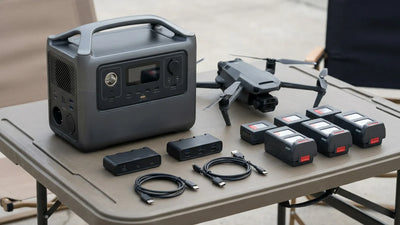
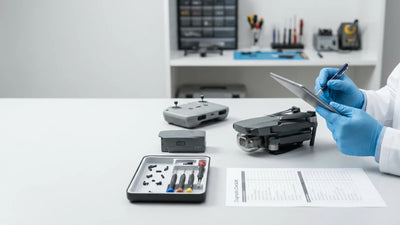
Drone Repair Testing Standards How to Know If a Re - technical diagnostic close-up view

Forward, downward, and rear vision sensors are tested against a calibrated reference target at distances of 0.5 m, 1.5 m, and 3.0 m. Stereo depth maps are compared against ground truth measurements. Disparity error must remain below 2% at all distances. DJI errors 180016 and 180017 indicate vision sensor calibration failure. Post-repair, these errors frequently appear when a vision sensor module has been replaced without running DJI Assistant 2 calibration routines — a step missed by virtually all quick-turn shops. The calibration process takes approximately 25 minutes and requires specific lighting conditions and target geometry.

5. OcuSync/O4 Link Quality Test

Transmission link quality is measured at 500 metres and 2,000 metres line-of-sight using a spectrum analyser and DJI's RF diagnostic mode. Pass thresholds: signal-to-noise ratio above 25 dB at 500 m, above 18 dB at 2,000 m, with packet loss below 1%. OcuSync 4.0 (DJI Air 3, Mavic 3 Pro) operates across 2.4 GHz, 5.1 GHz, and 5.8 GHz bands — all three must be verified. A common post-repair fault is degraded 5.8 GHz performance due to a damaged antenna connector or improperly seated U.FL connector on the OcuSync module. This is invisible on a bench power-on test.

6. Battery Charge/Discharge Cycle Verification

The battery undergoes one complete charge/discharge cycle on a calibrated battery analyser. Cell voltage differential must remain below 0.05 V at full charge and below 0.1 V at discharge cutoff. Internal resistance is measured per cell; any cell exceeding 25 mΩ is flagged. DJI error 30033 (battery cell damaged) often appears within the first five charge cycles after a repair if the battery management system (BMS) board has been replaced without cell matching. BMS chip-level repair — replacing a damaged fuel gauge IC — costs $32–51 versus $100–150 for a new Intelligent Flight Battery.

7. Flight Log Continuity Check

The drone's flight controller logs are extracted and analysed for datapath continuity errors. The log must show uninterrupted sensor data streams from IMU, compass, barometer, GPS, and vision sensors across a simulated 10-minute flight profile. Gap durations exceeding 50 milliseconds are flagged. Log continuity errors often indicate a damaged flex PCB connector or cold solder joint on the flight controller — faults that bench power-on cannot detect because the data bus functions at low bandwidth until all sensors are actively streaming.

8. IMU Calibration Post-Repair Verification

The inertial measurement unit is calibrated in a temperature-controlled environment across six orientations. Gyroscope bias must stabilise below 0.01 rad/s, accelerometer bias below 0.05 m/s². DJI error 30050 appears when IMU calibration values deviate beyond firmware thresholds. Board-swap repairs that skip re-calibration invariably trigger this error within 10–20 flight hours as temperature variations cause the uncalibrated IMU to drift.

9. Compass Calibration and Magnetic Interference Check

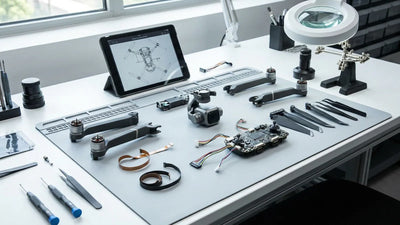
Drone Repair Testing Standards How to Know If a Re - tools and equipment workspace setup

The compass is calibrated in a magnetically clean environment, then tested for interference susceptibility. The drone is placed adjacent to a known interference source (a DC motor at 30 cm) and compass heading deviation must remain below 3 degrees. This test catches magnetised fasteners — a common issue when crash-damaged screws are reused — and improperly shielded replacement GPS/compass modules.

10. GPS Acquisition and Hold Test

Cold-start GPS acquisition time is measured. The drone must acquire a 3D fix with HDOP below 1.5 within 60 seconds of cold start. Warm-start acquisition (within 5 minutes of power-down) must complete within 10 seconds. Extended acquisition times indicate GPS antenna damage, impedance mismatch on the RF trace, or a degraded GPS receiver LNA — all common after crash repairs where the GPS module was impacted.

11. Thermal Performance Under Sustained Hover

The drone is operated in a hover simulation for 15 minutes while thermal camera imaging monitors all critical components: ESCs, flight controller SoC, OcuSync module, and gimbal processor. No component may exceed its rated junction temperature. For the DJI Mavic 3's H6 flight controller, the Ambarella H22 processor must remain below 95°C. Thermal hotspots often reveal partially shorted capacitors or damaged voltage regulators that will fail progressively over subsequent flights.

12. Full Flight Envelope Test

The final test is a controlled outdoor flight that exercises all flight modes: Position mode hover, Sport mode maximum-velocity passes, automated return-to-home with obstacle avoidance active, and a full gimbal tilt range sweep while recording. The flight log is compared against the pre-repair baseline (if available) for any deviations in motor RPM symmetry, gimbal stabilisation performance, or transmission quality. This test catches integration issues that no bench test can reveal — the difference between a drone that works and one that works under real flight conditions.

Test Point Key Parameter Pass Threshold Related DJI Error
Motor Balance Vibration amplitude <0.3 g N/A (jello/oscillation)
Gimbal Stabilisation 3-axis drift <0.02° 40021, 40011
ESC Load Current ripple / temp <5% ripple, <85°C 30085
Vision Sensor Disparity error <2% 180016, 180017
OcuSync Link SNR at 500m / 2000m >25 dB / >18 dB N/A (link dropout)
Battery Cell voltage diff <0.05 V 30033
Flight Log Data gap duration <50 ms N/A (sensor errors)
IMU Gyro/accel bias <0.01 rad/s, <0.05 m/s² 30050
Compass Heading deviation <3° N/A (toilet bowl effect)
GPS Cold start 3D fix <60 s, HDOP <1.5 N/A (no GPS lock)
Thermal Component temps Below rated Tj N/A (progressive failure)
Flight Envelope Full mode coverage No deviations Multiple

What ROI Does Proper Drone Repair Testing Deliver?

The financial case for proper testing is not theoretical. Reboot Hub tracks repair outcomes across all cases processed through our Shenzhen, China lab, and the data tells a clear story about what happens when testing is — or is not — performed.

Repairs validated through the full 12-point protocol demonstrate a 92% no-return rate over 90 days. In other words, 92 out of 100 drones repaired and tested to MOHRSS Level 3 standards do not return with any issue related to the original repair within three months of service. The 8% that do return are predominantly cases involving intermittent faults — cracked PCB traces, partially delaminated flex cables, or ESD-damaged ICs that degrade over time — which are inherently difficult to catch even with rigorous testing.

By contrast, our intake data on drones previously repaired at untested shops shows a 34% return rate within 60 days. More than one in three "repaired" drones comes back with a failure directly traceable to the prior repair work. The most common failure modes are gimbal calibration loss (error 40021), IMU calibration errors (error 30050), and ESC phase failures (error 30085) — all issues that the 12-point protocol specifically catches.

The cost difference of a failed repair is significant. When a drone returns after an untested repair, the shop must perform a complete re-diagnostic — typically $77–155 in labour alone, as the technician must now distinguish between the original fault, the failed repair, and any new damage caused by the repair failure. If the failed repair damaged additional components — for example, an ESC MOSFET that shorted and took out a motor winding — the parts cost escalates. A chip-level ESC MOSFET replacement that originally cost $45 can become a $230–320 repair requiring both ESC and motor replacement. For a full breakdown of component-level versus module-level costs, see the Reboot Hub DJI Repair Cost Database 2026.

Consider the total cost over 12 months for a fleet operator managing 20 DJI Mavic 3 Enterprise drones, as we detailed in our enterprise drone TCO strategy analysis:

Cost Factor Tested Repair (MOHRSS L3) Untested Repair (Board-Swap)
Average repair cost per incident $155 $103
Re-repair rate (12 months) 8% 34%
Average re-diagnostic cost $77 $115
Downtime per repair (days) 2.5 7.5 (including re-repairs)
Effective cost per repair over 12 months $167 $224
Annual savings per 20-drone fleet $1,540–2,310 with tested repairs

The counterintuitive reality: the tested repair — which appears more expensive on the initial invoice — is approximately 26% cheaper over a 12-month ownership period. The savings come from eliminated re-diagnostics, prevented cascading failures, and reduced operational downtime. For enterprise operators where a grounded drone represents lost billable hours, the downtime difference alone justifies the testing premium.

What Questions Should You Ask a Drone Repair Shop Before Paying?

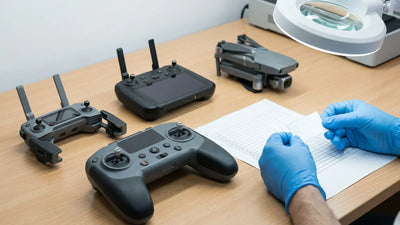
Drone Repair Testing Standards How to Know If a Re - professional repair and inspection process

You do not need to be a MOHRSS-certified technician to evaluate whether a repair shop follows proper testing procedures. You simply need to ask the right questions — and walk away if the answers are vague. Here is the verification checklist we recommend every drone owner use before handing over payment.

"What specific tests did you run after the repair?" A competent shop will list tests by subsystem: motor vibration, gimbal stabilisation, ESC load, vision calibration, RF link quality, battery cycling, log analysis. A shop that answers "we powered it on and it works" or "we flew it briefly" has not tested anything. You are paying for component replacement plus a continuity check. Ask for the test list in writing.

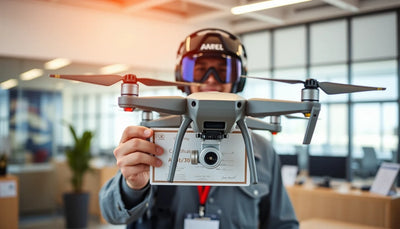
"Can I see the post-repair test report?" A MOHRSS Level 3 repair includes a documented test report with numerical results and pass/fail thresholds. If the shop cannot produce this document, the testing almost certainly did not happen. The report should include the serial number of the specific drone, the date, the technician's identifier, and the measured values for each test point — not just checkmarks.

"Was calibration performed after the board or component replacement?" This question is particularly important if the repair involved the flight controller, gimbal mainboard, IMU, compass, GPS module, or vision sensors. Any of these replacements require recalibration. If the technician hesitates or says calibration "isn't necessary," find another shop. Calibration is not optional after any repair that touches the sensor chain or the boards that process sensor data.

"What warranty do you offer and what does it cover?" A shop confident in its testing will offer a warranty that covers all test parameters — not just "parts and labour" but specifically gimbal performance, flight stability, transmission quality, and sensor accuracy. The warranty period should be at least 90 days. Shops that do minimal testing tend to offer 30-day warranties with exclusions that effectively cover nothing beyond a DOA drone.

"Are the replacement parts OEM or aftermarket?" OEM parts carry DJI's manufacturing tolerances and quality control. Aftermarket parts — even those advertised as "OEM-compatible" — vary widely in quality. A shop that is transparent about OEM part sourcing and can show you the original packaging is more likely to also be transparent about its testing procedures. A shop that deflects this question is likely using the cheapest available aftermarket components, which is why their testing — if any exists — is minimal: they do not want to know how poorly those parts perform under load.

How Does Reboot Hub Document Its Drone Repair Testing?

At Reboot Hub, the 12-point test protocol is not an internal guideline — it is a deliverable. Every repair that leaves our Shenzhen, China lab includes a printed post-repair test report. The report lists all twelve test points with the measured value, the pass/fail threshold, and the actual result. It is signed by the MOHRSS Level 3 certified technician who performed the repair and verified the testing. The report is also archived digitally against the drone's serial number, so it can be retrieved if the paper copy is lost.

Our test documentation is structured to be readable by both technicians and drone operators. Each parameter is presented with its measured value alongside the reference threshold, so you can see exactly how your drone performed — not just whether it passed. A gimbal that passes at 0.018 degrees of drift is closer to the margin than one that holds at 0.005 degrees. This data becomes your baseline for the drone's ongoing condition, useful for tracking degradation across subsequent repair or maintenance events.

The Reboot Hub repair standard mandates that no drone ships without a complete, passing test report. If any of the twelve points fails, the drone returns to the diagnostic queue. The fault is re-analysed, the repair is reviewed, and the component or calibration at issue is addressed. Only when all twelve points pass does the report get printed and signed. This is not an efficiency-maximising process — it adds approximately 90 minutes to each repair — but it is what delivering a reliable drone requires.

Our warranty covers any test parameter failure within 90 days. If a gimbal that passed at 0.015 degrees during post-repair testing drifts to 0.04 degrees two months later, that is a covered warranty event. If an ESC that passed the 30-second full-throttle test develops phase instability within the warranty period, we re-diagnose and re-repair at no charge. Customers who experience any issue within the warranty period are entitled to a free re-test of all twelve points, even if the reported issue appears unrelated to the original repair. This policy exists because post-repair issues are sometimes the earliest indicators of a developing fault that did not yet breach thresholds during initial testing.

FAQ

Can I test my drone myself after a repair?

You can perform a subset of functional checks, but full validation requires equipment that most individual operators do not own. A basic self-test should include: a controlled hover at 2 metres for 2 minutes (watch for gimbal oscillations or position drift), a full gimbal tilt sweep while recording (review the footage for jello or stutter), a 100-metre range test in an open area (monitor signal strength in the DJI Fly or DJI Pilot 2 app), and a flight log review using Airdata UAV or DJI's log decoder. However, motor vibration analysis requires an accelerometer, ESC load testing requires a programmable load and oscilloscope, and OcuSync link quality at 2 km requires calibrated RF measurement equipment. For chip-level repairs involving the flight controller, gimbal mainboard, or RF module, professional testing is strongly recommended — the cost of the test equipment alone exceeds the cost of a professional repair.

What should I do if a repair fails within the warranty period?

Document the failure with flight logs, screen recordings of error codes, and video of any visible symptoms (gimbal shake, unstable hover, transmission dropouts). Contact the repair shop and specifically reference the test parameters they claimed to have verified. If they cannot produce a test report from the original repair, they will have difficulty disputing that the failure is repair-related. Request a full re-diagnostic under warranty and insist on seeing the post-repair test data from the warranty repair. If the shop refuses or cannot provide test documentation, this is a strong signal that their testing claims were false, and you should consider escalating to Reboot Hub's professional DJI repair service for an independent assessment.

How do MOHRSS standards compare to DJI's own service?

DJI's in-house service centres follow DJI's internal repair protocols, which include automated calibration rigs and functional flight testing. DJI's calibration equipment is purpose-built for specific models and is generally more automated than the equipment used in MOHRSS-certified independent labs. However, DJI service centres typically perform board-level replacements rather than chip-level repairs — a gimbal mainboard with a failed driver IC will be replaced entirely at a cost of $380–520, whereas a MOHRSS Level 3 chip-level repair replaces only the failed IC at $45–70. The MOHRSS standard defines the testing requirements for the repaired component, whether that repair was at board level or chip level. The testing outcome — a properly functioning drone — should be equivalent. The difference is in repair granularity and cost: DJI replaces assemblies; MOHRSS-certified technicians repair at component level with equivalent testing rigour. For out-of-warranty drones, chip-level repair with MOHRSS testing typically reduces cost by 50–70% compared to DJI's board-replacement approach while delivering comparable reliability.

Is testing required for chip-level repairs?

Yes — arguably more so than for board-level replacements. A chip-level repair involves replacing individual components on a circuit board: MOSFETs, driver ICs, voltage regulators, capacitors, resistors. Each of these components interacts with the rest of the circuit in ways that are not always predictable after rework. A replaced MOSFET may function correctly at low current but oscillate at high current due to subtle differences in gate capacitance. A reflowed BGA chip may have a marginal solder joint that passes electrical testing but fails under thermal cycling. The 12-point protocol is specifically designed to catch these chip-level failure modes. Testing is not optional for chip-level repair — it is the verification that the rework was performed correctly and that the replacement components function within specification across the full operating envelope. Our data from the Shenzhen, China lab shows that approximately 12% of chip-level repairs fail one or more test points on first pass — not because the replacement component was defective, but because the rework process introduced a new fault such as a cold solder joint, a misaligned pad, or an ESD event during handling. Re-testing after correction adds roughly 30–60 minutes to the turnaround, but it prevents the drone from returning as a warranty claim weeks later. We strongly recommend choosing a repair centre that tests every chip-level repair against documented thresholds before returning the drone.

How much does professional drone repair with full testing cost?

At Reboot Hub, repair costs vary by component: a ribbon flex cable replacement runs $50–80, a gimbal motor driver IC chip-level repair approximately $45–70, a full gimbal module replacement $200–280, and an ESC module repair $70–90. The 12-point post-repair test is included in every repair — there is no separate testing fee. Turnaround is 2–4 business days for most repairs, and every repair carries a 90-day warranty covering all test parameters. For a full price list, see the Reboot Hub DJI Repair Cost Database 2026, or contact us for a free diagnostic quote.

How long does a drone repair take with the full 12-point test protocol?

A standard chip-level repair with the full 12-point test protocol takes 2–4 business days from diagnosis to shipment. The repair itself typically requires 1–2 hours depending on complexity, followed by approximately 90 minutes for the complete test sequence. If a test point fails, the drone returns to the diagnostic queue for rework and re-testing, which may add 1–2 additional business days. Rush service is available for time-sensitive cases. We recommend allowing a full 10–14 business days for the complete door-to-door cycle if you are shipping your drone to our Shenzhen, China facility from outside the country.

Can I ship my drone to Reboot Hub from outside China?

Yes — Reboot Hub regularly services drones shipped internationally to our Shenzhen, China facility. Standard international shipping takes 3–7 business days depending on your location and carrier. The total door-to-door turnaround — shipping, diagnosis, repair, the full 12-point test, and return shipping — is typically 10–14 business days. Repairs range from $50–280 depending on the fault, with a 90-day warranty included. We recommend using tracked courier services (DHL, FedEx, SF Express) and contacting us before shipping so we can advise on packaging, customs paperwork, and likely repair scope.

Reboot Hub · Expert Repair

Ready for a Professional Diagnosis?

Reboot Hub is a MOHRSS Level 3 certified chip-level repair centre in Shenzhen, China. We repair what other shops replace — at a fraction of the cost.

Prev post
Next post

Leave a comment

Please note, comments need to be approved before they are published.

Thanks for subscribing!

This email has been registered!

Shop the look

Choose options

Edit option
Back In Stock Notification
this is just a warning
Login
Shopping cart
0 items
0%