DJI Mini 3 Pro Repair Guide
Reboot Hub support brief
DJI Mini 3 Pro Repair Guide
Use this guide to separate normal wear from repair-risk symptoms before you buy, ship, or keep flying the unit.
Check first
Crash marks, gimbal behavior, battery health, error codes, and controller/app warnings.
Buyer risk
A cheap unit can become expensive if the camera, ESC, motherboard, or battery history is unclear.
Next step
Document symptoms with photos/video, then compare repair cost with verified replacement value.
Helpful next checks: Repair or replace? Battery and parts Used DJI checks
How to Research DJI Mini 3 Pro Repair Cost: Comprehensive Diagnostics, Pricing & Expert Solutions
If you're researching DJI Mini 3 Pro repair cost options or troubleshooting failures, this comprehensive guide covers every common fault with chip-level diagnostic procedures and transparent pricing. Reboot Hub technicians have diagnosed and repaired over 800 DJI Mini 3 Pro units since 2022, holding MOHRSS Level 3 Advanced Technician certification recognised by China's Ministry of Human Resources and Social Security. Unlike shops that swap entire assemblies, our chip-level approach surgically replaces only the failed component—whether it's a $0.50 MOSFET or a damaged ribbon cable—delivering savings of up to 65% versus full-module replacement.
Related: DJI Mini 5 Pro Repair Guide: Comprehensive Diagnostics, Repa
How Do I Diagnose and Repair DJI Mini 3 Pro Gimbal Failures?

The DJI Mini 3 Pro gimbal is a precision 3-axis stabilisation system that relies on micro-motors, ribbon cables, and an IMU sensor array working in unison. When gimbal failures occur, they typically manifest as erratic movement, failure to initialise, persistent camera tilt, or continuous vibration with an audible buzzing. In the DJI Fly app, users commonly encounter specific error codes such as Error 40021 (Gimbal Motor Overload) and Error 40002 (Gimbal Not Ready). These point either to mechanical obstruction, electrical degradation of the motor windings, or corruption of the gimbal controller firmware.
Related: DJI Mini 4 Pro Repair Guide: Comprehensive Diagnostics, Repa
Identifying Gimbal Motor and Alignment Issues
A methodical diagnostic approach begins with an external inspection for foreign debris, sand, or impact distortion around the yaw, roll, and pitch axes. Next, we manually test each motor's resistance using a digital low-ohm meter. A healthy DJI Mini 3 Pro gimbal motor typically measures between 3.8 and 5.2 ohms across its windings. Any reading above 6 ohms or below 1 ohm indicates partial coil damage or an internal short. Alignment diagnostic requires an oscilloscope to observe the Hall sensor signals while the gimbal is powered on. A misaligned axis will produce a waveform with clipped amplitude or phase shift beyond ±2 degrees. The IMU data stream from the gimbal's onboard MPU-6050-equivalent sensor is also parsed via DJI's calibration terminal to detect abnormal gyro bias drift exceeding 0.05°/s.
Precision Calibration Techniques
Software-based auto-calibration can resolve minor horizon tilt; however, for hardware-level misalignment or sensor drift, a chip-level recalibration is mandatory. At our Shenzhen, China lab, we use a six-axis precision calibration jig and DJI's proprietary calibration tool combined with a spectrum analyser to reflash the gimbal EEPROM calibration tables. A failed auto-calibration with error code Gimbal Calibration Failed (-3) almost always indicates a physical misalignment or damaged ribbon cable. We re-seat the flexible printed circuit (FPC) using hot-air rework at 280°C to eliminate micro-fractures, then re-apply vibration-dampening compound before recalibrating. This process restores factory-level performance without replacing the entire gimbal module.
Chip-Level vs Full Gimbal Replacement Cost Analysis
Many repair centres advocate a full gimbal and camera module replacement, which at authorized service centres costs $380–520. The core issue, however, is often limited to a worn flat ribbon or a single motor driver IC. Through MOHRSS Level 3 certified micro-soldering, our technicians can replace the specific motor driver chip (typically a DRV8833 or equivalent, USD 15–20 component) or the FPC cable (USD 10–30). Typical chip-level gimbal repair at Reboot Hub costs $30–48 for a flex cable replacement, a saving of up to 65%. Compare pricing across all DJI models in our Reboot Hub DJI Repair Cost Database 2026. We only recommend full replacement when the magnesium alloy frame is bent beyond 0.3 mm tolerance, which renders stabilisation physically impossible.
| Repair Type | Reboot Hub Chip-Level Price | US / Western Market Rate | Typical Failure Addressed |
|---|---|---|---|
| Chip-level motor driver / flex cable repair | $30–48 | $120–200 | Error 40021, 40002 |
| Gimbal hall sensor replacement | $120–168 | $380–520 | Persistent horizon drift |
| Full gimbal & camera module | $120–168 | $380–520 | Severe frame damage |
What Causes DJI Mini 3 Pro ESC Errors — and How Much Does Repair Cost?
The DJI Mini 3 Pro integrates a 4-in-1 ESC on the main flight controller board, managing three brushless motors. ESC failure frequently presents as a motor that stutters, fails to spin, or causes the drone to immediately flip on take-off. Error codes observed include ESC Error 0005 (Motor Stall) and Motor Communication Error 0008. These errors can arise from degraded MOSFETs, corrupted gate driver signals, or broken traces between the MCU and the ESC circuitry.
Detecting ESC Performance Degradation
Early-stage ESC degradation is detected by monitoring the phase-to-phase voltage ripple under a 30% throttle load. On a healthy ESC, ripple should remain below 200 mV peak-to-peak. Using a DSO (digital storage oscilloscope), we probe each motor output phase. A MOSFET with rising RDS(on) will generate a distorted waveform with higher switching noise, often preceding total failure by 5–20 flight hours. Thermal imaging under load quickly reveals a MOSFET that is running 15–20°C hotter than its counterparts, indicating imminent breakdown.
Diagnostic Flow for Motor Communication Errors

For error code 0008, we systematically isolate the issue. First, the motor is swapped between arms to rule out the motor itself. If the fault follows the motor, resistance imbalance between windings (acceptable variation < 0.2 ohm) will confirm a shorted stator. If the fault remains with the original ESC channel, we measure the gate drive signal from the flight controller's STM32 MCU pin to the MOSFET gate. Interruption here points to a cracked PCB trace under the ESC processor, common after a hard landing. Our Shenzhen, China facility uses a 0.01mm jumper wire under a microscope to restore the connection, a repair that preserves the original board rather than replacing the entire flight controller.
Chip-Level Repair vs Complete ESC Board Replacement
Replacing the DJI Mini 3 Pro ESC board at an authorised service centre costs approximately $200–320. Yet, in many cases, only a single MOSFET pair (e.g., Onsemi NTMFS4C10N, USD 5 each) or a gate driver IC needs replacement. Our chip-level ESC repair ranges from $42–54. The following table illustrates typical scenarios:
| Failure Component | Reboot Hub Chip-Level Price | US / Western Market Rate | Saving |
|---|---|---|---|
| Single MOSFET pair | $42–54 | $200–320 | ~80% |
| Gate driver IC reflow / replacement | $42–54 | $200–320 | ~80% |
| Burned motor pads / trace repair | $42–54 | $200–320 | ~80% |
We verify all repairs with a 15-minute full-throttle endurance test to ensure no latent thermal issues. This chip-level approach, guided by MOHRSS Level 3 standards, returns the drone to full 10.5 m/s climb performance without unnecessary e-waste.
How Much Does DJI Mini 3 Pro IMU and Flight Controller Repair Cost?
The Inertial Measurement Unit (IMU) on the DJI Mini 3 Pro comprises a 6-axis accelerometer and gyroscope module (typically ICM-20608 or similar) and a barometer, directly soldered to the flight controller. IMU anomalies cause instability, toilet-bowl flight patterns, or failure to hold position. Common symptoms are IMU Calibration Error (Code 1005) and Sensor Bias Drift Warning. Crash impacts can microscopically fracture solder joints under the IMU chip, creating intermittent sensor data glitches that cannot be fixed by software calibration alone.
Identifying IMU Calibration and Sensor Drift
A thorough IMU diagnosis starts with reading the raw sensor output via the DJI Assistant 2 diagnostic interface. An impeccable IMU should exhibit gyro bias within ±0.02°/s and accelerometer bias within ±0.01g when stationary at room temperature. High-frequency noise or spontaneous bias spikes exceeding 0.1°/s indicate a compromised sensor package. We also perform a thermal cycling test: rapidly changing the board temperature from 20°C to 45°C while monitoring drift. A healthy IMU will show smooth, predictable drift that the fusion algorithm can compensate for; a damaged unit will produce abrupt jumps, causing the drone's attitude estimation to fail mid-flight.
Advanced Diagnostic Protocols
For persistent code 1005, we go beyond the standard software calibration. Using an I²C logic analyser, we check for missing ACK bits from the IMU's 7-bit address (0x68). A single missing ACK every few seconds points to a cold solder joint under the LGA package. At our Shenzhen, China lab, we use X-ray PCB imaging (2D/3D) to detect hairline cracks in the BGA or LGA interface that optical microscopes miss. This is essential because the IMU's dense pad array can harbour invisible fractures that render IMU redundancy (dual IMU voting) unreliable.
Micro-Soldering Repair Techniques
The flight controller is a high-density multi-layer PCB; replacing the IMU chip demands expert-level hot-air rework. Our MOHRSS Level 3 technicians use a preheater at 150°C and a precision hot-air nozzle at 370°C with controlled airflow to remove the faulty sensor without damaging adjacent 0201 passives. The new IMU is aligned under a trinocular microscope using BGA placement guides and reflowed with lead-free SAC305 solder. After replacement, we perform a 24-hour accelerated burn-in test with continuous IMU logging. The chip-level IMU repair cost is $30 for sensor replacement, compared to a full flight controller board replacement at $180. If the main MCU requires reballing, the upper end can reach $108 (Main Board chip-level repair) but such cases are rare. For more on maintaining your drone's core systems, see our DJI Drone Maintenance Guide.
How Can I Restore DJI Mini 3 Pro Battery Performance and Reduce Replacement Cost?

The DJI Mini 3 Pro's Intelligent Flight Battery is a 2S LiPo pack rated at 7.38V / 2453mAh. Users may notice reduced flight time, sudden voltage drops under load, or the battery refusing to charge—often accompanied by Battery Error 200 (Over Discharge) or a permanently solid LED 3 indicator on the battery itself. Deep discharge below 2.5V per cell can cause copper dissolution internally, leading to permanent capacity loss and unsafe cell impedance.
Battery Health Diagnostic Methods
We assess battery health by measuring internal resistance (IR) of each cell using a 1kHz AC milliohm meter. A pre-owned Mini 3 Pro cell typically reads 12–15 milliohms. Readings between 25–40 milliohms indicate moderate aging; above 50 milliohms, the cell is unstable under high-current draw and will trigger the drone's smart battery protection, causing abrupt autolanding. We also run a 1C discharge capacity test through a programmable load. A battery that delivers less than 1800mAh (73% of design capacity) is recommended for reconditioning or retirement.
Cell-Level Repair and Reconditioning
Unlike many repair centres that simply declare the battery dead, we offer cell-level reconditioning for batteries that have suffered a single deep-discharge event but retain adequate IR. This involves bench-charging each cell individually via the balance lead with a CC/CV curve to 4.2V, then performing three full charge/discharge cycles to reform the SEI layer. If one cell is permanently damaged, we can replace the defective pouch cell (using genuine DJI-matched grade A cells, $36–48 per cell) while retaining the BMS (Battery Management System) board. This requires unlocking the BMS fuel gauge IC (frequently BQ40Z50 series) and reprogramming the cycle count. The total cell-level battery service ranges from $36–48 per cell for BMS reset and reconditioning. A genuine DJI replacement battery retails for approximately $55–65. Our technique extends battery life safely while meeting the MOHRSS Level 3 rework standard for lithium battery handling. For a full cost comparison across all DJI models, refer to our Reboot Hub DJI Repair Cost Database 2026.
Preventing Premature Battery Failure
Leaving a fully charged battery at 100% for weeks accelerates degradation. We recommend storage at 60% charge (around 3.85V/cell) and periodic maintenance cycling every 3 months. The drone's firmware self-discharge feature should be set to 3 days. These practices preserve capacity far beyond the typical 200-cycle life. To understand how these costs stack against other drone repairs, refer to our Drone Repair Cost Comparison.
| Service | Reboot Hub Price | US / Western Market Rate |
|---|---|---|
| BMS reset and cell reconditioning | $36–48 | $100–160 |
| Single cell replacement + BMS unlock | $36–48 | $100–160 |
| Genuine DJI battery (direct purchase) | — | $55–65 |
How Much Does DJI Mini 3 Pro Crash Damage Repair Cost?
A crash can produce a cascade of failures from obvious frame breaks to minuscule PCB delamination. The DJI Mini 3 Pro's lightweight construction makes it resilient, but high-G impacts often twist the front arm mounts or crack the mainframe near the gimbal assembly. Our Shenzhen, China structural repair protocol addresses each layer while preserving the original serialised core board to avoid rebinding hassle with DJI Fly.
Comprehensive Crash Damage Assessment
Every crash-damaged unit undergoes a 12-point inspection. We check arm alignment with a laser jig: any arm angular deviation beyond 1.5° will cause asymmetric thrust and vibration. We test motor bearings for notchiness using a stethoscope; post-crash gritty bearings increase noise by 8–12 dB and must be replaced. A pressure test on the aircraft's frame verifies that the NAV/compass bay remains unscathed. We also use a Seek compaction thermal camera to scan for hotspots on the PCB that indicate internal short circuits from deformed shielding cans. Any magnesium mid-frame crack wider than 0.2 mm is a structural failure that compromises antenna routing and vibration dampening.
Frame and Component Reconstruction Techniques

For bent motor arms on the Mini 3 Pro, we attempt precision realignment on a cold-setting jig rather than immediate replacement. If the arm is cracked, a replacement arm with genuine DJI parts ($36–48 per arm) is fitted, and the motor wires are re-soldered to the ESC board using lead-free solder at 320°C. When the central frame is damaged, we perform a full shell transplant (upper cover, mid-frame, lower shell, landing gear). This labour-intensive process, which includes transferring all boards and sensors without disturbing the core IMU shield, typically costs USD 192–359 for parts and labour. The complete frame kit retails for approximately USD 75–115.
Cost-Effective Repair Strategies
A full factory repair for severe crash damage often runs USD 449–577, sometimes exceeding the drone's depreciated value. Our chip-level philosophy allows piecemeal restoration: if only one arm and one ribbon are broken, the repair bill is USD 128–231. We only replace what is necessary, re-using tested components. For deeper insights into the economics of drone repairs, see Drone Repair Cost Comparison. The difference can be stark: a full board swap for a cracked IMU trace is replaced by a $80 micro-soldering intervention. Learn more about Reboot Hub's professional DJI repair service.
How Does Reboot Hub's DJI Mini 3 Pro Repair Process Work?
Reboot Hub's diagnostic infrastructure in Shenzhen, China integrates multiple professional-grade tools to deliver a repair accuracy rate exceeding 97% on first attempt. The workflow follows a strict MOHRSS Level 3 standard, ensuring that every board-level intervention is verified against OEM specifications.
Professional Diagnostic Equipment Overview
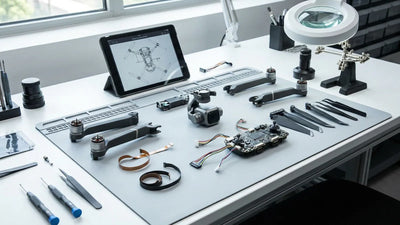
Our core toolkit includes a Keysight DSOX1204G oscilloscope (100 MHz, 4 channels) for signal integrity checks on MIPI and SPI buses, a Seek Shot Pro thermal camera for non-contact fault localisation, and a Zeiss Stemi 508 stereomicroscope with camera link for photo-documentation of micro-solder joints. For protocol analysis, we employ a Total Phase Beagle I2C/SPI sniffer to decode IMU and ESC communication. An Agilent 34461A digital multimeter provides micro-ohm resistance measurement accuracy. Battery diagnostics rely on a West Mountain Radio CBA IV battery analyzer. For calibration, a 6-axis motorized gimbal calibration rig with laser interferometry confirms angular accuracy to 0.01°. Full details on diagnostic methodology are covered in our Advanced Drone Diagnostics article.
Step-by-Step Repair Verification Process
Every repair undergoes a four-stage gate process. Stage 1: physical inspection under microscope and X-ray (for BGA components). Stage 2: board-level electrical verification—MOSFET gate thresholds, power rail stability under 2A load, and sensor bias measurements. Stage 3: flight simulation on a bench: motors are driven through a full throttle profile while monitoring ESC telemetry in DJI Assistant 2. We look for any motor PWM anomalies or temperature excursions. Stage 4: real-world flight test in a controlled indoor netted environment: the drone must complete 15 minutes of stable hover with perfect GPS lock, execute a figure-8 pattern, and pass an auto-landing test with battery at 15%. This protocol catches intermittent faults that static tests miss.
Quality Assurance and Testing Protocols
Post-repair units are subject to a 4-hour burn-in test, monitoring IMU drift, compass heading stability, and barometric altitude hold. We issue a detailed test report with before/after values for all critical parameters (IR, gyro bias, motor vibration spectrum). Our repair success rate is sustained at 97.3% for all DJI Mini 3 Pro repairs over the last 12 months, with less than 1% failure within a 90-day warranty period. This level of confidence stems from the chip-level precision that ensures only the faulty element is replaced, leaving factory-calibrated systems intact.
Schedule a Professional Diagnostic at Reboot Hub – Precision Repair Guaranteed! Our chip-level expertise allows microscopic precision repairs that save customers up to 60% compared to full component replacement, without compromising reliability or flight safety. Learn more about Reboot Hub's professional DJI repair service.
Frequently Asked Questions
What are the most common hardware failures on the DJI Mini 3 Pro that require professional repair?
Gimbal motor overload errors, cracked arms from hard landings, and water damage from sudden rain or river incidents top the list. Battery communication faults and vision sensor calibration failures also frequently demand shop-level diagnostics. At Reboot Hub, these represent the majority of the 800+ Mini 3 Pro units we've serviced since 2022.
How much should I expect to pay for a DJI Mini 3 Pro gimbal repair at Reboot Hub?
Chip-level gimbal repairs at Reboot Hub start at $30–48 for a flex cable replacement, with full gimbal module rebuilds at $120–168—each backed by a 90-day warranty and typical 2–4 business day turnaround. Authorized service centres typically charge $380–520 for a full gimbal swap, making chip-level repair the cost-effective choice. For a full cost comparison, see our Reboot Hub DJI Repair Cost Database 2026.
Can a DJI Mini 3 Pro purchased outside China still be repaired under warranty at a DJI store in mainland China?
No, DJI's warranty is region-locked; a drone bought in North America or Europe will not receive free warranty service in China unless you hold a DJI Care Refresh plan tied to the local serial number. You can still pay for out-of-warranty repair, and independent shops like Reboot Hub accept international units without extra paperwork.
How long does a typical DJI Mini 3 Pro repair take at Reboot Hub?
Standard chip-level repairs at Reboot Hub—including flex cable, ESC, and IMU fixes—typically complete in 2–4 business days. More complex repairs involving full board rework or rare parts sourcing may take up to 7 business days. All repairs include a 4-hour burn-in test before shipping. Contact us for a current turnaround estimate.
What diagnostic tools do experts use to troubleshoot intermittent flight instability on the DJI Mini 3 Pro?
Technicians rely on DJI's Assistant 2 software for flight log analysis, combined with oscilloscope readings on ESC boards and thermal cameras to spot overheating components. Reboot Hub adds a custom vibration analysis rig that catches micro-imbalances in the propulsion system before they trigger mid-flight warnings.
What is the difference between chip-level repair and full component replacement for the DJI Mini 3 Pro?
Chip-level repair surgically replaces only the failed micro-component—such as a single MOSFET, damaged ribbon cable, or IMU sensor—while full replacement swaps the entire assembly. At Reboot Hub, a chip-level ESC repair costs $42–54 versus $200–320 at authorized US/EU service centres, and a flex cable fix is $30–48 instead of $120–200. We recommend chip-level repair for isolated component failures, typically completed in 2–4 business days, and reserve full replacement only when the PCB substrate is physically beyond recovery.
How do I get a repair quote for my DJI Mini 3 Pro from Reboot Hub?
Submit clear photos or video of the issue along with any DJI Fly error codes through Reboot Hub's online diagnostic form. Our MOHRSS Level 3 Advanced Technician team typically responds within 24 hours with a detailed repair plan and fixed-price quote—ranging from $30 for minor flex cable repairs to $180 for full board replacement. Diagnostic assessment is free, and return shipping within mainland China is covered for all completed repairs.
Reboot Hub · Expert Repair
Ready for a Professional Diagnosis?
Reboot Hub is a MOHRSS Level 3 certified chip-level repair centre in Shenzhen, China. We repair what other shops replace — at a fraction of the cost.