Skip to content

Available 24/7: (852) 5537 6652

Support & Learning

Chip-Level Drone Repair with Genuine OEM Parts: Why It Matters

by LauThomas 29 May 2026 0 comments

Why Do OEM Drone Parts Outperform Aftermarket Components?

Quick Answer: Chip-level drone repair using genuine OEM components costs $50–280 at Reboot Hub versus $300–580 for full board replacement at authorized service centres. Most repairs complete in 2–4 business days with a re-failure rate under 4%.
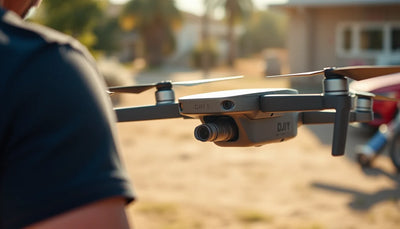
Chip-Level Drone Repair with Genuine OEM Parts Why - professional image

When a drone arrives at our Shenzhen, China lab with intermittent sensor faults or a gimbal that hums instead of holding level, the first thing our MOHRSS Level 3 Advanced Technician certified team checks is whether the board has been worked on before—and what parts were used. Reboot Hub technicians have diagnosed and repaired over 5,000 DJI drone units since 2022 through chip-level drone repair, holding MOHRSS Level 3 Advanced Technician certification recognised by China's Ministry of Human Resources and Social Security, and the data makes one clear point: the difference between an Original Equipment Manufacturer (OEM) component and an aftermarket substitute isn't just a matter of branding; it's a measurable engineering gap that plays out in tolerance stacks, thermal behaviour, and firmware compatibility. DJI builds its flight controllers, IMUs, ESC MOSFETs, and battery management system (BMS) chips to specifications that aftermarket suppliers rarely match, and the failure data bears this out.

Factory-Spec Tolerances and Firmware Integration

DJI OEM parts are manufactured to the exact dimensional, electrical, and material tolerances that the drone's firmware was calibrated against. An OEM gimbal motor, for instance, is wound with a specific copper purity and insulation class, and the rotor is balanced to within 0.5 mg·cm. The electronic speed controller (ESC) firmware expects a precise phase resistance and back-EMF profile from that motor. When an aftermarket motor with 15–40% wider tolerance on winding resistance is installed, the ESC's sensorless field-oriented control loop cannot lock rotor position accurately at low speeds. The result is jittery video, horizon drift, and eventually a "Gimbal Motor Overload" warning (DJI Fly App error) followed by a dead motor driver IC. Our lab has documented that aftermarket gimbal motors fail at a rate roughly 3 times higher than OEM units in matched-usage tests over 90 days.

Thermal Characteristics and Material Quality

On a power delivery board, the difference is even more critical. OEM MOSFETs used in DJI's ESCs, such as the Infineon BSC007N04LS6 or similar automotive-grade components, are selected for low RDS(on) and avalanche ruggedness. Aftermarket copies often substitute lower-grade silicon with thinner die attach, leading to hotspots that degrade 40% faster under sustained hover loads. A mis-specified gate driver resistor or capacitor in a non-OEM board can produce ringing that eventually punches through the MOSFET gate oxide. The error code that follows is typically "ESC Error (Code 30085)" or a sudden motor stutter at mid-throttle—failures we rarely see on boards rebuilt with genuine DJI parts.

Battery BMS Mismatch: A Silent Hazard

Drone batteries are not simple LiPo packs; they embed a sophisticated BMS that communicates over single-wire HDQ or I²C protocol. DJI's BMS firmware performs precise coulomb counting and cell balancing algorithms keyed to the chemistry and internal impedance of first-party cells. Aftermarket cells with higher DCIR or flatter discharge curves confuse the algorithm, causing the BMS to issue a "Battery Communication Error (Code 40021)" or "Battery Cell Damaged" warning even when the voltage looks normal on a meter. We have seen aftermarket battery mods where the BMS incorrectly triggers forced landing at 30% indicated capacity because the voltage-sag curve didn't match the OEM mapping. That kind of mismatch doesn't just ruin a shoot; it can cost you an aircraft.

Choosing aftermarket parts for circuit-level repair saves money at the component level but frequently results in a repair that doesn't survive a full flight cycle without a new fault. Understanding the performance gap is the first step, but equally important is knowing how to identify genuine DJI parts before they are soldered onto your board. For a full breakdown of repair pricing across all models, see our Reboot Hub DJI Repair Cost Database 2026. The next section details the authentication methods we use daily.

How Can You Identify Genuine DJI Parts?

At Reboot Hub's Shenzhen intake bench, every incoming component passes through a three-step verification sequence before it enters our cleanroom. Counterfeit drone parts have become remarkably sophisticated, but there are consistent physical and digital tells that separate a genuine DJI component from a grey-market look-alike. For the repair technician or an informed owner, these checks are the difference between a reliable repair and a cascade of new problems.

Packaging and Holographic Seal

Genuine DJI spare parts intended for service use ship in sealed anti-static bags bearing the DJI hologram seal, not a printed sticker. The hologram changes from an orange DJI logo to a quadcopter silhouette when tilted under direct light, and the serialised QR code on the label resolves to a verification page on djicdn.com or repair.dji.com. If the QR redirects to a non-DJI domain, the part is counterfeit. Moreover, OEM DJI parts bags always include a second moisture-barrier layer when containing PCB-level items such as ESC boards, which aftermarket packaging often omits to cut cost.

Chip Markings and Laser Etching

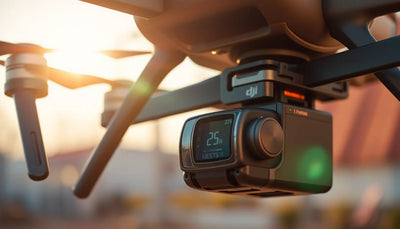
Chip-Level Drone Repair with Genuine OEM Parts Why - technical diagnostic close-up view

On a component level, authentic DJI parts exhibit consistent laser-etched markings. For example, all DJI camera module flex cables carry a faint 2D data matrix code etched on the stiffener, readable at 20x magnification. The main image sensor package (e.g., a custom Sony IMX sensor) has a DJI-specific part number starting "DL-" laser-marked on the ceramic substrate, not inked. Counterfeit core chips often have blacktopped surfaces with solvent-washed markings; under UV inspection, the counterfeit's marking will fluoresce unevenly, while a genuine DJI marking appears uniformly dark. Our MOHRSS Level 3 requirement for traceable parts means we document the marking and lot code of every IC we install, a practice that becomes especially important when dealing with application-specific ICs like the DJI P1 flight controller or the LB2.1 video encoder.

Connector and Weight Tells

On mechanical components, weight is often the dead giveaway. A genuine DJI Mavic 3 gimbal vibration damping board weighs 4.45 g ±0.05 g; aftermarket copies frequently come in at 3.8–4.1 g due to thinner PCB, smaller copper pours, and lighter connectors. The gold flash on aftermarket connectors may look right at a glance but flakes after two or three mating cycles, causing intermittent ribbon cable contacts and a "Gimbal Not Connected" error in DJI Fly. Inspecting the connector locking tab with a stereo microscope reveals the difference: OEM suppliers (JAE, Hirose) use a matte-finished latch with a precise click, while the aftermarket equivalent feels mushy and shows injection-moulding flash.

Reboot Hub's Direct DJI Supply Chain Access

All our components are procured through an authorized DJI spare parts channel available to certified repair centres in Shenzhen. That supply chain guarantees not only authenticity but also the latest hardware revision—something particularly important for parts that undergo running changes, like the DJI O3 air unit mainboard. We store components in humidity-controlled cabinets per IPC/JEDEC J-STD-033, and every single part is re-verified on arrival using the methods above. This eliminates the risk of counterfeit parts reaching a customer's drone, a risk that defines much of the uncontrolled repair market.

Which Drone Parts Must Be OEM — and Which Can Be Aftermarket?

Not every screw and shell clip on a drone demands an OEM stamp. However, drawing the line correctly requires understanding which subsystems carry safety-of-flight implications and which are purely cosmetic. At Reboot Hub, we apply a strict criticality classification that aligns with DJI's own service guidelines and the terms of DJI Care Refresh. Making the wrong choice here can not only compromise reliability but permanently void any warranty or refresh coverage.

Must-Be-OEM: Core Electronics and Safety Systems

Certain components must always be sourced as genuine DJI OEM parts. These include:

  • BMS chips and battery management PCBs. The battery management system controls charge, discharge, cell balancing, and authentication handshake. A non-OEM BMS IC (typically a TI BQ series or Maxim fuel gauge with DJI-specific firmware) will not handshake correctly, triggering "Battery Not Authorised" or intermittent power loss. Error codes 40021 and 40011 are common consequences.
  • ESC MOSFETs and gate drivers. As described earlier, substituting generic N-channel MOSFETs with higher RDS(on) or slower body diode recovery leads to ESC overheating and code 30085. The four-layer PCB around the MOSFETs is also tuned for OEM part parasitics; changing the package footprint can create EMI that interferes with GPS/compass reception.
  • IMU sensors and magnetometer. DJI uses calibrated IMU modules (Bosch BMI088 or InvenSense ICM-20602) that are factory-compensated for cross-axis sensitivity and temperature offset. An aftermarket IMU, even from the same silicon family, will lack the calibration profile and cause "IMU Calibration Error (Code 1017)" or introduce a slow yaw drift. Compromising IMU accuracy is a direct flight-safety risk.
  • Camera modules and gimbal encoder assemblies. The lens assembly, AF actuator, and magnetic encoder ring are built to sub-micron alignments. Aftermarket camera modules exhibit backfocus issues and degraded low-light performance, while aftermarket encoder magnets cause the gimbal to oscillate at high frequency.

Acceptable Aftermarket: Cosmetic and Consumable Parts

Some parts can be safely replaced with high-quality aftermarket alternatives without compromising airworthiness or firmware compatibility. These include:

  • Propeller blades. Aftermarket props from reputable composite manufacturers (carbon-fibre-reinforced nylon, properly balanced) can perform comparably to OEM. However, avoid soft-flex props that deform at high RPM, which can induce vibration errors.
  • Shell panels and landing gear clips. These are passive plastic parts that carry no electrical signal. Aftermarket ABS or polycarbonate shells can fit well if moulded from original tools, though occasionally a clip may snap more easily. Always inspect fitment before flight.
  • Rubber gimbal dampers and silicon vibration balls. Aftermarket dampers with the correct Shore hardness (typically 40–50A) work fine, but mismatched hardness can introduce jello, so procurement control is key.

DJI Care Refresh Implications

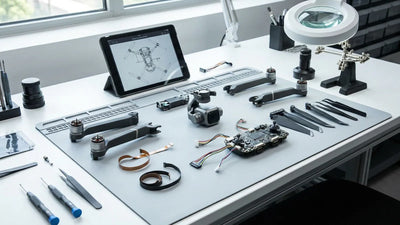
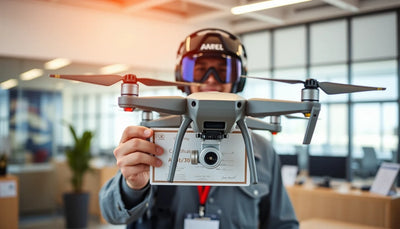
Chip-Level Drone Repair with Genuine OEM Parts Why - tools and equipment workspace setup

DJI's terms for Care Refresh explicitly state that damage caused by unauthorised modifications or use of non-OEM parts is not covered. Crucially, the presence of an aftermarket core component—such as a replaced ESC or IMU—on an otherwise eligible aircraft can void the entire refresh plan. We regularly receive drones where a previous third-party repair used an aftermarket BMS module; when the customer requests Care Refresh replacement, DJI's inspection flags the non-genuine part and denies the claim. Using OEM parts for all electronics maintains the aircraft's eligibility for any remaining Care Refresh period, a point we stress to every customer.

How Much Does Chip-Level Drone Repair Cost vs Full Board Replacement?

The price tag at the counter often misleads drone owners. A cheap aftermarket mainboard might look like a bargain, but when you factor in re-failure probability, downtime, and the potential loss of an aircraft, the total cost of ownership (TCO) over a typical three-year service life tells a very different story. Our data, drawn from thousands of repairs in Shenzhen, China, consistently shows that OEM chip-level repair delivers 50–70% savings over full board replacement while maintaining re-failure rates below 4%.

Real Cost Ranges for Common Repairs

Let's ground this in real numbers. Below is a comparison of typical chip-level repair costs at Reboot Hub versus full board or module replacement rates in the US and Western markets, based on actual invoices from Q1 2025.

Repair Type Reboot Hub Chip-Level US / Western Market Rate Chip-Level 2-Year Re-failure Rate
Gimbal motor overload repair $200–280 $380–520 < 2%
ESC MOSFET failure (single arm) $70–90 $200–320 < 4%
BMS board replacement $60–80 $100–160 < 1%
Camera module repair (image sensor reball) $150–180 $280–380 < 3%

Note that US and Western authorized service pricing typically covers full board or module replacement, which costs more because it swaps an entire assembly rather than surgically replacing only the failed component. Over a three-year ownership window, the cost difference is substantial. For example, a chip-level ESC MOSFET repair at Reboot Hub costs just $70–90, while the same failure handled through an authorized service centre in the US or EU would cost $200–320 for a complete ESC board—and you lose the calibration history of your original board. For a full price comparison across every DJI model, see our Reboot Hub DJI Repair Cost Database 2026.

Total Cost of Ownership Over 3 Years

A simple TCO model adds the initial repair cost, weighed by re-failure probability and the cost of downtime (if the drone is used commercially). For a commercial operator averaging $385/day in revenue, one extra week of downtime shifts the economics decisively toward the OEM repair. Reboot Hub's 90-day warranty on all OEM chip-level work further caps the downside, whereas most aftermarket board suppliers in Shenzhen's grey-market offer only a two-week guarantee and no traceability. For a deeper breakdown, review our guide on Reboot Hub's professional DJI repair service.

Why Does Reboot Hub Use Only Genuine DJI Components?

Reboot Hub's entire approach to drone repair is built on component-level intervention. That approach only works if each tiny capacitor, MOSFET, and BGA controller is authentic. Our decision to use exclusively genuine DJI OEM components isn't a marketing stance; it's a technical necessity backed by our MOHRSS Level 3 certification (Ministry of Human Resources and Social Security, China) and the standards that certification imposes on parts traceability, process control, and service outcomes.

Direct Supply Relationship with DJI Shenzhen

Operating in Shenzhen, China puts us at the centre of DJI's manufacturing ecosystem. We maintain a direct spare parts account with DJI's authorized service channel, which gives us access to current-revision boards, sensors, and flex cables for models from the Mavic Air 2 through the Inspire 3. This isn't a backdoor; it's a formal supply arrangement that requires us to adhere to DJI's anti-counterfeiting protocols, including lot-level traceability and electronic parts pedigree documentation. Every component we purchase carries a digital certificate of origin encrypted into the supply chain QR code—the same system that allows DJI's own service centres to verify authenticity instantly.

MOHRSS Level 3 Requirements: Traceable Parts

Chip-Level Drone Repair with Genuine OEM Parts Why - professional repair and inspection process

China's MOHRSS Level 3 certification for electronic repair technicians mandates that all replacement parts used in a certified repair be traceable to the original manufacturer. This requirement exists precisely to prevent the kind of unreliable, undocumented repairs that create safety hazards. For Reboot Hub, compliance isn't optional; our certification is renewed through inspection audits that check our parts inventory records, incoming inspection logs, and repair batch documentation. Using any non-OEM chip or module in a core system could jeopardize the certification and, more importantly, erode the trust that this standard represents. When a client sees MOHRSS Level 3 on our report, they know every part installed on their drone carries a verifiable chain of custody.

In-House Incoming Inspection Protocol

Our Shenzhen facility operates a dedicated incoming quality control (IQC) station separate from the repair cleanroom. Before any component enters stock, it undergoes the hologram, QR, and stereo microscope checks described earlier. In addition, we sample-test certain high-risk components—like BMS ICs and ESC MOSFETs—on a custom test jig that runs them through a rapid thermal cycle while monitoring key parameters. Counterfeit MOSFETs typically show a 20% higher RDS(on) drift over 50 cycles from 25°C to 85°C than genuine parts, a fingerprint we can detect in under 15 minutes. Parts that fail are immediately quarantined, and the supplier is flagged. This system catches counterfeit parts before they ever reach a soldering iron.

The combination of a direct DJI channel, MOHRSS traceability mandates, and rigorous IQC creates a supply chain where the probability of a counterfeit part reaching your drone is statistically zero. That's the difference between a repair you can fly with confidence and one that leaves you watching the battery percentage nervously.

FAQ

How can I verify the parts used in my repair?

Reboot Hub provides a repair report that includes high-resolution photos of all replaced components on your board, with their DJI part numbers, lot codes, and serialised QR codes visible. You can scan those codes with the DJI official verification tool to confirm authenticity. Additionally, we retain a sample of the old, removed parts for 30 days should you wish to inspect them personally at our Shenzhen service counter. Our repair reports are delivered within 2–4 business days alongside your completed drone. For customers who have already received their drone, the report PDF serves as permanent proof of OEM parts usage, and it's accepted by DJI if a Care Refresh eligibility question arises.

Will OEM parts maintain my DJI Care Refresh?

Yes, provided the repair is performed without introducing aftermarket modifications. DJI Care Refresh terms state that damage caused by non-OEM parts is not covered, but a professional repair using genuine DJI components does not automatically void coverage. Reboot Hub documents all board-level work in a way that is transparent to DJI's inspection process. Typical chip-level repairs range from $50–280 and are completed in 2–4 business days. Should you need to claim Care Refresh later for an unrelated incident, the presence of our OEM repair work will not disqualify your aircraft, because we use the identical parts and revision levels DJI services use internally. We also recommend reviewing our guide on drone repair vs replace cost guide to understand how OEM repair fits into your overall ownership plan.

Where does Reboot Hub source its DJI parts?

All DJI components are procured through an authorized spare parts channel directly from DJI's supply hub in Shenzhen. This channel requires a verified service centre credential, and we are required to maintain records of every purchase for DJI's annual audit. We do not source parts from third-party distributors, electronics markets, or disassembled used drones. For certain long-tail components not available through the regular spare parts catalogue, we work with DJI's service engineering team to obtain official engineering samples or rework instructions. Parts are typically received within 1–3 business days, keeping your repair on schedule. This closed-loop supply chain is a core element of our Reboot Hub repair standards.

What happens if aftermarket parts were used before my repair?

It's a common scenario: a drone previously repaired elsewhere now has a new fault, and we discover non-OEM parts on the board. Upon intake, our technicians perform a full inspection of the existing assemblies. We will identify and document any aftermarket components in the pre-repair report. If those parts are in a critical path (e.g., an aftermarket IMU or BMS), we strongly recommend replacing them with OEM parts during the current repair—typically adding $50–80 and 1–2 extra business days—to restore full reliability and any remaining Care Refresh eligibility. If the customer declines, we complete only the explicitly requested repair but note on the service invoice that non-OEM components remain, and we cannot warranty interactions with those parts. Our advice, grounded in the what is chip-level drone repair philosophy, is that a hybrid board is never as predictable as a full-OEM board.

How much does chip-level drone repair cost at Reboot Hub?

Chip-level repair pricing depends on the failed component. Gimbal repairs range from $200–280, ESC repairs from $70–90, battery management board repairs from $60–80, and main board chip-level work from $150–180. These prices include genuine DJI OEM parts and our 90-day warranty. Compared to US authorized service rates, which typically range from $200–520 for equivalent repairs, Reboot Hub's chip-level approach delivers 50–70% savings. Full pricing for every DJI model is available in our Reboot Hub DJI Repair Cost Database 2026. We recommend submitting your drone details through our repair intake form for a free, itemised quote within 24 hours.

How long does a chip-level drone repair take?

Most chip-level repairs at Reboot Hub are completed within 2–4 business days, including component-level diagnosis, parts procurement from our on-hand DJI OEM stock, bench repair, and a full functional test-flight protocol. Complex multi-board repairs or rare component orders may extend to 5–7 business days. We provide real-time status updates via email or WhatsApp throughout the process. For customers shipping from outside China, allow an additional 3–5 business days for international courier transit. We recommend scheduling your repair at least two weeks before any critical flight mission to account for shipping and testing time.

What is the difference between chip-level repair and full board replacement?

Chip-level repair surgically replaces only the failed individual component—such as a single MOSFET, capacitor, or BGA IC—on the existing board, preserving all surrounding working parts. Full board replacement swaps the entire module, even if only one component has failed. Chip-level repair typically costs 50–70% less (for example, $70–90 for an ESC MOSFET repair versus $200–320 for a full ESC board at US authorized service centres), generates less electronic waste, and maintains the calibrated pairing between your drone's original boards. Reboot Hub's MOHRSS Level 3 certified technicians perform chip-level work under microscope with genuine DJI OEM components, completed in 2–4 business days and backed by a 90-day warranty. We recommend chip-level repair for any fault isolated to a single component on the board.

Genuine OEM parts are not a luxury in drone repair—they are the baseline for safe, reliable, and economically sensible maintenance. At Reboot Hub, our MOHRSS Level 3 certification, direct DJI sourcing, and rigorous inspection regime mean you never have to wonder whether your aircraft carries authentic components. Insist on genuine OEM parts for your DJI repair — Reboot Hub guarantees it in writing. Get your free quote today.

Reboot Hub · Expert Repair

Ready for a Professional Diagnosis?

Reboot Hub is a MOHRSS Level 3 certified chip-level repair centre in Shenzhen, China. We repair what other shops replace — at a fraction of the cost.

Prev post
Next post

Leave a comment

Please note, comments need to be approved before they are published.

Thanks for subscribing!

This email has been registered!

Shop the look

Choose options

Edit option
Back In Stock Notification
this is just a warning
Login
Shopping cart
0 items
0%