Support & Learning / Module 8 branch
Symptoms, Evidence and Diagnosis
Before this lesson: Preserve the exact symptom and stop when structure, battery, liquid or powered hardware may be unsafe.
What you will understand
- Separate the visible symptom from the functional domains that can produce it.
- Use model- and board-bounded repair experience without turning one case into a universal claim.
- Move from the customer's concern to written findings, approval and staged acceptance evidence.
DJI Neo exact-model diagnosis
DJI Neo is a compact flying camera that weighs approximately 135 g and uses full-coverage propeller guards, several control methods and electronic image stabilization. Its light airframe does not make a crash, camera shake, battery warning or connection problem trivial. DJI Neo does not provide obstacle avoidance, so event context matters. This guide starts with the customer's concern and uses exact-model, case-level evidence to separate structure, imaging, propulsion, power and control before repair.
Quick answer
Preserve the flight mode and event because Neo behavior changes with the control path
Record the exact DJI Neo, battery, phone, controller or goggles path, selected mode, event and warning. Preserve original 4K/30fps footage, RockSteady or HorizonBalancing context, guard and propeller condition, motor response, Wi-Fi or controller link and battery behavior. Reboot Hub then states known and unknown findings, parts provenance, relevant board revision where observed and a written acceptance sequence for the customer's real use.
DJI Neo · series repair estimates by path
Each USD figure is a historical series-level estimate for the listed repair path, not a quote for this exact aircraft. Diagnosis determines the parts, labor, calibration, and testing needed.
| Repair path | Estimated USD range | When to consider it |
|---|---|---|
| Lens module | $35 | The optical module is damaged but a complete camera assembly is not required. |
| Complete camera assembly | $85 | The camera stack is damaged as an assembly. |
| ESC module / board | $75 | Propulsion warnings, motor-control faults, water exposure, or ESC-stage damage. |
| Main board | $120 | Main-board fault isolation or replacement planning is required. |
What evidence should be captured before the customer acts?
How does repair-bench experience map the fault domains?
Why must a DJI Neo repair intake record the exact control method?
DJI Neo can be used through palm control, a phone connection and supported controller or goggles configurations. Record which path was active, the selected mode, app state, battery and exact event. A palm-launch complaint is not the same as a controller-link failure, and a phone Wi-Fi problem does not prove the aircraft radio hardware is damaged. Photograph the full-coverage propeller guards and each corner before repeating a launch.
The exact model boundary matters because Neo's approximately 135 g airframe, integrated protection and creator-oriented control differ from folding camera drones. Reboot Hub records the board revision only if an approved inspection reaches that level. Real repair experience is published as case-level evidence tied to the exact unit, not as a claim that every Neo with similar wording needs the same component.

What can a damaged guard or unusual motor sound tell you?
Inspect the full-coverage propeller guards, attachment points, blade clearance, propellers, motor freedom and affected corner. Look for deformation, fine cracks, whitening, debris and contact marks. Compare all corners without forcing a bent guard. Do not command a takeoff when a blade can touch the guard, when a motor resists movement or when the airframe no longer sits consistently.
A vibration or propulsion warning can involve guard geometry, propeller, motor, connection, structure, power or drive electronics. The written finding names only the confirmed layer and lists adjacent risk. If a guard is replaced, the acceptance still needs to show propeller clearance and motor behavior. If the mechanical path is safe but the symptom persists, electrical evidence must be collected separately.
How should camera shake be separated from electronic stabilization behavior?
Preserve the original file, resolution and mode. DJI Neo records up to 4K/30fps and supports RockSteady and HorizonBalancing, so note which stabilization mode and control path were active. Compare the saved file with live view and record whether the horizon, vibration or artifact changes during hover, translation or a stationary ground observation. A digital stabilization symptom is not identical to a loose camera or shell impact.
Camera output, orientation sensing, processing, vibration, structure and recording settings can overlap. The public guide does not instruct owners to open the aircraft or write calibration data. Reboot Hub states what was reproduced, what environmental or mode variable changed it and what remains unknown. An internal component conclusion requires exact-unit and relevant board-revision evidence.

Why is obstacle avoidance not the explanation for a DJI Neo collision?
DJI states that Neo does not provide obstacle avoidance. That limitation must be preserved when reviewing a collision, especially during tracking, low-altitude flight or an indoor scene. Record the route, subject, lighting, wind, control method, visible obstacles and whether the pilot retained visual line of sight. Do not rewrite the event as a failed obstacle sensor that the aircraft does not have.
The diagnosis still examines attitude, camera, guards, propellers, motors and control response, but it separates event analysis from hardware fault. This protects the customer from a false repair promise and improves future use. Written findings can explain that the airframe passed defined functional checks while still retaining the operational limitation stated for the model.
How are phone Wi-Fi, controller and goggles link problems divided?
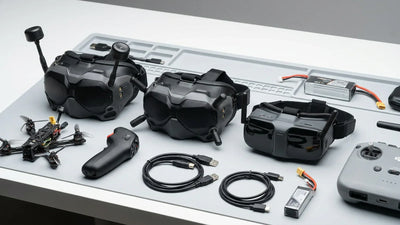
Record the phone model and app context where relevant, the supported controller or goggles, telemetry, controls, live image and whether onboard recording continued. A file-transfer problem, mobile-control disconnect, controller link loss and frozen FPV image are different branches. Use supported known-good equipment and a suitable low-interference setting only after the airframe and battery are safe.
The fault boundary can include phone, cable where used, Wi-Fi environment, supported controller, antennas, aircraft processing and camera output. Reboot Hub identifies which path was reproduced and which substitution changed it. Unsupported firmware, radio or region procedures are excluded. The customer receives written evidence instead of being told that one generic main board will solve every connection symptom.

What changes after moisture, impact or abnormal battery behavior?
Moisture can travel beyond the guard and shell opening, impact can load several corners and the camera area, and a battery symptom may involve the pack, charging equipment or aircraft-side power. Preserve photos, warnings and storage history. Stop repeated power cycles when there is liquid evidence, swelling, leakage, deformation, burnt odor or abnormal heat, and do not transport a damaged battery as an ordinary spare.
A powered aircraft is not automatically safe. The scope distinguishes confirmed damage, credible adjacent risk, inaccessible areas and tests intentionally withheld. The customer sees whether corrosion, structure, power and propulsion were assessed and which uncertainty remains. Repair or replacement follows that evidence rather than a headline price or an invented restoration promise.
When is repairing DJI Neo the stronger decision?
Repair is stronger when the affected guard, camera, control or power domain can be bounded, compatible parts provenance is available and a staged test can prove the customer's intended creator workflow. Replacement becomes more credible when damage spans several domains, corrosion is broad, geometry cannot be trusted or the complete control configuration cannot be validated.
Reboot Hub approaches the decision from the customer's perspective. We document exact configuration, condition, known and unknown findings, included equipment, written terms and what the acceptance will demonstrate. The customer can compare repair with an exact documented replacement without relying on a vague marketplace claim or being pushed toward work that has not been justified.

What should a DJI Neo quote and acceptance sequence contain?
The quote connects the customer's concern to reproduced evidence, names the exact model and relevant board revision where established, lists parts provenance, defines approved work, timing, tests and stop conditions, and returns for approval if the evidence changes. The normal workshop target is 1-3 business days after quote approval, subject to scope, parts and testing. Approved work has a 30-day repair warranty; qualifying complete products have a separate 180-day product warranty.
Acceptance begins with the original symptom, then checks guard clearance, propellers and motors, battery and charging, camera and recording, RockSteady or HorizonBalancing behavior, each required control path, telemetry and staged flight in an appropriate setting. Handover includes written findings and known limitations, including the lack of obstacle avoidance. It proves a bounded result for the exact Neo rather than promising every future scenario.
Keep exploring
Further reading
From The Reboot Hub Chronicle

From Drone Guides