Support & Learning / Module 8 branch
Symptoms, Evidence and Diagnosis
Before this lesson: Preserve the exact symptom and stop when structure, battery, liquid or powered hardware may be unsafe.
What you will understand
- Separate the visible symptom from the functional domains that can produce it.
- Use model- and board-bounded repair experience without turning one case into a universal claim.
- Move from the customer's concern to written findings, approval and staged acceptance evidence.
DJI FPV exact-system diagnosis
A DJI FPV repair decision has to preserve the aircraft as a connected system: aircraft, goggles, controller, battery, camera, sensing and radio path. The customer's concern may begin as a black image, unstable hover, motor warning or link drop, but those symptoms do not identify one board by themselves. This guide uses exact model architecture and case-level evidence to show how a professional bench narrows the fault while keeping the customer informed about known and unknown findings.
Quick answer
Record the complete FPV system and the failure sequence before naming a component
Identify the exact aircraft, goggles and controller, then preserve the warning, event history, original recording, battery state and whether flight control, telemetry and video failed together. The DJI FPV separates image processing, transmission, flight sensing, propulsion and ranging across distinct boards. Reboot Hub turns that evidence into written findings, an approved scope and staged acceptance rather than a guessed parts list.
What evidence should be captured before the customer acts?
How does repair-bench experience map the fault domains?
Why must the aircraft, goggles and controller be diagnosed as one FPV system?
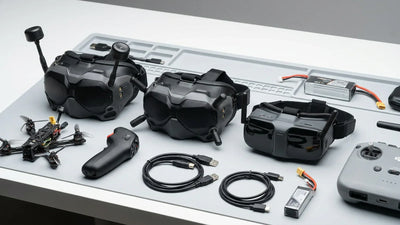
The DJI FPV experience depends on several linked devices. Start by matching the aircraft, goggles, controller, battery and charger to the intake record. Note which controller was used, whether the goggles remained powered, whether telemetry survived and whether the aircraft still accepted control. A black or frozen view with stable controls is a different branch from simultaneous video, telemetry and control loss.
This distinction protects the customer from an expensive but irrelevant replacement. The Pigeon board participates in image transmission and fan control, while the E1E board handles camera, vision, perception and flight-control signal processing. Goggles, antennas, connectors and the camera path add further boundaries. Exact model repair experience is useful only when the board revision and case-level evidence match the unit being assessed.

What does a black, frozen or breaking-up goggle image actually prove?
Preserve what the camera recorded locally, what the goggles displayed and whether flight telemetry and control were present at the same moment. A complete camera loss, intermittent artifacts, delayed frames and radio breakup are not interchangeable symptoms. Record whether the issue changes with the complete known-good supported system in an appropriate low-interference setting; do not rely on a single indoor session.
The IMX577 identifies the main camera sensor used in this architecture, but naming it does not prove that the sensor failed. Camera power, gimbal-camera connections, E1E processing, Pigeon transmission, antennas, goggles and environmental interference can overlap. Reboot Hub states which stage was reproduced and which stages remain unknown before a camera, board or radio scope is approved.
How are an unstable hover, IMU warning and GPS problem separated?
The flight architecture gives several evidence points: an MPU6600 on the IMU board, a UBX-M8030 GPS path, compass data and pressure sensing. Record whether the warning appears at startup or only in motion, whether the surface is stable, whether vibration or impact is present, and whether satellite, compass and inertial messages agree. Keep the aircraft grounded when behavior is not trustworthy.
A model-specific chip name is a map, not a universal verdict. The same warning can involve mounting, connection, vibration, power, environmental interference, the relevant sensor board or processing. The written finding connects the exact DJI FPV board revision to measured behavior. It does not tell an owner to open the aircraft, write calibration data or attempt unsupported software procedures.

What does the OPT3101 TOF path contribute to height and landing evidence?
The DJI FPV TOF board uses the OPT3101 alongside its illumination and receiving elements, while separate vision sensors support directional visual evidence. Record the exact height or landing symptom, surface texture, lighting, contamination and whether the warning persists in suitable conditions. Safe exterior cleaning and a controlled observation come before a hardware conclusion.
A TOF warning can involve the ranging board, illumination, connection, downward vision, processing or the environment being measured. Reboot Hub documents which direction and condition failed and whether related sensing remained available. A successful isolated check is not proof that every perception function is healthy; the acceptance plan has to cover the customer's actual launch, hover and landing concern.
How should a motor warning be divided between propeller, arm, motor and ESC evidence?
Photograph all four corners and preserve the exact event. Check propeller condition, motor freedom, arm geometry, debris, connector history, abnormal heat and the warning shown to the operator. Do not run a visibly damaged propulsion system merely to obtain more evidence. A collision can affect the propeller and structure while also loading the motor, cable or ESC channel.
The DJI FPV electric speed control path manages motor drive and arm-light functions, but one silent corner does not automatically prove an ESC board fault. A professional bench compares corners and the relevant electrical path under controlled conditions. The report names the confirmed layer, adjacent risk and the acceptance checks required after approved work.

What changes after a crash, liquid event or abnormal heat?
A crash can load the camera, gimbal, arms, motors, vision sensors, TOF board, antennas and internal connections in one event. Moisture can travel beyond its visible entry point, while abnormal heat can indicate a battery, supply, load or cooling concern. Preserve photos and logs, isolate the battery safely and stop repeated power cycles when deformation, liquid evidence, burnt odor or abnormal heat is present.
The repair scope distinguishes confirmed damage from credible adjacent risk. The customer sees which areas were accessible, which tests were intentionally not attempted and which uncertainty remains. This matters especially in an FPV system because an aircraft that starts may still have a weak video, sensing, radio or propulsion path that only appears under load.
When does repair make more sense than replacing the DJI FPV system?
Repair is stronger when the affected domain can be bounded, structure remains suitable, compatible parts provenance is available and a staged test can prove the required camera, radio and flight functions. Replacement becomes more credible when damage spans several high-value domains, corrosion is broad, airframe geometry is uncertain or the complete system cannot be validated reliably.
Reboot Hub does not force the customer toward a marketplace shortcut or a predetermined board. We compare the documented repair scope with an exact replacement configuration, including aircraft, goggles, controller, battery and written product terms. The customer's concern and budget are considered together with evidence, not used to hide unknowns.

What should a written DJI FPV quote and approval contain?
The quote should connect the intake symptom to reproduced evidence, name the exact model and relevant board revision, list known and unknown findings, state the approved work and parts provenance, and define the acceptance plan. It should also distinguish workshop time from shipping and identify items that require a revised approval if new evidence appears.
The normal workshop target is 1-3 business days after quote approval, subject to scope, parts and testing. Approved repair work carries a 30-day repair warranty. A qualifying complete product sold by Reboot Hub follows the separate 180-day product warranty. These are different promises and must remain written as such.
What must the DJI FPV return-to-service gate prove?
Begin with the original concern, then test systems affected by access or damage. Confirm camera output and recording, gimbal initialization, goggle image, telemetry, controls, link stability, GPS and inertial behavior, TOF and vision evidence, motor response and battery communication. Progress from safe ground checks to a controlled site and staged flight only when the earlier gates support it.
Handover should include written findings, completed tests, known and unknown items, parts provenance and observations the customer should monitor. The goal is not to claim that every future condition is guaranteed. It is to show that the exact DJI FPV system passed a defined acceptance sequence for the concern that brought it in.
How does Reboot Hub remove the customer's concerns before approval?
Reboot Hub starts with the customer's concern, the exact aircraft and every reasonable question that can affect the decision. We preserve the reported symptom, event history, supplied kit and visible condition; separate confirmed findings from repair-bench hypotheses; name the known and unknown items; and return written findings before asking for approval. Where a board revision and measured repair evidence identify a particular chip or component, that case-level experience can be stated directly. It is not silently expanded into a claim that every aircraft with a similar warning has the same fault.
Repair work normally takes 1-3 business days after quote approval. That workshop period is separate from inbound transit, parts availability, customs handling where relevant and return transit. A diagnostic fee applies to the inspection and written findings. When an eligible repair is approved, that diagnostic fee is credited toward labor or eligible service charges under the written quote. If the customer declines, the diagnosis still explains what was found and what remains unknown.
Eligible completed repair work has a 30-day repair warranty under the written terms. That is separate from the 180-day product warranty for qualifying complete pre-owned products. Neither term is a promise about unrelated later impact, liquid exposure, consumable wear, misuse or work outside the approved scope. The repair record should identify the exact work and acceptance evidence to which the repair term applies.
This is the commercial difference between a generic marketplace instruction and a Reboot Hub path. The customer sees the exact-unit evidence, the concern-by-concern response, the proposed scope, the parts path, the testing and the written terms before commitment. If replacement is stronger, the comparison uses a documented unit and kit rather than an anonymous headline listing. The purpose is not merely to share repair information; it is to turn technical uncertainty into a transparent decision the customer can trust.
Keep exploring
Further reading
From The Reboot Hub Chronicle


From Drone Guides