Support & Learning / Module 8 branch
Symptoms, Evidence and Diagnosis
Before this lesson: Preserve the exact symptom and stop when structure, battery or powered propulsion may be unsafe.
What you will understand
- Separate the visible symptom from the system domains that can produce it.
- Understand which repair-bench observations support a conclusion and which remain hypotheses.
- Move from concern to written findings, approval and staged return-to-service evidence.
Board-level diagnosis without unsupported repair claims
Chip-level repair is valuable when a measured board fault can be bounded and the original assembly can be restored and tested. It is not a promise that every warning can be solved by replacing one chip, and 'OEM' is not meaningful without exact part, revision and provenance evidence.
Quick answer
Start with the failed function and board architecture, not a guessed chip
Preserve the symptom, identify the exact aircraft and board revision, separate power, control, sensing and communication domains, then record the measured finding. Approve component-level work only when the proposed part, provenance, repair boundary and post-repair test are written down.
What evidence should be captured before the customer acts?
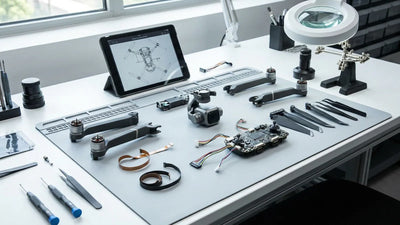
How does repair-bench experience map the fault domains?
What does chip-level repair actually mean?
Chip-level repair keeps the relevant board or assembly and corrects a bounded component, connection, trace or local circuit fault. It differs from replacing the complete board, but the distinction is only useful after diagnosis. A failed connector, corroded pad, shorted power component, unstable clock, damaged sensor interface and broken harness can all create board-looking symptoms with different repair paths.
The customer should receive the functional concern, confirmed finding and repair boundary in plain language. Reboot Hub may publish an exact chip identifier, measurement or case price when it belongs to a documented board revision and dated case-level record. That detail remains evidence for that case; it is not a shortcut for diagnosing every aircraft that shows a similar warning.

How does a modern DJI core board divide its work?
Model-specific training for DJI Mini 4 Pro identifies E1E as a platform handling flight-control processing, E3T as a camera platform, an LCPU for lens STM control and temperature-compensation collection, a Charger chip for USB charging, an MCU handling flight-control, gimbal and charging business, S2 for the operating and wireless-transmission platform, DDR for program and temporary data, and WIFI/BT for short-range communication.
Those names are useful because they show why 'main board failure' is too broad. They do not authorize a public repair recipe or prove that a named chip is defective. The correct board revision, power state, communication evidence and affected function still have to agree. Architecture narrows the investigation; measured findings close it.
How is an ESC fault separated from a motor or control fault?
Repair diagrams divide an ESC board into battery input, regulated supplies, motor-control signal input, MCU, motor-drive components, current sensing and battery-voltage measurement. A motor that does not turn can therefore involve the motor, harness, connector, drive stage, current-sense feedback, control signal or supply. A shorted MOSFET is one possible case, not the definition of an ESC error.
Professional diagnosis compares channels, records electrical and thermal behavior with appropriate bench controls and checks for impact or liquid evidence. Public content should explain those domains without publishing service-only probing locations, energized-board procedures or methods that defeat protection systems. The quote should state whether the proposed work is a connector repair, component-level repair, board replacement or a finding outside the board.

What does genuine, OEM-pulled or equivalent mean?
A genuine service component may arrive through an authorized service path; an OEM-pulled part comes from another original assembly and must be evaluated for identity and condition; a verified equivalent must meet the required electrical, thermal, package and reliability conditions for that exact use. These categories are not interchangeable, and packaging, a logo or a marketplace description does not prove installed provenance.
For a board repair, the written record should name the component category, board revision and source evidence. For a complete assembly, it should also state calibration, pairing or serialization dependencies. Reboot Hub does not ask the customer to accept 'OEM' as a magic word. We show what can be verified and identify any provenance that remains unknown.
Which components require the strictest evidence?
Safety-of-flight and tightly integrated systems deserve the strongest provenance and validation. Propulsion power stages, flight-control sensing, battery management, positioning, camera-and-gimbal control and radio assemblies can affect flight behavior or compatibility. Cosmetic shells and non-critical trim have different risks, but their fit can still affect cooling, sealing, antenna placement or structural alignment.
The responsible decision is not an absolute rule that one source is always acceptable and another never is. It asks what the component does, which failure mode matters, what the exact model expects and how the completed work will be tested. If provenance or compatibility cannot be established, that unknown belongs in the quote before approval.

When is board replacement stronger than chip-level repair?
Board replacement may be stronger when damage spans multiple power and signal domains, the substrate is carbonized or structurally compromised, calibration or security dependencies cannot be restored responsibly, a reliable component path is unavailable, or the time required to bound intermittent faults exceeds the value of the original assembly. A component-level repair should not be sold merely because it sounds more sophisticated.
Conversely, replacing a complete board can discard healthy systems and introduce new pairing, calibration or provenance questions. The customer should compare two written scopes: component-level repair with its finding and tests, and board replacement with the exact assembly, source, dependencies and tests. The better option is the one with less unresolved risk for the customer's use.
How should a previous repair be audited?
Record the original symptom, current symptom, visible rework, board revision, installed component markings, residue, pads, traces, connectors and any available invoice. Previous work may be competent, incomplete or unrelated to the new fault. A neat joint does not prove the correct component was used, and visible rework does not prove it caused the failure.
Bench conclusions should be graded: confirmed, supported, possible or not assessed. When an exact component is identified, document why its function and measured behavior connect it to the symptom. This protects useful repair experience from becoming an absolute fault claim and gives the customer a defensible next decision.

What should a post-repair test prove?
Testing should return to the original concern and then check adjacent systems affected by the work. A power-stage repair may require stable startup, controlled load, motor-channel comparison, temperature observation and a staged operational test. A camera or transmission repair needs image, recording, communication and thermal evidence. Calibration is used only where the exact repair and model require it.
The report should state the conditions and limits of each test. A successful bench power-on does not prove flight behavior, while one short flight does not prove every mode. Reboot Hub provides written findings and acceptance evidence so the customer understands what the repair demonstrated and what was not claimed.
How should cost and warranty be discussed?
The quote should separate diagnosis, labor, component or board, calibration, testing, parts lead time and shipping. A price from another model or an old invoice is not a current universal rate. Dated case prices can be shown as historical planning context when the model, board revision, scope and date are clear, but the approved amount must come from the current written quote.
Warranty follows the written repair scope rather than an unlimited promise about the whole aircraft. If a component-level repair is approved, the record should identify the work and acceptance evidence covered. Unrelated impact, liquid exposure, consumable wear or later faults outside that scope remain separate questions.
Keep exploring
Further reading
From The Reboot Hub Chronicle











From Drone Guides