Support & Learning / Module 6 branch
Propulsion, Battery and Power
Before this lesson: How Drone Propulsion Works: Batteries, ESCs and Motors
What you will understand
- Understand motors, ESCs, propellers, batteries and charging.
- Separate observable evidence from assumptions before choosing an action.
- Continue through the main lesson path or enter a focused topic branch when needed.
Propulsion fault isolation without unsafe powered experiments
A motor-looking symptom can begin at the propeller, motor, harness, ESC or flight controller. Reboot Hub uses a layered evidence path so the customer understands which domain failed and why the proposed work is narrower than the warning label.
Quick answer
Keep owner checks powered off and let bench evidence separate the layers
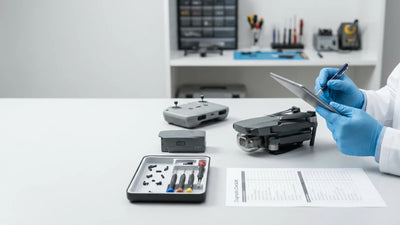
Inspect propellers, debris, motor mounting, shaft feel and visible harness condition with the aircraft safely unpowered. Record the exact startup sound, warning and event history. Do not command damaged propulsion to spin merely to identify a noise; ESC and flight-controller evidence belongs in a controlled professional diagnosis.
What evidence should be captured before the customer acts?
How does repair-bench experience map the fault domains?
What can an owner safely inspect without powering the motors?
Confirm that the aircraft cannot start and remove propellers when the model and service context allow safe handling. Check each propeller for the correct type, cracks, chips, distortion, contamination and hub damage. Look at motor mounting, arm geometry, debris, strike marks and harness routing. Rotate only gently where the model permits and stop if there is grinding, binding, unusual play or a battery and structure concern.
Record differences between channels instead of trying to prove a diagnosis. A smooth motor is one observation, not clearance to fly, and a rough motor does not explain whether the impact also affected the mount or ESC. Save the exact warning and note whether the symptom followed a crash, liquid, storage, propeller strike or previous repair. This gives the bench a clean starting point without exposing people or equipment to powered propulsion.

Why can a motor error originate outside the motor?
A brushless motor needs controlled phase drive. The ESC must receive a command, operate its logic and supply domains, sense current and switch the MOSFET power stage. The harness and phase connections must carry that output, and the flight controller must permit and request the response. A fault in any layer can appear to the operator as one motor failing to start, twitching or reporting an error.
Repair teaching diagrams are valuable because they make that architecture visible. They show why a normal-looking motor can remain still when the ESC lacks command or drive, and why a damaged winding or connection can stress the ESC. The diagrams do not turn every warning into one part number. The exact model, board revision, event history and bench evidence determine where the chain breaks.
How do propeller and airframe faults imitate a motor problem?
A bent or incorrect propeller changes aerodynamic load and can create noise, vibration, poor hover or motor stress. Debris can touch the bell, a motor mount can shift after impact, and a distorted arm can change alignment while the motor itself remains electrically sound. Payload or guard fit can also create contact or airflow effects. These conditions should be resolved or bounded before an internal motor conclusion is made.
A useful inspection compares all propulsion stations and records the asymmetry. The report should state whether the observed problem is a replaceable propeller, a structural or mounting concern, an actual motor-mechanical fault or something not reproduced while unpowered. That separation protects the customer from paying for a motor when the aircraft geometry or attached part is the cause.

What does bench motor evidence look like?
Bench evidence connects a repeatable symptom to a domain. A technician may compare mechanical feel, winding behavior, connections and the affected ESC channel with known references appropriate to that model. Historical repair material can include resistance observations and motor-drive circuit behavior, but those values belong to the exact motor and platform. Publishing the case is useful when its model, method and limits are clear; copying one value across DJI products is not.
The customer-facing report does not need a live-board procedure. It needs the answer: did the fault follow the motor, remain with the channel, disappear after correcting the connection or prove to be a wider control or power issue? The findings should identify which evidence supports that answer and what was not tested. That makes the repair decision traceable without encouraging unsafe experiments.
How are ESC and flight-controller causes distinguished?
An ESC channel can fail in its control input, local logic, current sensing, MOSFET power stage, supply or phase output. The flight controller can also withhold or corrupt the command because of arming state, another system fault or its own interface problem. If several motors are affected together, common power, communication and controller evidence becomes especially important. One motor warning is the beginning of a fault tree, not its end.
Diagnosis should state whether command was expected, whether the ESC logic responded and whether controlled drive reached the motor connection under professional conditions. Related warnings and event history can narrow the sequence. A firmware change is not a substitute for this evidence and may alter the state without repairing damaged hardware. The scope should follow the confirmed layer and preserve the customer's original symptom for acceptance testing.

When should the motor, ESC or wider aircraft be replaced?
A motor replacement is reasonable when mechanical or winding evidence is bounded to that motor and the mount, harness and drive channel are credible. ESC repair or module replacement is reasonable when channel evidence identifies the drive domain and the connected motor will not threaten the result. Wider aircraft repair or replacement belongs in the comparison when crash, liquid, structure, power and control faults overlap or reliable validation is not available.
The best option depends on mission continuity, exact kit, parts availability, downtime, wider condition and the quality of the proof. Reboot Hub approaches the decision from the customer's point of view: resolve each reasonable concern with exact-unit evidence, list every remaining unknown, and present the repair or replacement path with written scope, testing and terms before commitment.
What should a post-repair propulsion test prove?
Acceptance starts powered off with correct propellers, secure motors, sound arms, intact harness routing and a suitable battery. Ground startup should show a stable link, expected warnings cleared or explained, and consistent propulsion behavior without abnormal heat, odor, sound or vibration. A controlled low-risk flight is considered only after these layers are stable and in a location where the operation is permitted.
Observe hover stability, vibration, command response and the repaired channel before normal mission load. Compare the outcome with the original complaint and preserve the result in the repair record. If a warning, abnormal temperature, sound or control response appears, stop rather than extending the test. The customer should know what was demonstrated and which unrelated future condition remains outside the repair claim.

Keep exploring
Further reading
From The Reboot Hub Chronicle



From Drone Guides