DJI Drone Pre-Flight Checklist: The 15-Point Safety Check Every Pilot Needs Before Takeoff
Every experienced drone pilot knows a truth that separates professionals from amateurs: the most important part of your flight happens before you ever touch the throttle stick. Whether you fly a DJI Mini 4 Pro for real estate photography or command a Matrice 350 RTK for industrial survey work, a systematic DJI drone pre-flight checklist is the single most effective habit you can develop to protect your investment, avoid accidents, and stay compliant with aviation regulations. At Reboot Hub, our technicians have diagnosed and serviced over 800 DJI drone units across all major product lines since 2022, holding MOHRSS Level 3 Advanced Technician certification recognised by China's Ministry of Human Resources and Social Security—and we can tell you from direct experience that a five-minute inspection can save you hundreds of dollars in preventable repair costs.
Our Shenzhen, China repair centre services hundreds of DJI drones each year, and the number one pattern we see in damaged units is preventable pilot error: a cracked propeller that was never inspected, a firmware mismatch that caused erratic behaviour, or a return-to-home altitude set below the surrounding tree line. This guide distils our field experience into a clear, actionable 15-point pre-flight checklist you can follow before every single flight. Print it out, bookmark it, or save the PDF—just make sure you use it.
Why a Pre-Flight Checklist Matters More Than You Think
DJI drones are remarkably engineered machines, but they are still aircraft operating in complex, dynamic environments. Civil aviation authorities worldwide—including the CAAC in China, the FAA in the United States, and EASA in Europe—expect pilots to conduct pre-flight inspections as a matter of legal and operational responsibility. Skipping even one step can lead to fly-aways, loss of control, mid-air component failure, or violation of no-fly-zone restrictions.

A good checklist does three things: it catches problems on the ground where they are cheap and safe to fix, it builds muscle memory so inspections become second nature, and it creates a documented routine that protects you legally if an incident ever occurs. Think of it as the same discipline that commercial airline pilots follow before every departure—scaled for the world of consumer and professional drones.
1. What Hardware Should You Inspect Before DJI Drone Flight?
Before you even power on your DJI drone, perform a thorough physical inspection. Hardware failures account for a significant percentage of incidents we see at our repair centre, and nearly all of them could have been caught with a simple visual and tactile check.

Point 1 — Propeller Condition & Mounting
Propellers are the single most critical moving part on your drone, and they endure enormous stress during flight. Before every session, remove each propeller and inspect it carefully:
- Check for cracks along the blade surface, especially near the hub and the leading edge. Even hairline fractures can propagate mid-flight and cause catastrophic failure.
- Look for chips or nicks on the blade tips. Minor damage creates vibration that stresses motors and degrades image stabilisation.
- Verify the correct propeller is on each motor. DJI uses clockwise (CW) and counter-clockwise (CCW) props—they are not interchangeable. Mismatched props cause immediate instability.
- Ensure propellers are fully seated and locked. On quick-release models (Mini series, Air series), press firmly until you hear a click. On older screw-on designs, confirm they are hand-tight (never over-tighten with pliers).
If you find any damage, replace the propeller immediately. Do not fly with compromised props under any circumstances. Replacement propellers are inexpensive; your drone and the safety of people below are not.
Point 2 — Motor Inspection
Spin each motor gently by hand with the propellers removed. Each motor should rotate smoothly and freely with consistent resistance. Any grinding, catching, clicking, or uneven feel indicates a damaged bearing, debris in the bell housing, or a bent motor shaft. Also visually inspect the motor windings (the copper coils visible through the vents) for discolouration or signs of overheating from previous flights.
Point 3 — Frame & Landing Gear Integrity
Give the entire airframe a quick but deliberate visual once-over:
- Inspect arm hinges and locking mechanisms on folding drones (Mini, Air, Mavic series). Ensure arms lock firmly in the open position with no wobble.
- Check for cracks in the shell, especially around screw points, motor mounts, and battery compartment edges. Small cracks grow quickly under flight vibration.
- Examine landing gear or skid pads for cracks or missing rubber feet. Damaged landing gear can cause instability during takeoff and landing.
- Look for any signs of a previous crash that may have been cosmetically repaired but not structurally addressed—misaligned arms, scuffed props, or uneven gaps in the body panels.
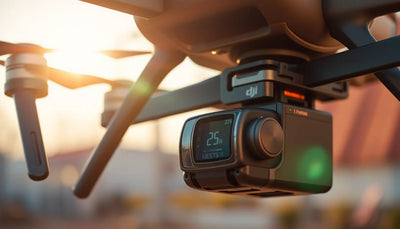
Point 4 — Camera Gimbal & Lens
The gimbal is one of the most delicate assemblies on any DJI drone. Before flight:
- Power on the drone and confirm the gimbal completes its initialisation sequence without error. You should see it self-calibrate smoothly.
- Gently move the gimbal by hand through its full range of motion to check for any obstruction, stiffness, or unusual resistance.
- Inspect the gimbal ribbon cable (visible on some models) for fraying or pinching.
- Clean the lens element with a microfibre cloth. Even a fingerprint can cause glare or soft focus that ruins an entire shoot. Check for internal fogging if you have been in a humid environment.
- Remove and inspect the gimbal protector/cover—these sometimes crack and can interfere with gimbal movement if partially attached.
Point 5 — Sensor Cleanliness
Most modern DJI drones feature obstacle avoidance sensors on the front, rear, bottom, and sides. Dirty or obstructed sensors are a leading cause of false obstacle detection, erratic braking behaviour, and collision during autonomous flight modes. Use a clean, dry lens cloth or compressed air to gently clean every sensor window on the aircraft. Pay particular attention to the downward-facing vision sensors and infrared ToF sensors near the bottom of the drone, as these are critical for precision landing and low-altitude positioning.
2. How Do You Check Your DJI Drone Battery Before Flight?
Battery issues are among the most dangerous failure modes in drone flight. A battery that appears healthy at takeoff can under-voltage mid-flight and trigger an emergency landing—or worse, a sudden loss of power. Proper battery management is non-negotiable.

| Check | What to Look For | Red Flag |
|---|---|---|
| Charge level | All cells above 90% for takeoff | Below 50%, or cells showing >0.3V imbalance |
| Physical condition | Flat, firm, no swelling | Puffing, soft spots, deformed casing |
| Cycle count | Within DJI's recommended lifespan | 200+ cycles on Mini series; 400+ on larger models |
| Temperature | 15°C – 40°C ideal | Below 5°C or above 50°C |
| Contacts | Clean, no corrosion | Green/white residue, bent pins |
Point 6 — Battery Charge Level
Always start with fully charged batteries—ideally 100%. DJI's intelligent battery system will warn you if voltage drops too low, but it is far better to begin with maximum capacity. For multi-battery shoots, charge all batteries the night before. Never attempt to fly with a battery that has been sitting partially discharged for weeks; lithium-polymer cells degrade and can deliver unreliable voltage under load.
Point 7 — Battery Health & Physical Condition
DJI Smart Batteries track their own health through cycle count and cell balance data, viewable in the DJI Fly or DJI GO 4 app. Before flight:
- Check the total charge cycle count. Most DJI batteries are rated for 200–400 cycles depending on the model.
- Inspect the battery physically for swelling, puffing, or deformation. A swollen battery is a fire hazard—remove it from service immediately and dispose of it at a certified recycling centre.
- Verify that cell voltage is balanced across all cells (typically 4-cell packs). A difference greater than 0.1V between cells is concerning; greater than 0.3V is dangerous.
Point 8 — Battery Insertion & Locking
This sounds obvious, but loose batteries cause more mid-flight shutdowns than you might expect. After inserting the battery:
- Push firmly until you hear and feel the locking mechanism engage.
- Gently attempt to pull the battery back out to confirm it is seated securely.
- Confirm the battery level indicator LEDs illuminate when you press the power button (a quick double-press on most models).
On models with multiple battery bays (like the Inspire 3), ensure all batteries are from the same set, charged to the same level, and inserted correctly. Mixing batteries with different health profiles can trigger voltage imbalance warnings or force an emergency landing.
3. How Do You Verify DJI Drone Firmware and App Status Before Flying?
Modern DJI drones are essentially flying computers. Software issues—from outdated firmware to corrupted flight logs—can cause unexpected behaviour that no amount of hardware inspection will catch.

Point 9 — Firmware Verification
Before every flight, check that your drone's firmware is up to date:
- Power on the drone and connect to the DJI Fly app (or DJI GO 4 for older models).
- The app will typically display a notification if a firmware update is available. Do not ignore these.
- Firmware updates often include critical flight stability improvements, battery management fixes, and no-fly-zone database updates.
- Ensure the remote controller firmware is also current—mismatched firmware between the drone and controller can cause connectivity drops.
Important: Never update firmware right before a time-sensitive flight. Updates can take 10–30 minutes and occasionally require multiple restarts. Update the night before and verify successful completion.
Point 10 — DJI Fly / GO App Status
Open the app and verify:
- The app is logged into your DJI account and your drone is registered.
- The DJI FlySafe database is current (the app downloads this automatically, but confirm via Settings).
- Your pilot profile and any required licence information (such as AOPA registration in China) are entered and visible.
- Check the Flight Record to ensure logging is active—you want a documented record of every flight.
Point 11 — SD Card Check
A full or corrupted SD card can prevent recording, cause the drone to lag during buffer operations, or even trigger error messages mid-flight. Before takeoff:
- Confirm the SD card is inserted and detected by the app.
- Verify available storage is sufficient for your planned flight duration and shooting resolution.
- Format the card in-camera (via the app settings) rather than on a computer. In-camera formatting ensures the correct file system structure.
- Use a high-speed UHS-I or UHS-II card rated for 4K/8K video if you are shooting at high resolutions. Slow cards cause dropped frames and write errors.
4. What Weather Conditions Are Unsafe for DJI Drone Flight?
No matter how well-maintained your drone is, adverse weather can turn a routine flight into an emergency. Checking conditions is a critical—and often overlooked—part of pre-flight preparation.
Point 12 — Weather Assessment
Check the weather forecast for your flight location using a reliable source (we recommend UAV Forecast or Windy for drone-specific data). Evaluate:
- Wind speed and gusts. Most DJI consumer drones handle winds up to 10.7 m/s (Level 5), but gusts above 8 m/s significantly reduce flight time and can push the drone beyond its ability to hold position. Larger professional drones (Mavic 3 Enterprise, Matrice series) tolerate higher winds but still have limits.
- Precipitation. DJI consumer drones are not waterproof. Rain, sleet, or heavy mist can damage electronics, fog the lens, and create short circuits. Even the IP55-rated Matrice 350 RTK should not fly in heavy rain.
- Visibility. You must maintain visual line-of-sight (VLOS) with your drone at all times under most regulatory frameworks. Fog, haze, or low cloud ceilings may make this impossible.
- Temperature. Extreme cold (below 0°C) reduces battery capacity significantly and can cause gimbal lubricant to stiffen. Extreme heat (above 40°C) can overheat the flight controller and battery.
Point 13 — GPS Signal & Satellite Lock
DJI drones rely heavily on GPS for position holding, return-to-home, and geofencing. Before launch:
- Confirm the drone has acquired at least 10–12 GPS satellites (shown in the app's top status bar). More satellites means more accurate positioning and more reliable RTH behaviour.
- Wait for the "Home Point Updated" notification in the app, confirming the drone has locked its takeoff location.
- If flying in urban canyons or near large structures, be aware of GPS multipath errors—reflected signals from buildings can confuse the positioning system. Consider waiting for a stronger satellite lock.
5. How Do You Configure Airspace Compliance and Return-to-Home Settings?
Regulatory compliance is not optional. In China, drone operations are governed by CAAC regulations, and violations can result in fines, confiscation, or criminal charges. Beyond legality, configuring your return-to-home settings correctly can be the difference between a safe recovery and a lost drone.
Point 14 — Airspace Authorisation & No-Fly Zones
Before flying in any location:
- Open the DJI FlySafe map in the DJI Fly app and check for restricted zones (red), enhanced warning zones (orange), and authorisation zones (yellow) at your planned flight location.
- If you are in an authorisation zone, you must unlock it through DJI's FlySafe portal (flysafe.dji.com) before arriving at the site. This process may require proof of authorisation from local aviation authorities.
- For flights in controlled airspace near airports, obtain explicit clearance from the relevant ATC authority. In China, this may involve coordination with the local Air Force division responsible for the airspace.
- Register your drone with the UOM (Unmanned Operation Management) system as required by CAAC regulations for drones weighing over 250g. If you need guidance on this process, check our drone registration guide for step-by-step instructions.
Never attempt to bypass DJI's geofencing system. It exists to protect manned aircraft and people on the ground. If you need legitimate access to restricted airspace, follow the official unlock process.
Point 15 — Return-to-Home (RTH) Configuration
The return-to-home function is your drone's safety net when communication is lost, the battery runs critically low, or you manually trigger it. Proper RTH setup is arguably the most important software configuration you will make:
- RTH Altitude. Set this higher than any obstacle between your drone and the home point. If you are flying near a 30-metre building, set RTH altitude to at least 40–50 metres. DJI default is often 20 metres—increase this before every flight based on your environment.
- Home Point. Confirm the home point is set to your current GPS location (the default behaviour) and that it has been updated in the app. On models with Dynamic Home Point, understand that the home point may track the controller's position—if you move during flight, the RTH destination changes.
- Low Battery RTH. Review the critical battery level threshold in the app. When this triggers, the drone will automatically return home. Ensure there is enough remaining capacity for the drone to climb to RTH altitude and fly back to the home point. As a rule of thumb, if you are flying more than 500 metres away, factor in a 20% buffer.
- Obstacle Avoidance during RTH. Confirm that APAS (Advanced Pilot Assistance Systems) and obstacle avoidance are enabled for the RTH flight path. Some pilots disable these during normal flight for performance but forget to re-enable them for automated return.
If you frequently fly in complex environments, consider reviewing our advanced flight tips for detailed guidance on RTH planning in urban and mountainous terrain.
6. What Does the Final Pre-Launch Walkthrough Involve?
You have inspected the hardware, verified the battery, updated the software, checked the weather, confirmed airspace compliance, and configured RTH. Now it is time for one last pass before you spin the props.
The Two-Minute Final Check
Stand at your launch position and run through these last confirmations:
- Launch area is clear. No people, animals, vehicles, or overhead obstacles (trees, power lines, overhangs) within a 5-metre radius.
- Controller signal. Confirm the remote controller is connected to the drone with a strong signal. Check the antenna orientation—antennas should point toward the drone, not at the ground.
- Flight mode selection. Choose the appropriate mode (Normal, Sport, or Cinema/Cine) for your mission. If you are doing precision work, Normal or Cine mode provides the smoothest control inputs and enables obstacle avoidance.
- Intelligent flight modes. If you plan to use ActiveTrack, Waypoints, Hyperlapse, or other automated modes, pre-configure them now rather than fumbling in the air.
- Broadcast Remote ID. If required in your jurisdiction, confirm Remote ID broadcast is active. In China, this is increasingly being required for commercial operations.
- Hover test. Take off and hover at 2–3 metres for 15–20 seconds. Observe the drone for any vibration, drifting, or unusual sounds. Listen for abnormal motor whine. Check that the gimbal is stable and the image feed is clean. If anything feels wrong, land immediately and investigate.
This hover test is the final gate between ground inspection and full flight. If your drone passes the hover check with no issues, you are cleared to proceed with confidence.
What Is the Complete 15-Point DJI Pre-Flight Checklist?
For convenience, here is the complete 15-point checklist condensed into a single list you can screenshot or print:
- Propeller condition & mounting
- Motor inspection (spin test)
- Frame & landing gear integrity
- Camera gimbal & lens check
- Sensor cleanliness
- Battery charge level
- Battery health & physical condition
- Battery insertion & locking
- Firmware verification
- DJI Fly / GO app status
- SD card check
- Weather assessment
- GPS signal & satellite lock
- Airspace authorisation & no-fly zones
- Return-to-home configuration
Print this list, laminate it, and keep it in your drone case. A disciplined pre-flight routine takes less than five minutes and is the hallmark of a professional pilot.
When Should You Stop Flying and Seek Professional DJI Repair?
If any point on this checklist reveals damage or malfunction that you are not confident addressing yourself, do not fly. Bring your drone to a certified repair centre like Reboot Hub. Our technicians in Shenzhen, China can diagnose issues from component-level repairs to full gimbal replacements, often with same-day turnaround. Chip-level repair means we surgically replace individual failed components—such as a damaged gimbal ribbon cable at $50–80 or a faulty ESC module at $70–90—rather than replacing entire boards, saving you significant cost compared to traditional authorized service centres where the same repairs typically run $120–200 and $200–320 respectively. Explore the full price breakdown in our Reboot Hub DJI Repair Cost Database 2026. Flying a drone you suspect has a fault is never worth the risk—to your equipment, to people on the ground, or to your reputation as a pilot.
If your drone needs professional attention, Reboot Hub's professional DJI repair service offers diagnostics, genuine OEM parts, and a 90-day warranty on every repair.
Frequently Asked Questions
How long should a DJI drone pre-flight checklist take?
A thorough pre-flight check typically takes 3–5 minutes once you have internalised the process. The first few times may take 10–15 minutes as you learn where everything is. Speed comes with repetition, but never rush the battery insertion and RTH configuration steps—these are where the highest-risk errors occur.
Can I fly my DJI drone if one propeller has a small chip?
No. Even a small chip or crack in a propeller creates asymmetric lift, increases vibration, and can lead to mid-flight disintegration under centrifugal force. Damaged propellers are the number one cause of crashes we see at our repair centre. Propellers are inexpensive—always replace before flying.
What is the minimum GPS satellite count for safe DJI flight?
DJI drones will function with as few as 6–8 satellites in ATTI (attitude) mode, but for reliable GPS positioning, Return-to-Home, and geofencing, you should wait for at least 10–12 satellites with a strong signal. In challenging environments like urban canyons, waiting for 15+ satellites provides additional reliability.
Do I need to update firmware before every flight?
You do not need to update firmware before every flight, but you should check for updates before every flight session. Update firmware whenever a new version is available, as updates frequently include critical safety fixes, battery management improvements, and no-fly-zone database refreshes. Always update at least several hours before a planned flight to allow time for troubleshooting if the update encounters issues.
What RTH altitude should I set for my DJI drone?
Your RTH altitude should always be set higher than the tallest obstacle between your drone and its home point, plus a safety margin of at least 10 metres. For example, if you are flying near 25-metre-tall trees, set RTH altitude to 40 metres or higher. DJI's default of 20 metres is appropriate for open, flat terrain but is dangerously low for most real-world flying environments. Adjust this setting before every flight based on your specific location.
What does it cost to repair a DJI drone after a crash or malfunction?
Repair costs depend on the component damaged. At Reboot Hub, chip-level repairs start at $50–80 for a ribbon or flex cable replacement, $70–90 for an ESC module, and $200–280 for a full gimbal module—all completed in 2–4 business days. US and Western authorized service centres typically charge two to three times these rates for equivalent work. See the full breakdown in our Reboot Hub DJI Repair Cost Database 2026, or contact us for a free diagnostic assessment.
How do I get a repair quote from Reboot Hub for my DJI drone?
Simply visit Reboot Hub's professional DJI repair service page and submit your drone model, a description of the issue, and any photos or video of the malfunction. Our team will respond with a diagnostic assessment and itemised quote within 24 hours. We service all DJI models with genuine OEM parts and back every repair with a 90-day warranty. Shipping is available worldwide from our Shenzhen, China facility.
Reboot Hub · Support
Need Professional Help?
If your drone needs repair after troubleshooting, Reboot Hub offers certified chip-level repair in Shenzhen, China — genuine OEM parts, 90-day warranty.