Support & Learning / Module 9 branch
Mission Systems and Field Applications
Before this lesson: Enterprise Drone Procurement: Evidence and Fleet Support
What you will understand
- Connect systems to mapping, inspection and agriculture work.
- Separate observable evidence from assumptions before choosing an action.
- Continue through the main lesson path or enter a focused topic branch when needed.
Exact-unit enterprise inspection
A pre-owned DJI enterprise drone should be evaluated as an exact operating system, not a model name or condition label. Identity and version, supplied kit, payload interface, battery evidence, controller and link, RTK context, service history and mission acceptance must all connect to the customer's intended task before commitment.
Quick answer
Verify the exact unit and its mission boundary before deployment
Build a written supplied-item record, preserve current photographs, confirm identity and version context, inspect the airframe and payload interface, review battery and controller evidence, document RTK and service history, and complete mission acceptance only for the intended configuration and environment. A condition grade supports disclosure; it is not deployment approval for every operation.
What should be visible before the customer acts?
How should identity and version be confirmed?
Start with the exact aircraft and controller in front of you. Record the model, serial evidence in a private transaction record, controller relationship, region or sales-version context where relevant, supported software context and any integrated or removable payload. Current photographs should show the actual unit from multiple useful angles rather than a generic model image. The public article does not need to expose a serial; the buyer record should connect identity to the offered unit and written supplied-item list.
Version language needs care. Consumer Mini, Air and Mavic models should not be described as though every unit has an enterprise domestic-versus-global procurement distinction. Some commercial or enterprise purchase contexts require more explicit version, activation, payload and support confirmation. Separately, DJI GEO and local airspace rules concern where operation is permitted; they are not proof of which sales version was purchased. Reboot Hub should explain those concepts while requiring supported configuration and full compliance with local requirements.
What belongs in the written supplied-item record?
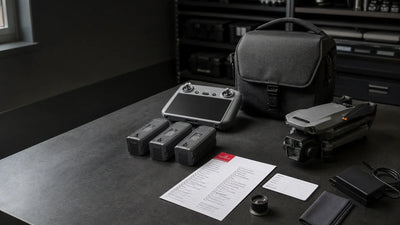
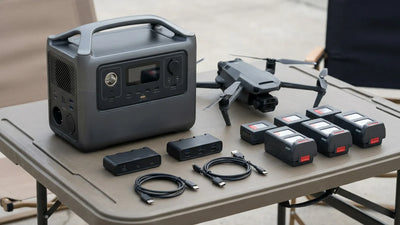
List the exact aircraft, controller, batteries, charger or charging hub, cables, case, propellers, payloads, mounts, RTK module and mission-specific accessories included in the offer. State whether an item shown in a photograph is included, contextual or excluded. A bundle name is not enough because two kits with the same headline model can have different controllers, battery counts, chargers or positioning equipment. Photograph the arranged kit so a customer can reconcile it at receipt.
The record should also name known missing items and visible condition concerns. If a payload or accessory requires a separate license, account, cable or software path, state that before commitment. Reboot Hub's value is not pretending every kit is complete; it is removing the worries that can be resolved, making remaining unknowns visible and helping the customer decide from the full operating requirement. The written supplied-item record becomes the reference for shipping, receipt, support and any later completeness question.

How should the airframe and payload interface be inspected?
Inspect the powered-off airframe in a stable, well-lit setting. Review shell alignment, arms, landing points, fasteners, motor areas, propellers, gimbal and camera protection, obstacle-sensing windows, ports, connectors, battery bay and signs of contamination or impact. Do not dismantle the aircraft or move delicate mechanisms beyond current product guidance. Photograph anything that needs explanation. The purpose is to describe observed condition and decide whether qualified diagnosis is needed, not to declare hidden internal condition from an exterior glance.
For payload capability, identify whether the camera or sensor is integrated or removable and confirm the supported interface for the exact model. Look for physical damage, missing caps, abnormal fit or undocumented modification. Then compare the represented payload with the intended deliverable and current official compatibility information. A clean connector does not prove the payload will support the customer's software, positioning or data workflow. That broader mission fit belongs in the acceptance plan and procurement record.
What battery evidence is useful?
Battery evidence should identify the exact compatible batteries supplied, their visible condition, available history and current behavior reported through supported interfaces. Check for swelling, deformation, leakage, damaged contacts or unusual odor and stop ordinary handling if a safety concern is present. Keep batteries protected and follow current DJI, carrier and local authority guidance for charging, storage and transport. Do not rely on a universal cycle, resistance, voltage or temperature threshold copied from an unrelated model or old article.
Ask how the battery pool supports the intended mission schedule and what remains unknown. A professional customer may need continuity across multiple sorties, while another may need only a small documented kit. Evidence can include current photographs, available supported-app information and the seller's written supplied scope. It cannot guarantee future runtime or remove the effect of environment, payload, flight profile and storage history. The inspection should lead to an operational energy plan, not a promise based on one headline number.
How should the controller and link be evaluated?
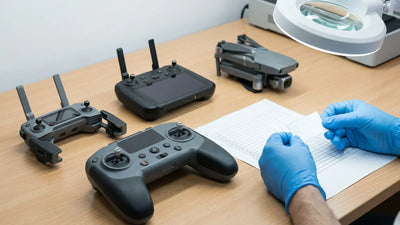
Confirm that the supplied controller is the represented model and supported for the exact aircraft and intended configuration. Inspect its housing, sticks, antennas, screen where fitted, ports, controls and battery condition without opening the enclosure. Preserve available account, binding or activation evidence through the appropriate supported process. A powered observation in a suitable environment can confirm what the system reports at that time, but it should not become a universal distance or interference claim.
Link behavior depends on aircraft, controller, software state, antennas, environment, interference, local radio rules and operator setup. Do not use a public long-range test as proof of readiness, and never imply that a regulatory or airspace restriction can be avoided. For enterprise work, record the controller and application context that the team will actually use. If the relationship is uncertain or warnings persist, move to qualified support before mission acceptance rather than experimenting at a live site.

What should be recorded about RTK and positioning?
Record whether RTK capability is integrated, supplied through a module or not included, and identify the exact hardware shown in the offered kit. Confirm physical condition, represented compatibility and the current supported setup path from official documentation. RTK is part of a positioning system that can also depend on correction services, base infrastructure, account or network context, mission software, environment and operating procedure. The presence of an RTK label does not by itself guarantee a stated field result.
Connect positioning evidence to the intended output. A mapping team may need a documented coordinate and data process; an inspection team may use positioning differently. State which parts of that process were observed and which remain the customer's deployment responsibility. Avoid invented accuracy claims or a universal acceptance distance. If the mission requires a defined deliverable, test the complete supported configuration under an appropriate controlled plan and compare the output with the customer's documented requirement.
How should service history affect the decision?
Gather the service records, incident disclosures, ownership and account handover evidence, replaced-part statements and prior symptoms that are actually available. Absence of history is itself a disclosed unknown; it should not be filled with a reassuring story. Compare the record with current visible condition and system behavior. A previous repair does not automatically make a unit unsuitable, and a clean exterior does not prove that no event occurred. The decision rests on the quality of evidence and fit for the intended role.
Look for patterns that affect continuity: repeated concern, incomplete accessory history, unsupported modification, uncertain payload relationship or a configuration the team cannot maintain. Decide whether the evidence supports acceptance, a qualified diagnosis, a narrower operating role or another unit. Warranty terms should come from the written policy applicable to the actual purchase or repair, not from a generic claim in the article. This keeps service history useful without turning it into an invented guarantee.
What is mission acceptance, and what is it not?
Mission acceptance is a controlled confirmation that the exact supplied system can support a stated task, configuration and environment after receiving evidence is satisfactory. Define the intended output, controller, payload, battery plan, positioning context, data path, site conditions, authority boundary and stop conditions. Begin with nonflight and ground observations, then use only an appropriate controlled operational sequence. Preserve the result and any limitation in the asset record so the team does not assume that one acceptance applies forever.
Mission acceptance is not deployment approval for every site, weather condition, payload, client or jurisdiction. It does not replace pilot responsibility, current official product guidance, local airspace checks, permits, registration, insurance or the organization's own risk process. A later change in payload, software, controller, battery condition or mission can require renewed review. The value of acceptance is that it ties evidence to one real operating need rather than making a broad claim that the aircraft passed everything.
How does Reboot Hub make a pre-owned enterprise purchase transparent?
Reboot Hub should stand on the customer's side of the decision. We show the actual available unit, visible condition and supplied kit; explain version, compatibility and service context; disclose the evidence we have and the unknowns we do not; and put the offered scope and terms in writing. That is stronger than asking a buyer to trust a condition label, a platform badge or a generic photograph. The customer can see which reasonable concerns have been removed before commitment.
Use the exact-model Wiki for architecture, the grading standard for condition language, The Reboot Hub Standard for evidence practice, the pre-owned collection for actual available units, and the shipping and warranty pages for transaction boundaries. If the mission needs enterprise fleet planning, continue through the scenario and procurement routes. This turns an inspection guide into an action page: the reader can connect technical evidence to a transparent Reboot Hub purchase and deployment decision.
Keep exploring
Further reading
From The Reboot Hub Chronicle






From Drone Guides