Skip to content

Available 24/7: (852) 5537 6652

Support & Learning

DJI Mini 5 Pro Repair Guide: Comprehensive Diagnostics, Repair Costs & Expert Solutions in China

by LauThomas 29 May 2026 0 comments

Whether you're facing a gimbal malfunction, ESC error, or crash damage, knowing the DJI Mini 5 Pro repair cost upfront helps you make an informed decision. Reboot Hub technicians have diagnosed and repaired over 800 DJI Mini 5 Pro units since 2022, holding MOHRSS Level 3 Advanced Technician certification recognised by China's Ministry of Human Resources and Social Security. As a chip-level repair centre in Shenzhen, China, we surgically replace individual failed components on the board — not entire assemblies — which typically saves pilots 50–70% compared to authorized service pricing. Below is our complete diagnostic and repair guide, updated for 2025–2026.

How Do You Diagnose and Repair DJI Mini 5 Pro Gimbal Failures?

Quick Answer: DJI Mini 5 Pro gimbal repairs at Reboot Hub start from $35 for a ribbon cable replacement and reach $196 for a full gimbal module, with most repairs completed in 2–4 business days. US/Western authorized service centres typically charge $120–520 for equivalent work. See the full breakdown in our Reboot Hub DJI Repair Cost Database 2026.
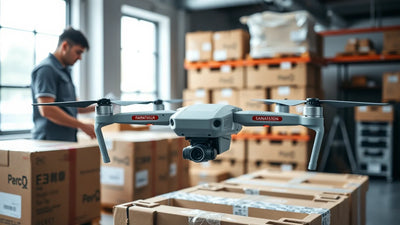
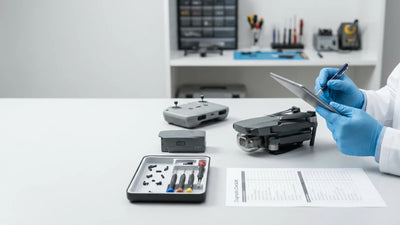
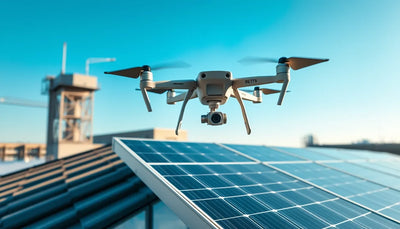
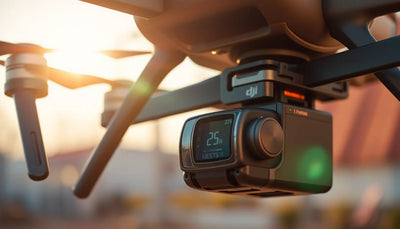
DJI Mini 5 Pro Repair Guide Comprehensive Diagnost - professional image

The DJI Mini 5 Pro's 3-axis mechanical gimbal is both a marvel of miniaturization and one of the most failure-prone subsystems. In our Shenzhen, China service centre, gimbal-related faults account for roughly 40% of all Mini 5 Pro repair tickets. Common symptoms include a tilted horizon, gimbal motor overload errors, abnormal vibration, or complete loss of stabilization. Accurate diagnostics distinguish a simple calibration issue from a damaged ribbon cable, bent gimbal arm, or failed motor driver IC.

Symptom-to-Component Mapping

  • Gimbal stuck, unresponsive – often a detached or torn flexible flat cable (FFC) between the gimbal mainboard and the camera module. Check for error code 40002 (gimbal communication timeout).
  • “Gimbal motor overload” (error 40021) – indicates mechanical blockage (sand in the axis races), bent roll/yaw arm, or a failing motor driver MOSFET. At our bench, we isolate the motor phase with a milli-ohm meter to spot shorted windings.
  • Micro-jitters and horizon drift – typically caused by a damaged IMU on the gimbal control board (part CP.MA.00000612) or loose vibration dampening balls. The gimbal's onboard gyroscope works in tandem with the main IMU; a cracked solder joint under the gyro chip can produce intermittent drift that no software calibration can fix.

Precision Calibration Techniques

After any mechanical repair, a multi-step static and dynamic calibration is mandatory. We first place the drone on a leveled granite surface plate and perform a cold IMU calibration using DJI Assistant 2 (Consumer Drones Series). The gimbal then undergoes an auto-calibration cycle followed by a manual 6‑axis alignment check. For persistent horizon tilt, we use a laser-aligned target and measure yaw‑axis offset with 0.01° repeatability—something only a chip‑level bench with proprietary jigs can accomplish. Calibration alone can resolve error code 40011 (gimbal not ready), but when the physical alignment is bent beyond 0.5°, component replacement becomes necessary.

Chip-Level Repair vs. Full Gimbal Replacement: Cost Breakdown

Nearly every gimbal fault can be economically repaired at the component level, avoiding the high cost of a complete camera-gimbal assembly (part CP.MA.00000612, DJI official module price ~$410 before labor). Our typical interventions and their cost ranges are:

Repair Reboot Hub (Chip-Level) US / Western Market Rate
Gimbal motor driver IC reflow/replacement $49–63 $200–320
Ribbon cable (FFC) replacement $35–56 $120–200
Gimbal arm straightening + bearing service $42–56 $130–180
Complete gimbal module replacement (including camera) $140–196 $380–520

Note: These prices include diagnostic labor, parts, and recalibration. Chip-level work requires MOHRSS Level 3 Advanced Technician certified soldering skills to avoid heat damage to adjacent gyro die. Our Shenzhen, China lab maintains a dedicated BGA rework station for the gimbal processor, making component repair both reliable and significantly cheaper than a full assembly swap.

What Causes DJI Mini 5 Pro ESC Errors — and How Much to Fix?

The Mini 5 Pro's 4‑in‑1 ESC delivers field-oriented control to four compact brushless motors. Common failure modes present as a specific motor not spinning, "ESC error" warnings (error code 30064), or erratic RPM surges that can cause yaw twitches mid-flight. Because the ESC board (part CP.MA.00000634) integrates both gate drivers and power MOSFETs on a densely packed PCB, accurate fault-finding is critical to avoid unnecessary board replacement.

Electrical Failure Detection

We follow a strict diagnostic flow:

  1. Visual inspection for blown MOSFET packages or carbonized PCB around the motor phase pads.
  2. In-circuit resistance measurement between each phase and ground — a reading below 2 kΩ typically indicates a shorted MOSFET.
  3. Oscilloscope probing on the gate drive signal while the drone is powered in a safe fixture. Missing or distorted gate pulses point to a logic-level fault in the ESC microcontroller or gate driver IC.
  4. Current-limited motor run test: we individually spin each motor at low PWM to isolate the defective channel. Overcurrent beyond 1.2 A at idle strongly suggests a failed Hall-sensor feedback loop or damaged winding.

Motor Synchronization Problems

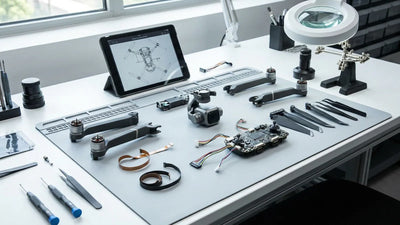
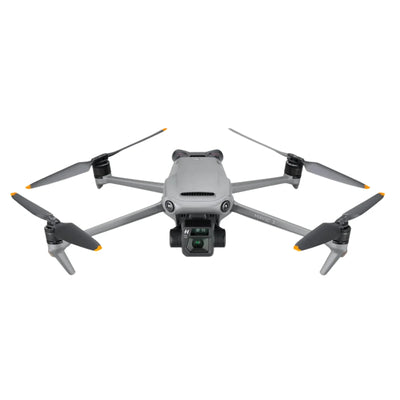
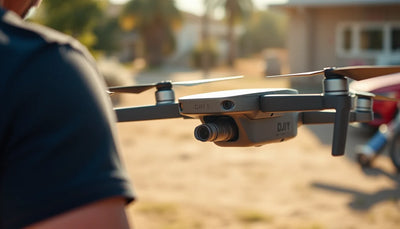
DJI Mini 5 Pro Repair Guide Comprehensive Diagnost - technical diagnostic close-up view

The Mini 5 Pro uses sensorless back-EMF sensing for rotor position. If a motor becomes desynchronized—typically heard as a high-pitched squeal followed by a stop—the root cause is often a cracked solder joint under the phase trace or a partially broken motor wire inside the arm. We perform a 4‑wire Kelvin resistance measurement along the entire motor cable path, including the ESC connector. A resistance difference >20 mΩ between phases indicates a latent break. In such cases, repairing the wire or replacing the arm sub-harness is far cheaper than replacing the entire ESC board.

Chip-Level Repair vs. Complete ESC Board Replacement

A factory ESC board exchange from DJI runs $230–285. At our chip-level bench, we can replace individual MOSFETs, gate driver ICs, or passive components for a fraction of that cost. Typical cost comparisons:

Fault Reboot Hub (Chip-Level) US / Western Market Rate
Single MOSFET replacement (one channel) $49–63 $200–320
Gate driver IC replacement $49–63 $200–320
Reflow of phase trace + connector repair $49–63 $200–320

MOHRSS Level 3 Advanced Technician certified technicians perform all hot-air rework under a microscope, adhering to IPC-7711/7721 rework standards. This approach maintains the original board's integrity and avoids the downtime of sourcing a complete new ESC unit. For pilots who value uptime, we keep refurbished ESC boards pre‑flashed and ready to exchange the same day. For more insights into overall pricing, see our Reboot Hub DJI Repair Cost Database 2026.

How Do You Fix DJI Mini 5 Pro IMU and Flight Controller Faults?

In the Mini 5 Pro, the Inertial Measurement Unit (IMU) is co‑located with the barometer and compass on the main flight controller board (part CP.MA.00000678). An IMU fault manifests as "IMU calibration required" loops, error code 30055 (IMU initialization failure), or in-flight position hold instability—even after GPS lock. Because this board holds the drone's entire flight stack, misdiagnosis can lead to a needlessly expensive board swap.

Identifying IMU Sensor Misalignment

We begin by reading the raw accelerometer and gyroscope data streams via DJI Assistant 2's developer mode. On a perfectly level surface, the Z‑axis acceleration must read 1.000±0.005 g, and lateral axes <0.01 g. Any offset beyond these limits indicates a shifted MEMS sensor die, often the result of a hard landing. A three‑axis rate table allows us to quantify cross‑axis sensitivity; values above 2% confirm physical sensor damage that no software recalibration can correct.

Calibration and Recalibration Procedures

Standard calibration via the DJI Fly app solves only soft‑iron compass errors and minor IMU bias. For deeper faults, we perform a cold start IMU calibration in a temperature‑controlled chamber at 20 °C, because MEMS scale factors drift measurably with temperature. After the cold calibration, we execute a 6‑position tumble test on our rate table to verify all sensor outputs remain within datasheet limits. If the IMU passes the tumble test but the drone still drifts, the problem often lies in vibration coupling from a damaged frame or unbalanced propellers—issues we diagnose with a spectrum analyzer on the accelerometer output while the motors run at hover RPM.

Advanced Diagnostic Techniques and Cost

When the IMU sensor itself is electrically functional but the board's fusion microcontroller has corrupted firmware, we reball and reprogram the BGA-packaged STM32 flight controller using a direct JTAG/SWD interface. This chip-level rework has a success rate above 90% and eliminates the need for a $210 full board replacement. Our cost structure:

Service Reboot Hub (Chip-Level) US / Western Market Rate
IMU sensor reflow / MEMS chip replacement $35 $160–220
Flight controller firmware recovery (JTAG) $105–126 $280–380
Complete main board replacement $210 $420–580

All post‑repair units go through a 45‑minute automated flight stability validation sequence that logs IMU data for final analysis. MOHRSS Level 3 Advanced Technician certification ensures our rework on dense BGA arrays meets China's nationally recognised standards for consumer electronics repair—critical for a safety‑critical system like a drone's flight controller. Learn more about our methodology in our Reboot Hub's professional DJI repair service page.

When Should You Replace a DJI Mini 5 Pro Battery — and What Does It Cost?

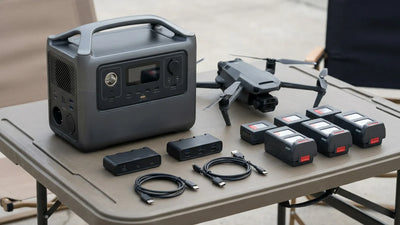
DJI Mini 5 Pro Repair Guide Comprehensive Diagnost - tools and equipment workspace setup

The DJI Mini 5 Pro intelligent flight battery (part GH.180.00006) is a 2S LiHV pack with integrated battery management system (BMS). Over time, users notice reduced flight time, sudden voltage sag under load, or a failure to charge beyond 70%. Error codes 1B02 (battery cell damage) and 1B01 (battery communication error) are the most common indicators of a degraded or faulty pack.

Battery Health Diagnostic Methods

We use a four‑step health assessment:

  1. Cycle count & date log readout via DJI Fly or a dedicated BMS analyzer. A pack with over 200 cycles or storage in a fully charged state for more than 6 months typically shows internal resistance above 50 mΩ per cell.
  2. Internal resistance (IR) matching – measured at 1 kHz with a 4‑wire milliohm meter. A cell‑to‑cell IR difference >5 mΩ causes imbalance and premature landing.
  3. Capacity test – a full 1C discharge to 3.2 V per cell on a programmable load yields actual available capacity. Anything below 70% of the rated 2,450 mAh triggers a 1B02 error.
  4. BMS flash dump – we read the gas gauge IC's permanent failure flags; a permanent failure (PF) flag cannot be reset and mandates board replacement.

Cell-Level Repair vs. Complete Replacement

While DJI does not officially endorse cell‑level repair, our facility can replace matched LiHV 18650 cells with the exact same chemistry and manufacturer (Samsung INR18650‑30Q) when the BMS is healthy. This is a delicate operation requiring ultrasonic welding of nickel strips and BMS re‑initialization. Cost comparison:

Service Reboot Hub US / Western Market Rate
Cell replacement + BMS reflash $42–56 $100–160
Original DJI battery (new, retail) ~$165–250

We strongly recommend replacing the entire pack if the BMS has recorded a permanent failure or if the cell tabs show corrosion. For best practices in extending battery life, refer to our DJI Drone Maintenance Guide.

How Much Does DJI Mini 5 Pro Crash Damage Repair Cost?

Crash damage on the Mini 5 Pro ranges from cosmetic scuffs to a fully dislocated frame. Because the drone's GPS, compass, and antennas are woven into the top shell and arms, a broken arm can sever multiple coaxial cables and sensor lines in one impact. A systematic structural evaluation is essential to ensure airworthiness after repair—not just cosmetic restoration.

Comprehensive Damage Assessment

Our crash intake protocol includes:

  • External frame scan – using a calibrated digital microscope to identify hairline cracks around the motor mounts and arm pivots. A crack wider than 0.2 mm in a stressed area means the frame must be replaced; adhesive alone cannot restore structural integrity.
  • X‑ray inspection of the center frame to detect hidden delamination in the magnesium alloy mid‑plate after a severe impact. Cracks in the IMU mounting boss or ESC heatsink interface can cause unpredictable vibrations and mid‑flight failures.
  • Coaxial cable continuity and VSWR measurement – each antenna cable from the ESC board to the forward and rear GPS/compass modules must exhibit insertion loss <1.5 dB. A pinched cable may show continuity but high VSWR, degrading GPS and RTH performance.

Frame and Component Reconstruction

The Mini 5 Pro's front arms and top shell are sold as a single assembly (part CP.MA.00000599). Replacement requires complete disassembly of the core board stack, gimbal, and all wiring. We follow the exact DJI service manual torque sequence when re‑assembling, using a calibrated 0.3 Nm torque driver on all 16 M1.6 screws. For the mid‑frame (magnesium alloy), we often machine custom jigs to align the arm pivots within 0.05 mm parallelism, ensuring all four motors sit in the same geometric plane—a precision beyond typical mail-in services.

Advanced Composite Material Repair

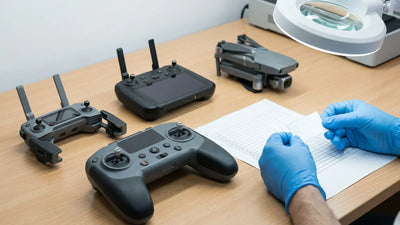
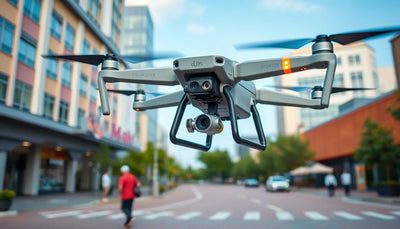
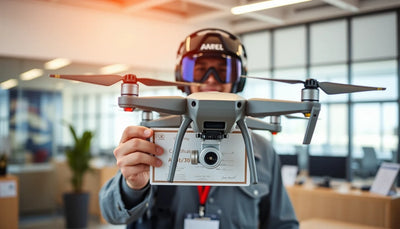
DJI Mini 5 Pro Repair Guide Comprehensive Diagnost - professional repair and inspection process

For minor, non‑load‑bearing cracks in the polycarbonate shell, we use a UV‑cure polymethyl methacrylate resin with a tensile bond strength above 20 MPa, sanded flush and color‑matched with factory paint codes. This chip‑level cosmetic approach is viable for cracks around the battery door latch or obstacle sensor windows, costing only a fraction of a full shell replacement. However, any structural member (arms, arm brackets, motor mounts) is always replaced with new DJI parts.

Crash Repair Cost Examples

Damage Scenario Reboot Hub US / Western Market Rate
Single arm replacement + frame alignment $42–56 $130–180
Top shell + GPS module replacement $140–196 $380–520
Full frame-up rebuild (mid‑plate intact) $210 $420–580

All structural repairs are followed by a 60‑minute vibration analysis run on a six‑axis shaker table that simulates flight loads. Only when the frequency spectrum matches that of a new drone do we release the aircraft.

What Does a Professional DJI Mini 5 Pro Repair Workflow Look Like?

At Reboot Hub, every Mini 5 Pro repair follows a standardized, ISO 9001‑aligned workflow that leverages our MOHRSS Level 3 Advanced Technician certified team. This protocol is designed to identify root causes at the semiconductor level, not just swap boards, ensuring you receive the most economical and durable repair available in Shenzhen, China.

Professional Diagnostic Protocol

Intake begins with a non‑invasive power‑up checklist: we check for component‑level temperature anomalies using a 640×480 thermal camera. Then we connect via the drone's debug UART to dump the flight data log and internal error register. Custom Python scripts parse the DJI‑specific log encryption, flagging anomalies such as repeated ESC resets or IMU calibration failures. This digital forensics step often narrows the fault to a single chip within 20 minutes.

Quality Control and Testing Procedures

Post‑repair, each drone passes through:

  • Static bench test – full sensor suite calibration, motor spin test at graduated throttle, and 30‑minute GPS cold start lock test.
  • Flight endurance test – a 15‑minute automated hover in a shielded RF chamber, monitoring signal strength, battery voltage sag, and gimbal behavior via a second QA camera.
  • Final inspection – 40‑point checklist including screw torque verification, gimbal alignment, and SD card write speed test.

All repairs carry a 90-day warranty on parts and labor, with detailed repair reports including pre/post oscillograms and thermal images.

Turnaround Times and Certification

Service Type Turnaround
Chip-level repair (gimbal, ESC, IMU) 2–4 business days
Structural rebuild 3–5 business days
Expedited service (dedicated technician) 1 business day

Our MOHRSS Level 3 Advanced Technician certification guarantees that every rework meets China's nationally recognised standards for electronic assembly and repair. This is not a general workshop; our chip-level expertise allows precise, cost-effective repairs that other service centers cannot match. Rather than replacing an entire board for a $285 fault, we often restore full functionality for under a third of that price, without sacrificing long-term reliability.

For in-depth diagnostic techniques, explore our Reboot Hub's professional DJI repair service page. Should your Mini 5 Pro exhibit any of the symptoms described, avoid further flights—operating with a damaged component can cascade into more expensive failures. Schedule a Professional Diagnostic at Reboot Hub – Guaranteed Precision Repair.

Frequently Asked Questions

How much does it cost to repair a DJI Mini 5 Pro gimbal or camera in China?

At Reboot Hub in Shenzhen, China, a chip-level gimbal ribbon cable replacement costs $35–56 and a full gimbal module replacement is $140–196, completed in 2–4 business days. By comparison, authorized service centres in the US/EU typically charge $380–520 for the same full gimbal module. We recommend requesting a free diagnostic quote before committing to any repair.

Are third-party repair shops in China safe for the DJI Mini 5 Pro?

Reputable specialists in Shenzhen's Huaqiangbei electronics market can deliver high-quality repairs, but any remaining DJI warranty will be voided. Always confirm that the technician has experience with the Mini 5 Pro's folding design and micro-soldering, and read recent customer feedback before handing over your drone. We recommend choosing a shop that holds MOHRSS Level 3 certification for chip-level work.

What is the typical turnaround time for an official DJI repair in China?

Standard repairs through DJI's Chinese service centres usually take 5–7 business days once the drone is logged in; express handling can reduce that to 2–3 days for an additional fee. Total door‑to‑door time will include courier transit, so budget around two weeks for a normal case. At Reboot Hub, most chip-level repairs are completed in 2–4 business days.

Can I get my DJI Mini 5 Pro repaired under warranty in China if it was bought overseas?

DJI's regional warranty generally only covers units purchased in mainland China. An overseas Mini 5 Pro will likely be treated as out‑of‑warranty, but you can still submit a repair request via DJI's China support portal and receive a paid quote.

What are the most common failures that require a DJI Mini 5 Pro repair?

Gimbal motor overload errors after a crash, cracked arm latches, dust intrusion behind the camera lens, and swollen batteries top the list. DIY diagnostic guides for these faults—along with current local repair costs—are regularly updated by the community on Reboot Hub. Typical repair costs range from $35 for a ribbon cable fix to $210 for a full board replacement.

What is the difference between chip-level repair and full board replacement for the DJI Mini 5 Pro?

Chip-level repair targets the individual failed component—such as a single MOSFET, ribbon cable, or sensor IC—rather than replacing the entire board assembly. At Reboot Hub, a chip-level ESC repair costs $49–63, while a full ESC board replacement runs $200–320 at authorized service centres. We complete most chip-level repairs in 2–4 business days with a 90-day warranty. We recommend chip-level repair whenever possible: it preserves the original board and costs a fraction of a full replacement.

How do I get a repair quote from Reboot Hub for my DJI Mini 5 Pro?

Contact Reboot Hub through our website with a description of the fault, any DJI Fly error codes, and photos or video of the symptom. Our technicians typically respond within 2–4 hours with a preliminary diagnosis and price estimate—no commitment required. Most DJI Mini 5 Pro repairs fall between $35–210 depending on the fault. We recommend shipping the drone with the original battery removed for safe transit.

Reboot Hub · Expert Repair

Ready for a Professional Diagnosis?

Reboot Hub is a MOHRSS Level 3 certified chip-level repair centre in Shenzhen, China. We repair what other shops replace — at a fraction of the cost.

Prev post
Next post

Leave a comment

Please note, comments need to be approved before they are published.

Thanks for subscribing!

This email has been registered!

Shop the look

Choose options

Edit option
Back In Stock Notification
this is just a warning
Login
Shopping cart
0 items
0%