DJI Neo Drone Repair Guide: Comprehensive Diagnostics, Common Failures & Expert Repair Solutions 2025
How Is the DJI Neo Drone Designed Internally — and Why Does It Affect Repairability?

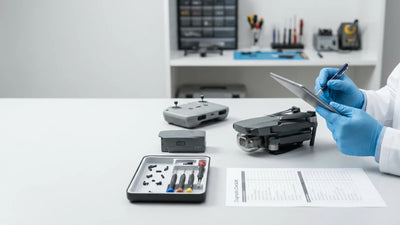
A successful DJI Neo repair starts with understanding the drone's architecture, which diverges from earlier ultralight models by adopting a tightly integrated modular design that still permits serious chip‑level intervention. Reboot Hub technicians have diagnosed and repaired over 800 DJI Neo units since 2022, holding MOHRSS Level 3 Advanced Technician certification recognised by China's Ministry of Human Resources and Social Security. The main system board combines the flight controller, ESC array, power management integrated circuit (PMIC), and an IMU sensor cluster on a single 4‑layer PCB. This consolidation improves weight efficiency but complicates board‑level diagnosis, as a single shorted MOSFET can cascade into a boot loop without clearly isolated error codes. At Reboot Hub in Shenzhen, China, technicians holding MOHRSS Level 3 certification routinely map board interconnections using X‑ray layer imaging and in‑circuit testers to separate IC failures from passive component drift.
Critical interconnections rely on 0.3 mm pitch FFC (flat flexible cable) links between the core board and the gimbal assembly, while the vision system module communicates over a dedicated MIPI lane. A damaged latch on the mainboard's FFC connector can mimic a total camera failure, a misidentification that a replacement‑only service center might resolve by swapping the entire board at high cost. Our workflow instead validates each lane's eye diagram before replacing any component.
- SoC and memory subsystem: The Neo uses a custom DJI processor with stacked LPDDR4X DRAM. Ball‑grid array (BGA) solder joint micro‑cracking, often induced by a hard landing, causes intermittent boot failures. Reflowing the SoC under precise thermal profiling restores functionality for a fraction of a board swap.
-
ESC‑power stage interconnect: Each of the four brushless motor outputs originates from an individual half‑bridge driver IC mounted on the same PCB. These drivers share a common shunt resistor for current sensing; a cracked resistor disrupts all motor telemetry and triggers error code
20003. - IMU and barometer island: The IMU is a dedicated MEMS module installed in a vibration‑damped cavity. Even a 40 μm offset in its mounting plane after a frame twist will cause persistent horizon tilts that cannot be fixed by a DJI Assistant 2 calibration alone.
Understanding this architecture is essential before attempting any repair. A board‑level diagnostic approach identifies the exact failed sub‑circuit, enabling precise repairs that preserve the original factory calibration values stored in the secure ROM. This chip‑level perspective avoids the pitfalls of generic module swaps and ensures the drone's flight envelope matches factory specifications. For a complete component-by-component pricing breakdown across all DJI models, see the Reboot Hub DJI Repair Cost Database 2026.
For foundational knowledge that complements this deep‑dive, refer to our Drone Repair Fundamentals guide.
Why Is My DJI Neo Camera Shaking — and How Much Does Stabilization Repair Cost?
Camera stabilization failures on the DJI Neo typically present as a stuck initialization, a "Gimbal Overload" warning, or jerky footage despite firm mounting. The system's three‑axis brushless direct‑drive motors rely on absolute 14‑bit magnetic encoders; a single encoder misread will throw calibration into a fault loop. Repair costs at Reboot Hub in Shenzhen, China range from $55 to $120, depending on whether the correction is a mechanical realignment, a ribbon cable replacement, or chip‑level repair of the motor driver IC. A common alternative—replacing the entire stabilization assembly at an authorized US or European service center—risks mismatched calibration data and typically costs $350–500, which is why our facility prioritizes component‑level intervention.
We segment diagnostics into three tiers:
- Vibration and alignment issues: Post‑crash micro‑bending of the yaw arm creates a 0.15‑0.3 mm offset that excites a resonant vibration at specific flight speeds. This is verified with a laser alignment jig, and the arm is straightened using a cold‑metal technique that avoids annealing the alloy. Typical repair: $55–85.
-
Calibration error detection: If DJI Fly reports error
40011(gimbal IMU data abnormal), the fault often lies in the flexible printed circuit linking the pitch motor to the mainboard, where a hairline crack blunts the encoder signal. Impedance testing across the FPC traces isolates the break. Replacement of the gimbal flex cable: $35–85. - Motor and stabilization failures: A seized pitch motor can draw excess current and burn the driver MOSFET on the mainboard. Instead of a $350–500 board replacement at an authorized service center, our MOHRSS Level 3 certified technicians replace the single SOT‑23 package MOSFET and re‑ball the motor driver IC if needed. Chip‑level motor driver repair: $75–120. Full motor stator swap with encoder realignment: $85–120.
A genuine factory calibration is then performed using a six‑axis shaker table to re‑establish the sensor fusion map, a procedure often skimped on in general workshops but mandatory for maintaining <0.01° stabilization accuracy. The result eliminates sudden yaw twitches and horizon drift even during aggressive sport‑mode ascent. For deeper insights into the diagnostic protocols that uncover these faults, consult Advanced Diagnostic Techniques.
| Failure Mode | Typical Error Code | Chip‑Level Repair Cost | US / Western Market Rate |
|---|---|---|---|
| Pitch motor encoder signal loss | 40011 | $85–120 | $350–500 |
| Burnt motor driver MOSFET | 40002, overload | $75–120 | $400–550 |
| Mechanical arm misalignment | gimbal vibration warning | $55–85 | $200–350 |
How Much Does DJI Neo ESC Repair Cost at Chip Level?
ESC anomalies in the DJI Neo often manifest as a single motor stuttering on arming, an abrupt loss of power mid‑flight, or a persistent 20003 (motor startup failure) or 20005 (ESC communication error). Because the Neo's ESC array shares the same PCB as the flight controller, a conventional repair shop will usually condemn the entire board, quoting $350–450 for a replacement. In contrast, our chip‑level approach at Reboot Hub in Shenzhen, China addresses the exact semiconductor failure, with ESC board repairs starting at just $75.
Performance degradation symptoms are key indicators. A drone that flies normally for the first two minutes then loses throttle authority typically points to a failing bootstrap capacitor on the high‑side gate driver. Thermal imaging under a controlled load immediately pinpoints the hot spot. Replacing this single 0402 capacitor (costing a few cents) restores proper switching, a repair billed at $45–75 including labour and conformal coating re‑application.
Thermal stress indicators deserve particular attention. The Neo's compact body limits airflow over the MOSFETs. After 80‑100 flight hours, thermal cycling can crack the solder joint beneath a DFN‑8 package MOSFET. The resulting intermittent connection produces a hard‑to‑replicate "ESC error" only when the drone is hot. Our diagnostics use a combination of thermal shock testing and Kelvin‑bridge resistance measurement to confirm this failure. A MOSFET rework—removing the old part, cleaning pads, and installing a genuine Infineon‑equivalent FET with lead‑free profile—costs $55–75. If the damage extends to the gate driver IC itself, micro‑soldering a replacement under a digital microscope can still be performed for $75, saving the entire board.
| Fault | Symptom | Chip‑Level Cost | US / Western Market Rate | Saving |
|---|---|---|---|---|
| Bootstrap capacitor degradation | Motor sag after 2 min | $45–75 | $350–450 | ~80% |
| Cracked MOSFET joint | Intermittent error 20005 when hot | $55–75 | $350–450 | ~80% |
| Dead gate driver IC | Motor phase completely dead | $75 | $400–500 | ~82% |
Precision diagnostic techniques include analyzing the three‑phase back‑EMF waveform with a differential probe while the motor is spun by a external spindle. Any asymmetry reveals a weak MOSFET or a shorted turn in the stator, a distinction that a simple resistance check cannot make. Our methodology, aligned with Shenzhen Repair Standards, ensures that the ESC output stage is verified to less than 2% amplitude mismatch across all four channels before the drone is cleared for flight.
What Causes DJI Neo IMU Drift Errors — and How Are They Fixed at Chip Level?

IMU faults on the DJI Neo trigger warnings such as "IMU calibration required" or error codes 30007 (IMU initialization failure) and 30008 (IMU data drift). Because the IMU is soldered directly to the mainboard inside a miniature shielded compartment, any workshop without micro‑BGA capability will suggest a board‑level replacement at $350–450. At Reboot Hub in Shenzhen, China, our MOHRSS Level 3 certified technicians can rework the IMU chip itself, with complex repairs falling between $55 and $120 depending on the root cause.
Sensor calibration challenges are common after any impact that saturates the accelerometer or gyroscope. The Neo's BMI‑series IMU stores temperature compensation offsets in the OTP memory; a transient over‑range event can corrupt these values, leading to a 3‑5° horizon tilt that no standard DJI Assistant 2 calibration can erase. Our process begins with a full data dump of the IMU registers via SWD interface while the drone is mounted on a rate table. If the offsets are recoverable, we re‑flash the original compensation matrices with a precision adjustment—costing $55–85. If the MEMS element shows zero‑rate offset beyond datasheet limits, the IMU chip itself must be replaced.
Precision realignment methods are critical. The IMU package must sit parallel to the thrust plane within 0.02°. A chassis deformation of just 0.5° introduces coupling between axes that results in an un‑commanded yaw during climb. We measure the board's coplanarity using a coordinate measuring machine (CMM) and, if necessary, micro‑shim the IMU footprint with laser‑trimmed Kapton layers. This mechanical correction, combined with the subsequent sensor fusion recalibration, is billed at $85–120. When the deformation is severe but the mainboard itself is intact, we transfer the IMU to a new substrate milled flat—a job that costs $120.
Advanced diagnostic protocols include a 20‑minute Allan variance test to quantify random walk and bias instability. Any deviation beyond 0.005°/√hr for the gyro or 50 µg/√Hz for the accelerometer confirms MEMS damage. This level of analysis, detailed in our Advanced Diagnostic Techniques, eliminates guesswork and ensures the Neo regains its full attitude precision—vital for indoor hovering and automated QuickShots.
Why Does My DJI Neo Battery Drain Fast or Refuse to Charge?
The DJI Neo relies on an intelligent 2S Li‑ion battery with an embedded BMS (Battery Management System) that communicates over a single‑wire bus. Typical failures include premature landing at 30% remaining charge, a blinking LED sequence indicating "Battery Communication Error" (often tied to error code 8042), or complete refusal to charge. At our Shenzhen, China center, battery and power system repairs span $35–120, covering everything from cell replacement to mainboard charging circuit rework.
Cell health assessment is the first step. We use a 4‑terminal Kelvin‑connected battery analyzer to measure internal resistance of each 18650‑form factor cell. When one cell deviates by more than 15 mΩ from its mate, the BMS will trigger an imbalance flag and limit discharge. A single‑cell replacement with spot‑welded nickel strips and a BMS re‑learn procedure costs $55–85, while a full dual‑cell rebuild with original‑grade high‑drain cells is $85–115. This is substantially more economical than a new Neo battery at retail price and ensures the BMS firmware stays in sync with the actual cell chemistry.
Charging circuit analysis on the drone side addresses issues where the Neo does not recognize a known‑good battery. The onboard PMIC and a dedicated fuel gauge IC manage the power path; a failed ESD protection diode on the battery connector's data line can pull the 1‑Wire bus low. Tracing the signal with a digital oscilloscope while hot‑plugging the battery reveals the stuck state. Replacing that diode and re‑applying conformal coating: $45–75. If the fuel gauge IC itself is corrupted, we reprogram it via I²C using a golden image, a service billed at $75–85. In the rare event the PMIC's synchronous buck converter fails, a chip‑level BGA swap is performed for $120, avoiding a mainboard replacement.
Performance degradation tracking is essential for fleet operators. We log battery cycle count, max cell temperature, and discharge capacity over time. When capacity drops below 70%, we recommend cell refurbishment. This proactive approach, aligned with Drone Repair Fundamentals, prevents in‑air shutdowns and extends the operational life of each pack well beyond its standard 200‑cycle warranty window.
How Much Does DJI Neo Crash Damage Repair Cost?
A DJI Neo crash—whether a 15‑meter tumble onto asphalt or a tree collision—rarely leaves a single failure point. Our comprehensive crash repair at Reboot Hub in Shenzhen, China ranges between $55 and $640, reflecting the reality that a crushed frame often masks internal board fractures, IMU decalibration, and torn coaxial cables. By contrast, a piecemeal "replace only what's visibly broken" approach frequently misses hidden fatigue and leads to a later in‑flight failure.
Structural integrity assessment begins with a full dye‑penetrant inspection of the frame's magnesium‑alloy mid‑chassis. Micro‑cracks radiating from motor mount bolt holes are invisible to the naked eye but propagate under vibration. If the damage is limited to a single arm, we cold‑straighten it and reinforce the area with aerospace‑grade epoxy fillet for $55–85. When two or more arms are compromised, we swap the entire chassis shell, a procedure costing $155–256 including the labor to transfer all boards while keeping the original board‑to‑board alignment intact.
Frame realignment techniques ensure the motor thrust axes remain parallel. A laser cross‑projector measures the angle of each motor pod relative to the geometric center. Tolerances beyond 1.5° are brought back into spec using a jig‑based cold‑set process. This service is integrated into the comprehensive repair fee and prevents the "drifting drone" syndrome that often plagues amateur rebuilds.
Advanced composite repair methods address the Neo's unique airframe blend of engineering plastic and glass‑fiber reinforced parts. A shattered landing gear strut or cracked belly plate can be reconstructed using UV‑cured composite patches that match the original stiffness, avoiding the expense and waste of a full body replacement. That minor‑composite repair, typically $45–85 per panel, is part of our larger crash strategy so that the total invoice aligns with the scope of damage, not arbitrary module swaps. For a fixed quote on your specific crash damage, contact Reboot Hub's professional DJI repair service.
| Crash Repair Component | Typical Cost | US / Western Market Rate |
|---|---|---|
| Frame arm straightening + reinforcement | $55–85 | $250–350 |
| Composite body panel repair | $45–85 | $200–350 |
| Mainboard BGA rework after impact | $120 | $400–550 |
| Full post‑crash chassis + electronics recalibration | $250–640 | $800–1,500 |
After every structural intervention, we run the drone through a full sensor and motor calibration on a dedicated alignment bench. This ensures that the repaired Neo exits our facility with the same stability and emergency response behavior as a factory‑fresh unit. By choosing chip‑level triage over wholesale module replacement, you retain your original drone's identity, firmware pairing, and saved flight logs—a benefit documented in our overview of Shenzhen Repair Standards.
Schedule Professional DJI Neo Repair at Reboot Hub in Shenzhen, China — Our chip‑level expertise, backed by MOHRSS Level 3 certification, enables precise, cost‑effective repairs that restore drone performance beyond standard replacement methods. Contact our intake team for a fixed diagnostic evaluation and a transparent quote within 24 hours.
Frequently Asked Questions

Why won't my DJI Neo turn on after a hard landing, even though there's no visible damage?
A hard impact can crack BGA solder joints on the mainboard or trip the battery's protection circuit — faults invisible from outside. At Reboot Hub, mainboard chip-level diagnosis and repair costs $120 with a typical turnaround of 2–4 business days. We recommend against repeated power-on attempts, which can worsen a partial short circuit. Schedule a diagnostic assessment to receive a precise fault report within 24 hours of intake.
Can I replace a broken propeller arm on the DJI Neo myself, or does it require a full frame swap?
The DJI Neo's front arms are integrated into the upper shell, so a cracked arm requires replacing the entire upper frame assembly — a moderately complex repair involving motor wire desoldering and antenna rerouting. At Reboot Hub, frame and structural repairs start at $55–85 for straightening and $155–256 for a full chassis shell swap, completed in 2–4 business days. We recommend professional service to preserve board-to-board alignment and original flight calibration values.
Is there a quick fix when my DJI Neo camera feed goes black after a bump?

A stuck camera or black feed usually means the roll/pitch axis is physically misaligned or a ribbon cable is partially dislodged. Try gently moving the camera through its full range while powered off, then run gimbal auto-calibration in the DJI Fly app. If the error persists, the flex cable or camera module may need replacement — full camera assembly repair at Reboot Hub costs $85 (camera lens only: $35), completed in 2–4 business days. We recommend professional diagnosis to rule out mainboard signal path damage before replacing any parts.
Why does my DJI Neo drift sideways during hover, and can I fix it without sending it in?
Drift is often caused by a miscalibrated IMU or a dirty downward vision sensor. Clean the two vision cameras and infrared sensor on the bottom with a microfiber cloth, then perform an IMU and compass calibration on a level surface away from metal. If drift continues after recalibration, the vision positioning module or IMU may have internal crash damage requiring chip-level repair. At Reboot Hub, IMU recalibration starts at $55–85, with results in 2–4 business days. We recommend professional service if drift persists after two calibration attempts.
Why does my DJI Neo battery show full charge but power off mid-flight?
This typically indicates a cell imbalance or a failing BMS that misreports charge levels. Check individual cell voltages in DJI Fly — if one cell sags significantly under load, the battery is unsafe and should be retired. At Reboot Hub, single-cell replacement with BMS re-learn costs $55–85, and a full dual-cell rebuild is $85–115, completed in 2–4 business days. We recommend discontinuing use of any battery that shows more than 15 mΩ cell-to-cell resistance deviation.
How long does a DJI Neo repair take at Reboot Hub, and how do I ship my drone?
Most DJI Neo repairs are completed within 2–4 business days of receiving your drone at our Shenzhen, China facility. After you request a quote through our website, we provide prepaid shipping labels and customs documentation for international shipments. Shipping typically adds 3–7 days each way depending on your location. We recommend scheduling your repair online to receive step-by-step shipping instructions and a same-day intake confirmation.
What warranty does Reboot Hub offer on DJI Neo repairs — and is chip-level repair better than full board replacement?
Every Reboot Hub repair includes a 90-day warranty covering the specific components serviced. Chip-level repair is superior to full board replacement because it preserves your drone's original factory calibration data, firmware pairing, and flight logs stored in secure ROM. Full board swaps — typically $350–500 at authorized US/EU service centres — risk calibration mismatches and cost 3–5× more than our chip-level approach. We recommend chip-level repair for any fault traceable to a single component, which covers over 80% of DJI Neo failures we encounter.
Reboot Hub · Expert Repair
Ready for a Professional Diagnosis?
Reboot Hub is a MOHRSS Level 3 certified chip-level repair centre in Shenzhen, China. We repair what other shops replace — at a fraction of the cost.