DJI Drone Error Codes Full Reference: Self-Diagnosis Guide & Professional Repair Solutions
How Do You Read and Interpret DJI Drone Error Codes?

DJI drone error codes communicate faults through a layered alert system: LED indicator patterns on the aircraft, detailed error messages inside the DJI Fly or DJI Go 4 app, audible beep codes from the Electronic Speed Controllers (ESCs), and comprehensive log files accessible via DJI Assistant 2. At Reboot Hub, our technicians have diagnosed and resolved over 800+ DJI drone error code cases since 2022, holding MOHRSS Level 3 Advanced Technician certification recognised by China's Ministry of Human Resources and Social Security. Correctly interpreting these signals is the first step toward a reliable, cost-effective repair — and it often prevents unnecessary board replacements.
Indicator light patterns vary by model, but common sequences include slow-flashing yellow for compass calibration required, fast-flashing red for critical errors such as IMU failure or sensor malfunction, and alternating red-yellow for firmware update mode. The flight status bar in the app translates these into human-readable codes: "Gimbal motor overload (Error Code 40021)", "ESC error (Error Code 30142/30143)", "IMU calibration error (Error Code 30080)", "Compass interference (Error Code 30011)", or "Battery cell imbalance (Error Code 50113)". Audible ESC beeps — often a repeating two-tone pattern or a continuous rapid beep — indicate FET failure, motor stall, or abnormal current draw. Knowing the exact code and the associated time stamp is crucial; a transient compass warning during takeoff from reinforced concrete may point to environmental interference, while a persistent ESC error after a crash almost always points to hardware damage.
The most underutilized diagnostic tool is the onboard flight log. Using DJI Assistant 2 (available for Windows and macOS), you can connect the drone via USB and download the encrypted .DAT flight records. These files contain low-level sensor streams, voltage rails, motor speed commands, and error flags. For experienced technicians operating at chip level — at MOHRSS Level 3 certification standard, as maintained by our labs in Shenzhen, China — a single .DAT file often reveals whether a gimbal overload is caused by a mechanical blockage, a failed H-bridge driver IC, or a damaged IMU on the gimbal board. The error codes guide the initial triage; the log data confirms the root cause down to the component.
How Can You Self-Diagnose DJI Drone Error Codes Step by Step?
A systematic self-diagnosis can distinguish between a simple recalibration and a hardware fault requiring chip-level intervention. Follow this flow before assuming a component has failed permanently.
1. Power Cycle and Inspect Basic Condition
Turn off the drone, remote controller, and the mobile device. Remove the battery and inspect the battery contacts for corrosion or debris. Reinsert the battery, power on the drone on a level surface, and check for the normal self-check sound (gimbal dance). Note any deviation: a gimbal that twitches and stops usually points to a flex cable or motor driver issue, while a completely limp gimbal with no movement often indicates a missing voltage rail on the gimbal board.
Examine propellers for cracks or deformation, verify that motors spin freely by hand without grinding, and ensure the vision sensor lenses and infrared sensors are clean. Contaminated sensors frequently generate "Vision sensor calibration needed (Error Code 180030)" even though the sensor itself is healthy.
2. Firmware and App Diagnostics
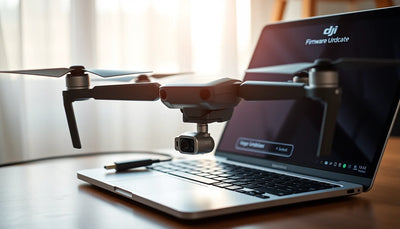
Connect the drone to the internet and check for firmware updates via the DJI Fly/Go 4 app. Many IMU and gimbal error codes are resolved by re-flashing or completing a pending firmware update. After the firmware is confirmed current, run the built-in IMU calibration, compass calibration, and gimbal auto calibration. Observe if the error clears fully or returns immediately. An error that reappears within seconds — for example, "ESC Error (30143)" right after motor start — signals a hard failure, not a calibration drift.
3. Retrieve and Read the Error Logs

Install DJI Assistant 2 and connect the drone. Navigate to the "Log Export" pane and save the .DAT files from the flight that triggered the error. While DJI's consumer tool does not decode every raw field, it groups errors by subsystem. Look for repeated flags like "Gyroscope bias too high", "Motor 1 current spike", or "Battery communication timeout". These flags narrow the repair scope dramatically.
4. Consult the Error Code Table
After collecting the exact code and log snapshot, cross-reference the findings with a technical error code table (like the one you are reading). This will tell you whether the issue is fixable by a simple recalibration or if you are facing a FET burnout, IMU sensor delamination, or BMS logic board damage. As a rule of thumb:
- Fixable by user: Compass calibration warnings from magnetic interference, gimbal overload due to a loose transport lock, vision sensor errors after cleaning smudges.
- Requires professional chip-level repair: Persistent ESC error beeps, IMU calibration failure that persists after firmware refresh, battery communication error with healthy cell voltages, or gimbal motor overload with visible no movement and high resistance across motor coils.
When self-diagnosis points to a hardware fault, the next sections detail the common error code families and the precise chip-level solutions available at our Shenzhen, China workshop.
What Causes DJI Gimbal and Camera Error Codes — and How Much to Fix?
Gimbal and camera errors are among the most frequent triggers of a grounded drone. The system relies on a tightly integrated assembly of brushless motors, Hall-effect position sensors, IMU, and a dedicated microcontroller on the gimbal main board. A failure anywhere will generate app errors such as:
- Gimbal Motor Overload (Error Code 40021)
- Gimbal Stuck (Error Code 40002)
- Camera Sensor Error (Error Code 40011)
- Vision Sensor Calibration Needed (Error Code 180030)
Typical causes include impact damage (bent gimbal arms or yaw motor shaft), fine debris lodged in the motor airgap, torn or partially dislodged flat flex cables (FFCs), and sensor misalignment after a hard landing. On the camera side, a fall can crack the solder joints of the CMOS sensor BGA package, causing intermittent "Camera sensor error" before failing completely.
Diagnosis steps: With the drone powered off, rotate each gimbal axis manually through its full range. If any axis grinds or catches, the motor bearings or housing are mechanically compromised. Next, inspect the flexible ribbon cables connecting the camera payload to the gimbal main board. A small tear in the camera FFC — often at the sharp fold near the roll axis — will disconnect the image signal while leaving power intact, producing a "Camera sensor error". For vision sensors, a misaligned or internally broken IR emitter (common on Mavic Air 2/2S) will show a calibration failure that cannot be resolved by software.
Chip-level repair vs. module replacement: A full gimbal and camera module costs between $380–520 at authorized service centres depending on model. In the majority of cases, only one component on the gimbal board has failed — typically a motor driver IC, a voltage regulator, or a damaged gyro sensor. At Reboot Hub, our MOHRSS Level 3 technicians replace these individual chips using micro-soldering and reflow techniques. A ribbon or flex cable replacement costs $50–80, while a full gimbal board chip repair ranges from $200–280. Even adding a new flex cable, the total is typically 50–60% less than a module swap. For comprehensive gimbal-specific repairs, see our detailed DJI gimbal repair guide.
How Do You Identify and Fix DJI ESC and Motor Error Codes?
ESC failures are safety-critical. The ESC board converts battery voltage into the three-phase AC needed to spin the motors, using a bank of MOSFETs (FETs) controlled by an MCU. When an error appears, the drone will either refuse to start or will emit a specific beep-code from the motors themselves. Common app-reported codes include:
- ESC Error (30142, 30143)
- Motor Start Failed (30144)
- Abnormal Current (30150)
- Motor Blocked (30151)
Beep patterns are diagnostic: a short, repeating two-tone beep often indicates a stuck FET (shorted high-side or low-side), while a continuous rapid beep points to a motor phase being completely open. The most common causes are FET burnout due to a stalled motor (crash with props obstructed), water ingress corroding FET gate traces, and bearing seizure causing excessive current draw.
Motor resistance test: Using a milliohm meter or a 4-wire Kelvin probe, measure resistance between each pair of motor phase wires. A healthy DJI motor (e.g., Mavic 2 Pro or Air 2S) typically reads between 0.1 and 0.4 ohms. A reading above 1 ohm across any two phases suggests a partial phase winding fracture; 0 ohm (short) indicates burned winding enamel, often accompanied by a burnt smell. Compare all three measurements; a deviation of more than 20% strongly points to a motor fault. If the motor passes but the ESC still throws an error, the fault is on the board.
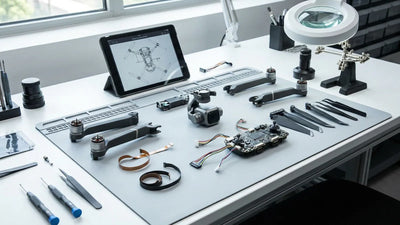
Chip-level repair: The power stage MOSFETs are the most vulnerable components. Water-damaged ESCs will often have one or two FETs with gate-source shorts, which can be replaced individually. The repair involves removing the damaged FETs with a hot air rework station, cleaning the pads, and soldering new, matched-specification components. Cost for FET replacement on one ESC channel is $70–90. In severe cases where the microcontroller (usually an STM32 or a DJI-custom ARM chip) is damaged, replacing the MCU and reprogramming it ranges from $150–180. Compare this to a full ESC board replacement at $200–320 at authorized service centres — chip-level repair saves 50–70% while preserving the original, already-calibrated board. If the motor bearings are rough, a bearing and motor arm replacement costs $60–80 per motor, far less than an authorized service motor assembly at $130–180.
Post-crash scenarios frequently combine a bent motor bell and a stressed ESC. For a full walkthrough of assessing crash-related electronics, refer to our DJI drone crash damage repair guide.
Why Is Your DJI Drone Showing IMU and Compass Error Codes?

The Inertial Measurement Unit (IMU) and dual redundant compasses provide the drone's spatial orientation and heading. Even a small drift can trigger failsafe "Atti mode" or prevent takeoff. Common error codes include:
- IMU Calibration Error (30080) — often "IMU redundancy switch" or "IMU calibration required"
- Compass Error / Compass Interference (30011, 30060)
- High Accelerometer Noise / Vibration Warning (30085)
- Gyro Bias Too High
Environmental factors play a significant role: flying near reinforced concrete (rebar), power lines, or metallic structures can trigger compass errors even on a perfectly healthy drone. However, after an impact, the MEMS sensors inside the IMU may develop micro-cracks in the solder spheres beneath the IMU chip, causing intermittent noise spikes that software calibration can no longer compensate. A telltale sign is an IMU calibration that completes but the drone still shows a red "IMU error" minutes later, or accelerometer bias values that drift significantly in Assistant 2's sensor tab.
Chip-level intervention: Reflowing the IMU chip (usually an InvenSense or Bosch 6-axis sensor in a 3×3 mm LGA package) with proper flux and temperature profiling can reestablish solid connections and eliminate noise — at a cost of $50. If the sensor is permanently damaged, a full IMU chip replacement, including factory-grade calibration, runs $150–180. In contrast, a replacement IMU board at an authorized service centre costs $160–220. For compass errors caused by a failed magnetometer chip, we can replace the individual compass IC on the GPS/compass module for $50 — an authorized GPS module replacement alone is $160–220.
Always attempt a calibration in an open field before concluding hardware damage. Our Shenzhen, China lab has developed a shielded calibration jig that emulates interference‑free conditions to validate whether a compass genuinely needs chip replacement or merely a recalibration routine. This diagnostic step alone often saves customers from unnecessary repairs.
What Do DJI Battery and Power System Error Codes Mean?
DJI Intelligent Flight Batteries are complex systems incorporating lithium-polymer cells, a Battery Management System (BMS) board with its own microcontroller, and a communication protocol that reports state-of-charge, cell voltages, temperature, and cycle count. When the BMS detects an anomaly, the app will display one of the following:
- Battery Error (50110)
- Cell Over-Discharge / Low Voltage (50112)
- Cell Imbalance (50113)
- Battery Communication Error (50120)
Open the battery page in DJI Fly and check individual cell voltages. A healthy 4S LiPo should show all cells within 0.02 V of each other; a difference exceeding 0.1 V will trigger a cell imbalance error. Aging cells naturally develop higher internal resistance and voltage sag, often flagged as "Battery error" during high-throttle maneuvers. Physical swelling of the pouch cells is an immediate safety risk — the pack must be discharged and disposed of safely before any repair attempt.
Chip-level battery repair: In many cases, the BMS board itself is the failure point, not the cells. Water intrusion through the power button or around the LED window can corrode the BMS microcontroller traces, causing a communication error despite the cells measuring normal voltages. Repairing the BMS board — by ultrasonic cleaning, trace bridging, and component-level replacement — costs $60–80. If one or two cells have drifted significantly but the remaining cells are healthy, we can replace individual cells with genuine, capacity-matched cells, at $40–80 per cell. A full pack refurbishment (all four cells) typically totals $80–160 compared to a new DJI battery pack at $100–160. The economic advantage is clear when only the BMS or a single cell is faulty, avoiding a costly complete replacement. For a deeper dive into battery diagnostics and refurbishment options, see our DJI battery repair and replacement guide.
How Much Can You Save with Chip-Level Repair vs Board Replacement?
The core philosophy at Reboot Hub is component-level intervention: fixing the failed chip, not swapping entire boards. This approach, executed by our MOHRSS Level 3 certified technicians in Shenzhen, China, yields substantial savings while retaining the drone's original factory‑calibrated modules. For a full breakdown of repair costs across all DJI models, see the Reboot Hub DJI Repair Cost Database 2026. The table below summarizes typical cost ranges for the most common error‑code repairs.
| Error System | Chip‑Level Repair (Reboot Hub) | Authorized Service (US/EU) | Typical Savings |
|---|---|---|---|
| Gimbal & Camera | $50–280 | $380–520 | 50–75% |
| ESC & Motor Driver | $70–180 | $200–320 | 50–70% |
| IMU & Compass | $50–180 | $160–220 | 55–80% |
| Battery (BMS & Cells) | $60–160 | $100–160 | 10–50% (varies by cell count) |
Note: Costs are indicative and depend on model, damage severity, and parts availability. All chip-level repairs include thorough post-repair calibration, functional testing, and a 6-month warranty on the replaced components.
Board-level replacements often seem expedient, but they carry hidden costs: re-pairing the drone to the remote, recalibrating all sensors, and potential compatibility mismatches. By retaining the original board and replacing only the faulty IC — such as a gimbal motor driver, an ESC MOSFET, or a BMS voltage reference — we preserve the drone's identity and reduce electronic waste. Our MOHRSS Level 3 certification ensures these micro-soldering procedures meet aerospace repair standards, not merely consumer electronics.
If you're experiencing persistent error codes, our expert technicians can diagnose and repair at chip level. Visit Reboot Hub's professional DJI repair service for a free quote.
Frequently Asked Questions
What does DJI error code 30085 mean and can I fix it myself?

Error 30085 indicates a motor control anomaly, often caused by debris in the motor or a loose propeller. Power off the drone, inspect each motor for obstructions, and reseat the propellers firmly; if the error persists, a full IMU and compass calibration through the DJI app is the next step. Should the code return after calibration, professional ESC chip-level diagnosis at Reboot Hub costs $70–90 with a 2–4 business day turnaround — we recommend submitting flight logs for a free preliminary assessment before booking a repair.
Why does my Mini 3 Pro show an "IMU calibration required" error after a minor hard landing?
Impact forces can shift the inertial measurement unit's baseline, so the drone flags a calibration fault to prevent unstable flight. Place the drone on a perfectly level surface and run the full IMU calibration from the safety menu — avoiding any vibration during the process is critical for success. If the error returns after calibration, a chip-level IMU reflow at Reboot Hub costs $50 and is completed in 2–4 business days, versus $160–220 for an authorized service IMU board replacement. We recommend sending the flight log first so we can confirm whether the MEMS sensor or the board traces are at fault.
How can I distinguish between a genuine GPS module error and a temporary weak signal warning?
A genuine GPS error code (like 10022) will persist even after moving to an open area away from interference, while a weak signal warning clears once satellites are acquired. If you see the error repeatedly across multiple flights, check for metallic stickers or accessories near the GPS antenna — common on refurbished drones — and try the diagnostic steps at Reboot Hub to rule out firmware corruption. A compass IC replacement at Reboot Hub costs $50 and takes 2–4 business days, versus $160–220 for a full authorized service GPS module swap. We recommend sending the error log so we can pinpoint whether the fault is the magnetometer, the GPS receiver, or a firmware issue.
Is error code 40021 always a battery failure, or could the charging hub be the cause?
Code 40021 points to a battery communication or cell imbalance issue, but it can also be triggered by a faulty charging hub that misreports status. Test the battery in the drone first; if the error follows the battery, it needs replacement, but if multiple batteries show the same fault, inspect the drone's battery contacts and cross-check hub logs before replacing expensive components. BMS board chip-level repair at Reboot Hub costs $60–80 with a 2–4 business day turnaround, saving significantly versus a full battery replacement at $100–160. We recommend sending both the drone and battery logs so we can isolate whether the fault is in the BMS, the cells, or the charging circuit.
What should I do if I get an "ESC error" code and the drone won't arm?
An electronic speed controller error usually means the flight controller detects a stalled or shorted motor phase. Remove all props, carefully check each motor for magnetic debris, and give each a gentle spin by hand — any grit or resistance indicates a contaminated bearing that may require a professional motor rebuild or replacement. If the motors spin freely but the ESC error persists, the fault is on the ESC board itself. Professional ESC chip-level repair at Reboot Hub costs $70–90 with a 2–4 business day turnaround, saving 50–70% versus authorized service ESC replacement at $200–320. We recommend uploading the .DAT flight log for a free preliminary diagnosis before shipping the drone.
How long does professional DJI error code diagnosis and repair take?
Standard diagnosis and chip-level repair at Reboot Hub takes 2–4 business days from receipt, including post-repair calibration, functional flight testing, and a 6-month warranty on all replaced components. Complex multi-system faults — for example, a crash that damaged both the gimbal board and an ESC channel — may take up to 5 business days. We provide a free initial diagnostic assessment and a detailed cost breakdown before any work begins, so you approve the repair only after seeing the exact fault and price. We recommend shipping the drone with its battery and remote so we can perform a full system test.
Do you offer warranty on error code repairs, and how do I ship my drone from overseas?
All chip-level repairs at Reboot Hub include a 6-month warranty on replaced components, covering both parts and labour. To get a free quote, visit Reboot Hub's professional DJI repair service page or email your drone model, error codes, and flight logs to our team — we typically respond within 24 hours. International customers ship to our Shenzhen, China facility via DHL, FedEx, or UPS; we handle customs documentation and return shipping is included in the repair quote. Typical door-to-door turnaround for international orders is 7–14 business days including transit. We recommend including a printed summary of the error codes and symptoms to expedite diagnosis on arrival.