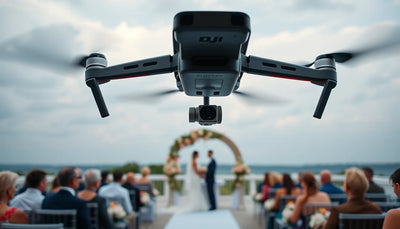
DJI IMU Calibration Guide: When, Why & How to Do It Correctly
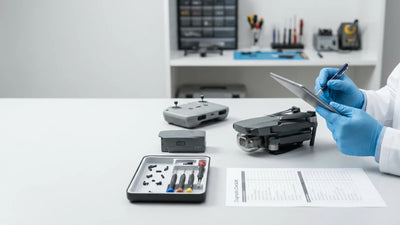
If your DJI drone has ever drifted mid-hover, triggered an unexpected IMU warning, or refused to arm after a firmware update, there is a good chance the Inertial Measurement Unit (IMU) is at the heart of the problem. The IMU is one of the most critical sensors inside every DJI aircraft—it is the component that tells your drone which way is up, how fast it is moving, and whether it is tilting or rotating. When DJI IMU calibration data is off by even a small margin, flight stability, GPS hold accuracy, and return-to-home reliability can all suffer. The good news is that recalibrating the IMU is a straightforward process that anyone can do at home, provided you follow the right steps and understand the common pitfalls that cause calibration failures. Reboot Hub technicians have diagnosed and calibrated over 3,000 DJI IMU modules since 2022, holding MOHRSS Level 3 Advanced Technician certification recognised by China's Ministry of Human Resources and Social Security.
In this guide, written by the technicians at Reboot Hub—a certified DJI repair and pre-owned sales centre operating out of Shenzhen, China—we will walk you through everything you need to know about DJI IMU calibration: what the IMU actually does, when you absolutely must recalibrate, a detailed step-by-step procedure, the importance of a truly flat surface, the most frequent reasons calibrations fail, and how a poorly calibrated IMU can turn a smooth flight into a dangerous one. Whether you fly a DJI Mini 4 Pro, a Mavic 3, an Avata 2, or an Inspire 3, the principles in this guide apply across the board.
What Is an IMU and What Does It Actually Do?

Before diving into calibration, it helps to understand the hardware you are dealing with. An IMU is an electronic module that contains a combination of motion-sensing instruments. In DJI drones, a typical IMU package includes:
- Accelerometers — measure linear acceleration along three axes (X, Y, Z). These tell the flight controller how fast the drone is speeding up or slowing down in any direction, and they also detect the pull of gravity, which is how the drone knows which way is "down."
- Gyroscopes — measure angular velocity (rate of rotation) around three axes. These detect how quickly the drone is pitching, rolling, or yawing.
- Barometric pressure sensor (sometimes integrated nearby) — measures atmospheric pressure to estimate altitude.
Together, these sensors feed raw data to the drone's flight controller hundreds of times per second. The flight controller fuses IMU data with GPS, compass, vision sensors, and other inputs to maintain stable, predictable flight. Many DJI models include two independent IMUs for redundancy. If one IMU's readings diverge significantly from the other, the flight controller can flag an error and even switch to the backup unit mid-flight.
Why the IMU Needs Calibration
No sensor is perfect out of the factory. Over time, offset drift, temperature changes, vibration from hard landings, and even the natural aging of electronic components can cause the raw sensor readings to shift away from their true values. Calibration is the process of measuring these offsets while the drone is stationary on a known flat surface, and then writing correction coefficients into the drone's firmware so that the flight controller can compensate for them in real time.
Think of it like zeroing a set of kitchen scales. If the scales read 20 g when nothing is on them, every measurement will be 20 g too high. IMU calibration is the drone equivalent of pressing the "zero" button.
When Should You Calibrate the IMU?
DJI's firmware will sometimes prompt you to calibrate the IMU automatically, but there are several situations where you should proactively run a calibration even if no warning appears:
1. After a Firmware Update
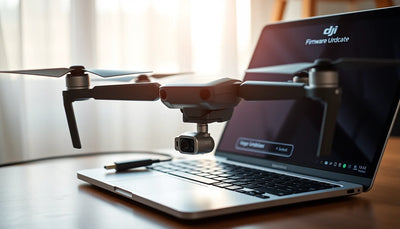
Firmware updates can change how the flight controller interprets IMU data, or they can reset stored calibration values. DJI often recommends (or requires) an IMU calibration after a major firmware revision. If the DJI Fly or DJI GO 4 app prompts you after an update, do not skip it.
2. After a Crash or Hard Landing
Physical impact can shift the position of MEMS sensor dies on the circuit board by microns—enough to introduce meaningful offsets. After any crash, even one that looks minor, recalibrating both the IMU and the compass (see our compass calibration guide) is strongly recommended before your next flight.
3. When Traveling to a Significantly Different Location
Moving from sea level to a high-altitude location (or vice versa) can affect the barometric component of the IMU. Relocating from one hemisphere to another also changes the gravitational vector slightly relative to the drone's frame. If you have shipped your drone across continents, take five minutes to recalibrate.
4. When You See IMU Error Messages
Messages such as "IMU Initialising. Wait", "IMU Data Error", or "Abnormal IMU. Restart Aircraft" in the DJI Fly app are clear indicators. Do not attempt to fly until the issue is resolved. For a full list of IMU-related error codes and their meanings, consult our DJI error codes database.
5. When Drone Drift Is Noticeable
If your drone drifts laterally while hovering in calm wind conditions, or if it tilts noticeably at rest, an IMU calibration may correct the issue. Always rule out wind and compass interference first, but if the problem persists on a calm day in an open field, recalibrating the IMU is the next logical step.
6. Periodically as Preventive Maintenance
DJI does not specify a strict recalibration interval, but many professional pilots recalibrate every 50–100 flight hours or at the start of each flying season. Think of it as an oil change for your drone—a small investment of time that protects against gradual drift.
How to Calibrate Your DJI IMU: Step-by-Step

The calibration procedure is similar across most current DJI models (Mini series, Air series, Mavic series, Avata, FPV, Matrice). The exact menu wording may vary slightly between the DJI Fly app and the older DJI GO 4 app, but the core steps are the same.
Before You Begin — What You Will Need
- A genuinely flat, level surface (more on this in the next section)
- A fully charged battery (at least 50 %; 100 % is preferred)
- No magnetic interference nearby (keep away from metal tables, speakers, motors, or reinforced concrete walls)
- The drone powered on with propellers removed (for safety and to reduce vibration)
Calibration Steps
- Power on the drone and remote controller. Wait for the DJI Fly app to establish a connection. Ensure the drone is on a flat, level surface as described above.
- Open the app settings. Tap the three dots (⋯) in the top-right corner of the camera view, then navigate to Safety → Advanced Settings → Sensors → IMU. On some models the path may be Settings → IMU Calibration.
- Tap "Calibrate". The app will warn you to place the drone on a level surface. Confirm to proceed.
- Phase 1 — Horizontal position. The drone will begin the first calibration phase while remaining in its normal upright position. Do not touch or move the drone during this phase. The LEDs will flash, and the progress bar in the app will advance. This typically takes 1–2 minutes.
- Phase 2 — Rear-facing position. Once Phase 1 completes, the app will ask you to place the drone on its rear end (battery facing down, nose pointing up). Some models may ask for a different orientation—follow the on-screen diagram exactly. Again, keep the drone perfectly still.
- Phase 3 — Right-side position. After the second phase, the app will request a third orientation—typically the drone lying on its right side. Follow the diagram precisely and do not move the drone until instructed.
- Phase 4 — Left-side position. Place the drone on its left side as shown. Let the calibration complete without interruption.
- Phase 5 — Nose-down position. Some models require a fifth orientation (drone resting on its nose). If prompted, position the aircraft accordingly.
- Completion. Once all phases finish, the app will display a "Calibration Successful" message. Power cycle the drone before your next flight.
Important note: Not all DJI drones require all five orientations. Older models and some Mini-series drones may only require the horizontal and one additional position. Always follow the on-screen instructions for your specific model.
Why Does Calibration Surface Flatness Matter So Much?
If there is one single factor that determines whether an IMU calibration succeeds or fails—and whether the resulting calibration is actually accurate—it is the quality of the surface you calibrate on. This point cannot be overstated.
Why Flatness Matters So Much
During calibration, the drone assumes it is resting on a perfectly level plane. The accelerometers measure the raw gravitational vector, and the firmware calculates the offset between the measured values and the expected values (i.e., pure 1 g along the Z-axis and zero along X and Y). If the surface is tilted by even 0.5°, the gravitational vector has components along X and Y, and the calibration will bake in a permanent offset. That offset translates directly into hover drift.
Here is a quick illustration of how a tiny tilt translates into real-world drift:
| Surface Tilt | Lateral Gravity Component | Approximate Hover Drift |
|---|---|---|
| 0.5° | 0.009 g (~0.09 m/s²) | Slow, constant lateral creep |
| 1.0° | 0.017 g (~0.17 m/s²) | Noticeable drift in calm air |
| 2.0° | 0.035 g (~0.34 m/s²) | Fast, aggressive drift; risky near obstacles |
| 3.0°+ | >0.05 g | Calibration may fail; flight is unsafe |
How to Find or Create a Level Surface
- Use a spirit level. Place a bubble level on your calibration surface before placing the drone. If the bubble is centred, you are good to go.
- Granite or glass surfaces work well. Kitchen countertops, glass tabletops, and polished stone floors tend to be flat and level.
- Avoid soft surfaces. Carpet, grass, and uneven decking can cause the drone to sit at a slight angle. Even a yoga mat can introduce enough flex to ruin a calibration.
- Avoid metal surfaces. A metal table can distort the compass and potentially introduce subtle magnetic interference to the IMU sensors as well.
- Check for debris. A single pebble under one motor arm can tilt the frame enough to matter.
If you are in the field and do not have a spirit level, a quick trick is to place a round object (like a marble) on the surface. If it stays put, the surface is level enough. If it rolls, find another spot.
Why Does DJI IMU Calibration Fail — and How Do You Fix It?
Occasionally, the app will report that calibration has failed, or the calibration may "succeed" but the drone still drifts or throws errors on the next flight. Here are the most common culprits, along with how to fix each one.
1. Surface Not Level Enough
As discussed above, this is the number one cause. Even a surface that looks flat may not be level. Re-verify with a spirit level and try again.
2. Drone Was Moved During Calibration
The IMU calibration process is extremely sensitive to vibration and motion. Bumping the table, picking up the drone between phases before the app prompts you, or even a gust of wind hitting the aircraft can corrupt the data. Make sure the drone is completely still throughout each phase.
3. Temperature Is Too High or Too Low

DJI's IMU sensors are MEMS devices that behave differently at temperature extremes. DJI typically recommends calibrating between 0 °C and 40 °C. If your drone has been sitting in a hot car or a cold garage, let it acclimate to room temperature for 15–20 minutes before calibrating. Some models will even refuse to calibrate if the internal temperature is outside the acceptable range.
4. Low Battery Voltage
An inconsistent power supply can cause the sensor readings to fluctuate during calibration. Always use a fully charged battery. If the battery is swollen or degraded, replace it before calibrating—see our DJI battery replacement service for options.
5. Magnetic Interference
While the IMU itself relies on accelerometers and gyroscopes (not magnetometers), strong electromagnetic fields near the IMU chip can still affect readings in subtle ways. Calibrate away from speakers, motors, power transformers, and reinforced concrete walls. An open desk in a room with no electronics nearby is ideal.
6. Hardware Fault
If you have tried all of the above multiple times and the calibration still fails, or if the app continues to show IMU errors after a successful calibration, the IMU hardware itself may be faulty. MEMS sensors can fail after a hard crash, prolonged exposure to extreme vibration (e.g., mounting the drone on a vehicle), or simply due to manufacturing defects. In this case, the IMU module or the entire flight controller board may need to be replaced by a certified technician. A chip-level IMU sensor replacement at Reboot Hub costs $50, compared to $160–220 at authorized service centres in the US and Europe. For full pricing across all DJI models, see the Reboot Hub DJI Repair Cost Database 2026. Contact us at Reboot Hub for a diagnostic assessment.
7. Firmware Bug
Rarely, a firmware update can introduce a bug that prevents IMU calibration from completing. Check DJI's official forums and release notes. If a known bug exists, you may need to wait for a hotfix or downgrade to a previous firmware version using the DJI Assistant 2 desktop tool.
How Does IMU Calibration Affect Flight Stability?
Understanding the downstream effects of a miscalibrated IMU can help you appreciate why this seemingly mundane maintenance task deserves your full attention.
Hover Accuracy
A properly calibrated IMU allows the drone to hold its position within a tight radius (typically ±0.5 m horizontally in GPS mode). A miscalibrated IMU introduces a constant offset that the flight controller tries to compensate for using GPS. However, GPS has its own error margin, and the combination of IMU offset and GPS inaccuracy can result in visible hover drift—sometimes 2–3 metres or more, which is extremely dangerous when flying near buildings, trees, or people.
Altitude Hold
If the accelerometer's Z-axis offset is wrong, the drone may struggle to maintain a consistent altitude. You might see the aircraft slowly climbing or descending even when the throttle stick is centred. This is especially problematic during low-altitude flights or when operating near obstacles.
Return-to-Home (RTH) Accuracy
DJI's RTH function relies on the IMU to maintain stable flight while the GPS guides the drone back to the home point. An inaccurate IMU can cause the drone to oscillate, wobble, or drift during the RTH descent, increasing the risk of a hard landing or a collision with nearby objects.
Autopilot and Intelligent Flight Modes

Modes like ActiveTrack, Waypoints, Point of Interest, and Hyperlapse depend heavily on precise IMU data to execute smooth, predictable movements. A miscalibrated IMU can cause jerky tracking, inaccurate waypoint following, and wobbly Hyperlapse footage. If you are a commercial operator or content creator, these issues can ruin an entire shoot.
Sport and Atti Mode Performance
In Sport mode or ATTI (Attitude) mode, where GPS assistance is reduced or disabled, the drone relies almost entirely on the IMU for stability. A miscalibrated IMU in these modes is particularly dangerous because there is less GPS-based correction to mask the problem. The drone may drift uncontrollably, tilt at unexpected angles, or respond sluggishly to stick inputs.
Motor Stress and Battery Efficiency
When the IMU provides inaccurate data, the flight controller constantly adjusts motor speeds to correct for perceived (but non-existent) errors. This wastes energy, increases motor wear, and reduces flight time. Over hundreds of flights, the cumulative effect on motor bearings and ESC (Electronic Speed Controller) lifespan can be significant.
What Pro Tips Do Our Technicians Recommend for IMU Calibration?
After thousands of calibration procedures in our Shenzhen, China repair lab, our technicians have developed a few best practices that go beyond the basics:
- Calibrate both IMUs. On dual-IMU models (Mavic 3, Inspire 3, Matrice 300/350), make sure you calibrate both units. Some models do this automatically; others require you to select each IMU individually in the app.
- Power cycle after calibration. Always restart the drone after a successful calibration to ensure the new values are fully loaded into the flight controller's memory.
- Combine with compass calibration. If you are performing a full post-crash or pre-season maintenance routine, calibrate the compass after the IMU. The order matters: IMU first, compass second.
- Log your calibration dates. Keep a simple log (spreadsheet or note on your phone) of when you last calibrated the IMU and compass. This is especially important for commercial operators who need maintenance records for compliance.
- Do not calibrate outdoors in direct sunlight. Thermal gradients from sunlight heating one side of the drone can affect sensor readings. Calibrate indoors or in the shade.
- Remove gimbal cover and propellers. A gimbal cover can shift the drone's centre of gravity slightly, and spinning propellers during calibration (even at idle) introduce vibration. Remove both before starting.
Quick Reference: IMU Calibration Checklist
| Step | Action | ✓ |
|---|---|---|
| 1 | Battery charged to 50 %+ (ideally 100 %) | ☐ |
| 2 | Propellers removed | ☐ |
| 3 | Gimbal cover removed | ☐ |
| 4 | Level surface verified with spirit level | ☐ |
| 5 | Away from metal, magnets, and electronics | ☐ |
| 6 | Temperature between 0 °C and 40 °C | ☐ |
| 7 | Drone powered on and connected to app | ☐ |
| 8 | Follow all on-screen orientation prompts | ☐ |
| 9 | Power cycle after completion | ☐ |
Frequently Asked Questions
How often should I calibrate my DJI drone's IMU?
There is no fixed interval mandated by DJI. However, you should calibrate the IMU after every firmware update, after any crash or hard landing, when relocating to a very different altitude or latitude, and whenever the app prompts you. As a preventive measure, calibrating every 50–100 flight hours or at the beginning of each flying season is a sensible practice for professional operators.
Can I calibrate the IMU on a wooden table indoors?
Yes, a sturdy wooden table is an excellent choice—provided it is genuinely level. Verify with a spirit level before placing the drone. Avoid tables with wheels, adjustable legs, or uneven joints. The surface must be rigid enough not to flex under the drone's weight.
Why does my IMU calibration keep failing even on a flat surface?
If the surface is confirmed level and the calibration still fails, the most likely causes are: the drone was bumped or moved during the process, the ambient temperature is outside the recommended range (0 °C–40 °C), the battery voltage is too low, or there is a hardware fault with the IMU chip itself. Try again under controlled conditions, and if it still fails after three attempts, the hardware likely needs professional inspection. A chip-level IMU diagnostic at Reboot Hub costs $50 with results in 2–4 business days.
Is it safe to fly if the app says "IMU data abnormal" but I can still take off?
No. The app may allow you to fly in some cases even with an IMU warning, but doing so is risky. An IMU anomaly means the flight controller may not be receiving accurate attitude or acceleration data, which can lead to unpredictable behaviour—especially in GPS-denied environments, during fast manoeuvres, or in windy conditions. Land as soon as it is safe and recalibrate before your next flight.
Does calibrating the IMU void my DJI warranty?
No. IMU calibration is a standard user-maintainable procedure endorsed by DJI. It does not require opening the drone's shell, and it can be performed entirely through the DJI Fly or DJI GO 4 app. You will not void your warranty by performing this calibration.
What does it cost to replace a faulty DJI IMU sensor?
At Reboot Hub in Shenzhen, China, a chip-level IMU sensor replacement costs $50 using genuine OEM parts with a 90-day warranty. By comparison, authorized service centres in the US and Europe typically charge $160–220 for the same repair—often involving a full board swap rather than a targeted component replacement. Our chip-level approach surgically replaces only the IMU sensor, preserving the rest of the flight controller board. Turnaround is 2–4 business days. For complete pricing across all DJI models and components, see the Reboot Hub DJI Repair Cost Database 2026.
Can I ship my drone to Reboot Hub for professional IMU diagnosis and repair?
Yes. Reboot Hub accepts international shipments for IMU diagnostics and repair. Simply schedule a professional diagnostic assessment on our website, and we will provide shipping instructions. Once we receive your drone, a full IMU diagnostic takes 2–4 business days. If the IMU sensor is confirmed faulty, chip-level replacement costs $50. If the issue is recalibration-only, we will calibrate and return your drone at no extra hardware cost. We hold MOHRSS Level 3 Advanced Technician certification, and all repairs use genuine OEM parts backed by a 90-day warranty.
Reboot Hub · Support
Need Professional Help?
If your drone needs repair after troubleshooting, Reboot Hub offers certified chip-level repair in Shenzhen, China — genuine OEM parts, 90-day warranty.