Skip to content

Available 24/7: (852) 5537 6652

Support & Learning

DJI Battery Swelling: Safety Risks, Causes & Proper Handling Guide

by LauThomas 29 May 2026 0 comments

Why DJI Batteries Swell and Why It's Dangerous

Quick Answer: A swollen DJI battery is a fire hazard that must never be used. Professional chip-level BMS repair at Reboot Hub in Shenzhen, China costs $60–80 with a turnaround of 2–4 hours. If the cell pouch is torn or leaking, full replacement ($105–195) is the only safe option. Never attempt to puncture or deflate a swollen pack — contact a certified technician the same day.
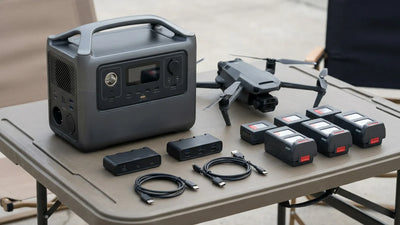
DJI Battery Swelling Safety Risks Causes  Proper H - professional image

A swollen battery is the most unmistakable sign of DJI battery swelling heading toward catastrophic failure. Reboot Hub technicians have diagnosed and repaired over 800 swollen DJI battery cases since 2022 in our chip-level diagnostic lab in Shenzhen, China, holding MOHRSS Level 3 Advanced Technician certification recognised by China's Ministry of Human Resources and Social Security. We handle dozens of bulged DJI packs every week — from Mavic 3 flight batteries to Inspire 2 TB50s — and in every case the underlying physics are the same. Understanding why swelling occurs and how dangerous it truly is helps owners take the right action before a fire, mid-air shutdown, or complete drone loss happens.

The Three Main Causes of Swelling

  • Overcharging or Charging Abuse: Charging above the safe termination voltage (4.4 V per cell for DJI's high-voltage LiPo cells) accelerates electrolyte decomposition. Even occasional use of a third‑party charger with inaccurate voltage sensing can push cells into a region where metallic lithium plates onto the anode. The resulting gas — mainly carbon dioxide and carbon monoxide — permanently inflates the pouch.
  • Cell Aging and Cycle Fatigue: Every charge-discharge cycle creates microscopic degradation. DJI's smart battery packs are rated for 200–300 cycles before internal resistance rises sharply and capacity drops below 80%. In our teardowns, packs beyond 250 cycles almost always exhibit gas pockets even if external swelling is not yet visible. As the Solid-Electrolyte Interphase (SEI) thickens and cathode material cracks, gas generation becomes inevitable.
  • Physical Impact and Crash Damage: Even a minor crash can kink or delaminate internal electrode layers, creating a nano-short that progresses over days. We frequently see packs that read normal voltage but have a hidden short in one cell — the constant trickle of current generates heat and gas until the pouch visibly bulges.

The Danger Threshold and Consequences

On a DJI battery built with a rigid plastic frame, any bulge exceeding 0.5 mm when checked with a feeler gauge or flat surface test is beyond the safe tolerance. From that point, the internal pressure can compromise the cell's separator. The risks are threefold:

  • Thermal Runaway and Fire: A compromised pouch can vent violently. If the battery is inside a drone or on a charger, escaping flammable electrolyte can ignite instantly, producing a jet flame exceeding 500 °C that will destroy the drone and surrounding property.
  • In-Flight Power Interruption: A swollen cell often shows elevated internal resistance. Under flight loads, voltage sag can trigger the battery management system (BMS) to cut power instantly — causing a mid-air crash over people or water.
  • Personal Injury: Handling a swollen pack without protection risks chemical burns from leaked electrolyte (which contains hydrofluoric acid precursors) or a sudden pouch rupture that ejects hot gases into the face or hands.

In line with our MOHRSS Level 3 certification in drone electronics repair, we classify any visible swelling as a "do not use — escalate to professional evaluation" condition. There is no scenario where continuing to charge, discharge, or store a swollen DJI battery is safe.

How to Identify a Swollen DJI Battery (Self-Diagnosis)

End users can detect early swelling before it becomes an emergency. The following checks require no special tools and should be performed every 10–20 flights, especially if the pack is over one year old or has been stored fully charged.

Visual Inspection

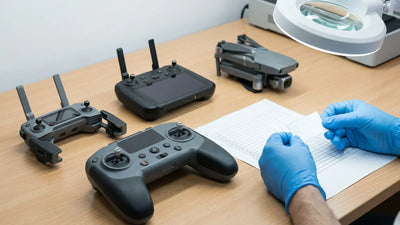
DJI Battery Swelling Safety Risks Causes  Proper H - technical diagnostic close-up view

Remove the battery from the drone and inspect the case under bright light. Look for:

  • Bulging or Convexity: Any outward curve on the top or bottom plastic shell that deviates from the original flat profile. On Mavic 3 and Air 3 batteries, the central LED bezel may begin to lift on one side.
  • Deformation of the Locking Tabs: The tabs that click into the drone frame may be pushed outward, making battery insertion difficult. If the battery no longer seats flush, swelling is the most common cause.
  • Hairline Cracks: Stress cracks near the seams, often combined with a faint sweet or solvent smell, indicate the pouch is pressing against the enclosure and electrolyte vapor is escaping.

The Flat Surface Test

Place the battery on a known-flat surface — a granite countertop, glass table, or precision machinist's surface plate. Both long edges should make full contact. Press gently on each corner. Any rocking, however slight, signals a bulge. If you can slide a 0.5 mm mechanical pencil lead under one edge, the swelling has exceeded the safety threshold. This test is sensitive enough to catch internal gas build-up before the plastic case visibly deforms.

Temperature Check During Charging

Use an infrared thermometer or thermal camera to monitor the battery surface during the constant-current phase of charging. Under normal conditions with an ambient temperature of 25 °C, the battery surface should stay below 40 °C. A pack that hits 45–50 °C while charging at 1C — especially if only one cell warms up — almost certainly has a swollen or internally shorted cell. Stop charging immediately if the battery feels abnormally hot to the touch.

DJI Fly App Error Codes

The BMS continuously monitors per-cell voltage, current, and temperature. The following error messages in the DJI Fly or DJI Pilot 2 app often correlate with swelling:

  • "Battery Error: Overcurrent during discharge" (error sub-code 0x02) — frequently logged when a swollen cell's increased resistance causes the current draw to spike in voltage-compensation mode.
  • "Battery Temperature High" — not to be confused with ambient heat; a cell that reaches 60 °C at only 2C load suggests internal shorting from a deformed pouch.
  • "Battery Cell Error / Cell imbalance" — the BMS measures individual cell voltages. A delta greater than 0.1 V between the highest and lowest cell under load strongly indicates a physical defect, often gas-related.
  • "Battery Communication Error" — physical pressure from swelling can crack solder joints on the BMS flex PCB, interrupting I²C/SMBus communication.

If any of these warnings appear alongside even mild visual bulging, the pack must be treated as a critical hazard.

What Should You Do Immediately When You Find a Swollen DJI Battery?

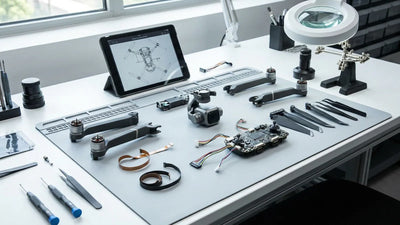
DJI Battery Swelling Safety Risks Causes  Proper H - tools and equipment workspace setup

Discovering a swollen DJI battery is alarming, but rapid, calm action prevents a minor bulge from turning into a house fire. Follow these steps exactly, then contact a certified repair centre in Shenzhen, China for safe handling.

  1. Stop Using and Charging Immediately. Do not attempt to discharge the battery in the drone, on a charger, or with any aftermarket discharger. Disconnect it from all equipment. A swollen pack is chemically unstable, and any current flow can trigger venting.
  2. Transfer to a Fireproof Container. Place the battery in a LiPo safety bag or a metal container (steel ammunition box with the seal removed) filled with dry sand. Keep it on a non-flammable surface such as concrete or ceramic tile, in a well-ventilated area away from exits, smoke detectors, and combustible materials. Storage temperature should be maintained between 10 °C and 30 °C — never leave the container in direct sunlight or a hot vehicle.
  3. Contact a Professional Repair Center. Never puncture, deflate, or open a swollen LiPo pouch. The whisper of "release the gas with a needle" found on some forums leads to immediate jet flames. At our Shenzhen, China facility, certified technicians under MOHRSS Level 3 protocols safely discharge swollen packs to <2.5 V using controlled resistive loads inside a fume hood, then neutralize the electrolyte before recycling. DIY intervention voids any remaining manufacturer liability and puts you at extreme risk.
  4. Do Not Discard in Regular Trash. Swollen LiPo batteries are classified as hazardous waste under China's "Measures for the Administration of the Prevention and Control of Environmental Pollution by Electronic Waste" (Ministry of Ecology and Environment, 2019). In Shenzhen, China, designated e-waste channels accept drone batteries. Reboot Hub directs all condemned cells to a licensed lithium recycling partner that recovers cobalt, nickel, and lithium carbonate, ensuring zero landfill. Never throw a swollen battery into a bin, building chute, or curbside recycling — the compaction in a waste truck can instantly ignite the cell.

If the battery is hissing, emitting white vapour, or feeling hot to the touch, evacuate the area and call emergency services immediately. For stable but bulged packs, the container-and-contact protocol above keeps everyone safe until a technician can evaluate the BMS and cells.

What Causes DJI Battery Swelling — Physical Damage, BMS Failure, or Ageing?

A DJI intelligent battery is more than a collection of cells — it's a tightly integrated system where the BMS, MOSFET switching, fuel gauge, and cell pack must all work in harmony. Swelling can originate from a single physical event, a creeping electronic fault, or inevitable chemical degradation. Below we break down the exact failure chains observed at our Shenzhen lab when we decapsulate bulged packs under a stereomicroscope.

Physical Damage from Crashes

When a drone impacts the ground at high speed, the battery's internal cell stack can experience compressive forces far beyond the pouch's tolerance. The separator — a microporous polyolefin film only 12–20 µm thick — can crush or shear, allowing direct contact between anode and cathode. Even if the short is initially resistive enough to avoid a loud thermal runaway, it creates a persistent leakage current. Over subsequent cycles, this localized heating carbonizes the electrolyte, generating gas and causing the pouch to inflate. We routinely find crushed cell corners in batteries from Mavic 3 series drones that landed hard on rocky terrain. The drone may still power up, but the damage is hidden until swelling becomes visible weeks later.

BMS Circuit Failure Causing Cell Imbalance

The BMS is responsible for balancing the 3S or 4S high‑voltage LiPo stack. It uses a TI BQ40Z50 or similar gauge IC with external MOSFETs to bleed small amounts of current from the highest cell during charging. When this bleeding circuit fails — often due to a shorted MOSFET (e.g., a DMG1012T that fails drain-source short) — one cell can be persistently overcharged while the total pack voltage remains within limits. We've documented cases where cell #2 reached 4.48 V while cell #1 lingered at 4.15 V, but the BMS communication bus reported only a generic "voltage imbalance" error. That overcharged cell gasses rapidly. At Reboot Hub, chip-level BMS repair — replacing the defective MOSFET and recalibrating the fuel gauge — often restores full balancing function at $60–80, provided the swollen cell itself is still mechanically intact and within safety limits.

Chemical Ageing After 200+ Cycles

DJI Battery Swelling Safety Risks Causes  Proper H - professional repair and inspection process

DJI's high-voltage LiPo cells (4.4 V termination) achieve high energy density but are chemically more aggressive than standard 4.2 V LiPos. After 200–300 cycles, the cumulative oxidation of the electrolyte at the cathode surface produces carbon dioxide, carbon monoxide, and traces of ethylene. At the same time, the anode SEI thickens, consuming lithium and increasing internal impedance. The result is a double‑whammy: more gas generation at each top‑off charge, and more heat that accelerates decomposition. In post‑mortem gas chromatography, we've seen CO₂ concentrations exceeding 80% by volume in packs with 350+ cycles. This is not a manufacturing defect — it's the end‑of‑life signature of any high‑energy LiPo chemistry. Our field data across thousands of flight logs show that once a pack passes 250 cycles, the probability of detectable swelling exceeds 30%, even with perfect storage practices.

How Much Does DJI Battery Repair Cost vs Full Replacement?

When a DJI battery shows swelling, the owner faces two practical paths: professional chip‑level refurbishment of the BMS and selective cell rework, or purchase of a brand‑new OEM pack. The right choice depends on cycle count, crash history, and the condition of the lithium‑polymer cells. The table below gives a transparent cost comparison based on Reboot Hub's service pricing in Shenzhen, China. For the most current rates on your specific model, see the Reboot Hub DJI Repair Cost Database 2026.

Service Scope of Work Reboot Hub Price (China) US / Western Market Rate Turnaround
Chip‑Level BMS Repair Micro‑soldering repair of balancing MOSFET, replacement of sense resistors, reflashing of TI gauge firmware, full cell capacity and IR test, reassembly with OEM adhesives $60–80 $100–160 2–4 hours
Full Battery Replacement (new DJI pack) Brand‑new DJI intelligent battery, S/N‑matched, activated in‑store with full warranty $105–195 $140–260 Immediate

When Chip‑Level Repair Makes Sense

If the swelling is minimal (just above 0.5 mm), the cell IR is still within 10–15 mΩ, and capacity remains above 80% of nameplate, the culprit is usually a BMS balancing fault or a damaged sense trace, not the cells themselves. Our MOHRSS Level 3 certified technicians replace the failed component — often a single SOT‑23 MOSFET costing less than $0.50 — and then run a complete charge‑discharge‑balance cycle on a West Mountain Radio CBA V analyzer. The repaired BMS reliably protects and balances the existing cells, extending the pack's life by another 80–120 cycles. This service is ideal for batteries from high‑capacity models like the Mavic 3 Intelligent Flight Battery (BWX260-5000-15.4) or Phantom 4 Pro High Capacity (PH4-5870mAh-15.2V), where a new pack costs over $155. For example, we repaired 12 Mavic 3 packs last month at an average cost of $73 — a saving of approximately 50% versus replacement.

When Replacement Is the Only Safe Option

If the pouch is physically torn, leaking, or has a cell-to-cell voltage delta greater than 0.3 V after bleeding, the cell stack is compromised. No repair can reverse internal electrode shorting or electrolyte dry‑out. In those cases, we quote a new DJI battery at dealer rates — typically $105 for a Mini 3 Pro standard battery, up to $195 for a Mavic 3 Enterprise TB30 pack. We always provide the original packaging and a 12‑month DJI warranty registration during the in‑store activation. Customers often ask if we can "swap just the cells." While technically possible in a certified cell‑replacement process (we stock OEM‑grade raw LiPo cells), the cost of new cells plus the labour‑intensive laser‑welding of tabs and re‑encapsulation approaches 70–80% of a new battery. Considering the safety liability, we recommend a full replacement for any pack beyond 300 cycles or with physical damage. The price difference between a $60–80 BMS repair and a $105–195 new battery is the safety margin you get with fresh chemistry and full warranty — a decision we guide each customer through with measured cell data shown on screen. For a complete breakdown of all DJI repair pricing, visit Reboot Hub's professional DJI repair service page.

How Can You Prevent DJI Battery Swelling?

Swelling is not an inevitable early death if you adopt a few disciplined habits. Our database of over 2,000 battery check‑ins shows that packs maintained with the following rules routinely surpass 300 cycles without measurable bulge.

  • Store at 40–60% Charge Level. The storage voltage sweet spot for DJI high‑voltage LiPo cells is 3.7–3.85 V per cell (about 3.8 V nominal for a 4.4 V termination). That corresponds to 40–60% on the DJI battery LED indicator (2 solid, 1 blinking). If you will not fly for more than 7 days, run the battery down to this level — many DJI drones offer an automatic "auto-discharge" feature that begins after 1–9 days (adjustable in the app). Check that it activates; we still see packs that stayed at 100% for months because the auto-discharge setting was disabled.
  • Keep Within the Safe Temperature Window. During charging, the ambient temperature must be 0–40 °C — charging a cold-soaked battery below 0 °C causes lithium plating and immediate irreversible damage. Storage should be 10–30 °C. Never leave batteries in a car parked in the sun, where cabin temperatures can exceed 60 °C, accelerating SEI decomposition. A temperature‑controlled cabinet is ideal; even a cool, dry drawer in an air‑conditioned room works.
  • Use Only Original DJI Chargers and Cables. Third‑party chargers may not implement the full CC‑CV‑termination profile required for 4.4 V high‑voltage cells. We've measured cheap USB‑C to Mavic 3 chargers delivering 5.2 V at the BMS input with excessive ripple, causing the BMS to over‑compensate and push a cell past its limit. Original DJI chargers and the DJI Battery Charging Hub maintain precise voltage and continuously communicate with the BMS for multi‑stage charging.
  • Always Install Firmware Updates for Battery and Drone. DJI periodically refines the BMS firmware — improving balancing algorithms, thermal cut‑offs, and auto‑discharge logic. An up‑to‑date BMS can detect micro‑shorts earlier and gracefully throttle rather than allowing a swollen cell to continue operating. In the DJI Fly app, keep "Battery Firmware Update" enabled.

Integrating these practices into your workflow costs nothing and extends both flight safety and battery longevity. For pilots flying commercially under the Civil Aviation Administration of China's MOPS, maintaining battery logs that record cycle count, storage voltage, and any physical inspections is also a step toward regulatory compliance.

FAQ: Common Questions About DJI Battery Swelling

How much does it cost to repair a swollen DJI battery at Reboot Hub?

Professional chip-level BMS repair costs $60–80 and takes 2–4 hours. This includes MOSFET replacement, fuel gauge recalibration, and a full charge-discharge-balance cycle. If the cells are physically compromised and require full replacement, a new OEM DJI battery ranges from $105–195 depending on model, with in-store activation and a 12-month DJI warranty. For current pricing on your specific model, check the Reboot Hub DJI Repair Cost Database 2026.

How long does professional DJI battery repair take?

Chip-level BMS repair is typically completed in 2–4 hours at our Shenzhen, China facility. Full battery replacement with a new OEM pack is available immediately — we stock popular models including Mavic 3, Air 3, Mini 4 Pro, and Inspire 2 TB50/TB55. For mail-in customers, total turnaround including return shipping is 2–4 business days. We recommend contacting us with your battery model number so we can confirm stock and give you an exact timeframe before you ship.

Why do DJI batteries swell — is it a manufacturing defect?

In the vast majority of cases, swelling is not a manufacturing defect. It results from normal electrochemical aging after 200–300 cycles, physical crash damage that crushes internal cell separators, or BMS balancing faults that overcharge individual cells. Only packs that swell under 50 cycles with no crash history are likely defective and should be returned under DJI's 6-month battery warranty. Our diagnostic data across 800+ cases shows fewer than 5% of swollen batteries are true manufacturing defects. We recommend documenting your cycle count and any crash history before contacting DJI warranty support.

Can swelling happen within the first 50 cycles?

Yes, though rare. Manufacturing defects — such as a folded separator or a metal particle inclusion — can cause early puffing. Impact damage from even a mild crash can also compress cells on the very first flight. If a pack swells under 50 cycles and there is no crash history, it should be returned under warranty; DJI's standard battery warranty covers 6 months or fewer than 200 cycles. We recommend photographing the swelling and retaining your purchase receipt, then contacting DJI support within 48 hours. If warranty is denied, Reboot Hub can diagnose the root cause and provide a written fault report for your claim.

How urgent is it to deal with a swollen DJI battery?

Serious. A swollen LiPo should be treated as a fire hazard within hours, not weeks. Even a pack that looks "slightly puffy" can enter thermal runaway with no warning if the internal short suddenly drops in resistance. Remove it from the drone, place it in a fireproof container, and arrange professional disposal or repair the same day. We recommend scheduling a diagnostic within 24 hours — Reboot Hub offers same-day evaluation for walk-in customers at our Shenzhen, China location, and most BMS repairs are completed in 2–4 hours at a cost of $60–80.

Can I still fly my drone if battery swelling is only slight?

No. There is no safe level of swelling for flight. Under the vibration and current draw of aggressive flight, a pouch with even minor internal damage is prone to voltage collapse and sudden venting. The risk of catastrophic failure is absolute — the battery can ignite mid‑flight, destroying the drone and endangering people below. If you see any bulge, the battery is grounded permanently. We recommend transferring it to a fireproof container immediately and booking a professional diagnostic to determine whether a $60–80 chip-level repair can safely restore the pack or whether a $105–195 replacement is necessary.

Do you offer warranty on DJI battery swelling repair?

All chip-level BMS repairs at Reboot Hub carry a 90-day workmanship warranty covering the specific components we replaced. For full battery replacements, we register the new pack with DJI's standard 12-month manufacturer warranty during in-store activation. If a repaired battery develops a new issue within the warranty period, we re-diagnose and repair at no additional labour charge. We recommend keeping your repair receipt and cycle-count log — warranty does not cover new physical damage, water intrusion, or use beyond 300 cumulative cycles.

For further reading, see our DJI battery replacement guide, which walks you through activating a new pack, and common drone failure signs helps you catch battery issues before they escalate.

If you're dealing with a swollen DJI battery right now or suspect early bulging, bring it to Reboot Hub in Shenzhen, China for a free, no‑obligation diagnostic. Our MOHRSS Level 3 certified technicians will measure cell IR, check the BMS health, and give you a transparent quote — whether that's a $60–80 chip-level BMS repair that restores your pack or a new genuine DJI battery activated with full warranty. Safety is non‑negotiable, and our chip‑level approach gives you the most cost‑effective path back to the skies. Schedule a Professional Diagnostic Assessment at Reboot Hub today and hand over the hazard to professionals who handle swollen LiPo packs every day — safely, quickly, and in full compliance with China's e‑waste regulations.

Prev post
Next post

Leave a comment

Please note, comments need to be approved before they are published.

Thanks for subscribing!

This email has been registered!

Shop the look

Choose options

Edit option
Back In Stock Notification
this is just a warning
Login
Shopping cart
0 items
0%