Support & Learning / Module 1 of 9
Flight Foundations
What you will understand
- Understand lift, thrust, drag, torque and multirotor control.
- Separate observable evidence from assumptions before choosing an action.
- Continue through the main lesson path or enter a focused topic branch when needed.
Support & Learning
A drone is an aircraft system, not just a camera with propellers
Modern drones make flight look effortless because several systems continuously cooperate: motors and propellers create thrust; a flight controller interprets a pilot request; sensors estimate motion; and the aircraft adjusts motor output to remain on the intended path. Once you understand those relationships, you can ask more useful questions about a first flight, a task, or the exact unit in front of you.
Quick answer
A multirotor flies by turning propellers into controlled thrust. A blade shapes and turns air; the controller changes motor output; sensors report what the aircraft is doing; and the power system has to provide usable energy under real conditions. Bernoulli's principle helps describe the pressure field around an airfoil, but rotor thrust also involves accelerating air downward and the equal-and-opposite reaction on the aircraft.
What is a drone?
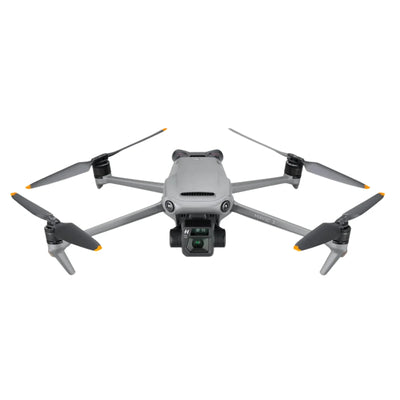
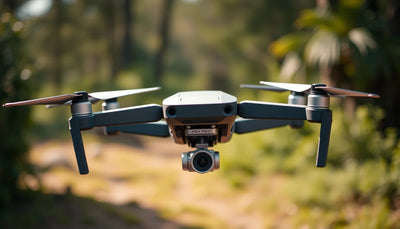
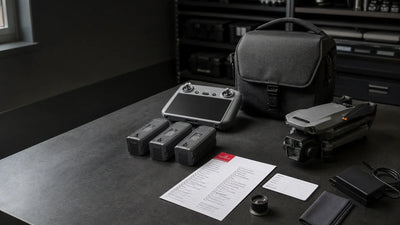
A drone is an unmanned aircraft system. The airframe is only one part of a working setup. A real setup can include an aircraft, propellers, motors, electronic speed controllers, battery, flight controller, radio link, controller, sensors, camera or payload, and the information needed to operate it responsibly. Some functions may be automated on supported models, but the exact model, supplied kit, current condition and operating context always matter more than the word "drone" alone.
How does a propeller turn air into lift?
A drone propeller is a rotating airfoil. As each blade moves through the air at an appropriate angle, it creates a pressure distribution around the blade and changes the direction and speed of the air flowing through the rotor. Across all of the blades, that produces thrust. In a hover, total upward thrust balances aircraft weight; to climb, total thrust increases; to descend in a controlled way, it reduces.

Bernoulli principle, stated carefully
Bernoulli's relationship connects higher local airflow speed with lower static pressure in an idealized flow. It helps describe part of the pressure field around an airfoil, but it is not a standalone "suction" story. The familiar equal-transit-time explanation is incorrect: air flowing over and under a blade does not have to meet again at the same time. At the rotor level, thrust is also understood through accelerating air downward; the airflow momentum change and the pressure forces describe complementary views of the same physical result.

That is why propeller condition is a real flight-system question. Blade geometry, surface condition, model compatibility, rotational speed, airflow, air density, turbulence and aircraft motion all influence what the rotor can do. This is not an invitation to modify components. It is a reason to treat the correct, visibly sound propellers and the aircraft's normal setup guidance as meaningful evidence before flight.
How does a drone move, turn and stay level?
A multirotor does not steer like a conventional airplane with large control surfaces. It creates controlled differences in motor output. The flight controller turns a pilot request into motor commands, then compares the aircraft's measured movement with the intended movement. This is a closed control loop: request, measure, correct, repeat. It is why a hovering aircraft can make continuous tiny corrections without the pilot manually adjusting every motor.
Gyroscopes and accelerometers commonly help estimate rotation and acceleration. Depending on the model, other systems can contribute context such as satellite positioning, barometric altitude estimation, visual positioning or obstacle sensing. These systems can be useful support, but they do not turn a feature list into a guarantee. The exact aircraft, conditions, surroundings and current operating requirements remain part of the decision.


How does power become usable flight time?
The battery supplies energy to the motors and onboard electronics, but energy is not the same as a fixed flight promise. Usable endurance changes with aircraft setup, battery condition, workload, temperature, wind, payload and how the aircraft is flown. A responsible page therefore avoids promising a universal minute figure for a model or a used unit.

What types of drones are used for different jobs?
Multirotors are familiar because they can take off vertically, hover and position a camera or payload precisely. Fixed-wing designs normally trade hover capability for efficient forward flight. VTOL designs combine vertical takeoff with wing-borne flight, and single-rotor platforms use a helicopter-like arrangement. The useful choice depends on the task, operating environment, organization, local requirements and the equipment evidence that can actually be shown.
- Photography and observation: camera, controller, surroundings and actual kit condition affect the outcome.
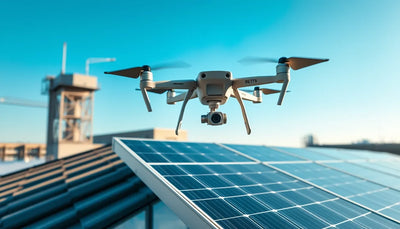
- Inspection, mapping and field work: payload, site context, operator requirements and project evidence should be understood before equipment selection.
- Learning and first flights: model identity, battery condition, propellers, control setup and local requirements are more useful starting points than a generic "best drone" claim.
A learning path from first principles to a real decision
What should you confirm before a first flight or a pre-owned purchase?
This is where a transparent buying path matters. Reboot Hub aims to remove the concerns a customer should not have to guess about: exact-unit condition, supplied kit, visible evidence, remaining unknowns and written terms. That is a materially different decision from relying on a generic model description or a stock image.
Keep exploring
Further reading
From تاريخ Reboot Hub


From أدلة الطائرات بدون طيار