How a 3-Axis Drone Gimbal Works: Stabilization, Parallax and Motion Blur
Read the DJI Matrice 4E technical mapping guide

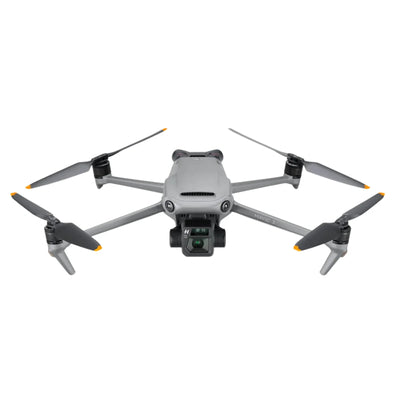
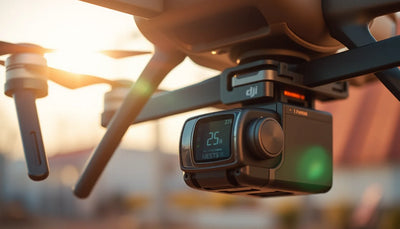
A three-axis drone gimbal controls camera orientation through roll, pitch and yaw. It helps keep the view steady as the aircraft changes attitude, while allowing deliberate framing commands. It does not hold the camera at a fixed point in space, and it cannot guarantee a sharp image of every moving subject. Smooth footage and blur-free individual frames are different requirements.
Roll, pitch and yaw describe rotation
Roll tilts the camera sideways, changing the horizon's slope. Pitch points it upward or downward. Yaw changes its horizontal heading. These are rotations, not three directions of linear travel. DJI's developer documentation describes gimbal attitude and rotational control across these axes; supported commands and modes depend on the product. See DJI's gimbal API reference.
DJI specifies three-axis stabilization for both the Matrice 4E and Matrice 4T. Its specification also distinguishes mechanical ranges from software limits. This matters because the existence of three axes does not imply unlimited movement or unrestricted operator control. Check the Matrice 4 series gimbal specifications for the exact model.
| Axis | Rotation | Typical framing effect |
|---|---|---|
| Roll | Sideways tilt | The horizon slopes left or right. |
| Pitch | Upward or downward tilt | The view includes more sky or ground. |
| Yaw | Horizontal turning | The camera faces a different heading. |
Stabilization and intentional movement must coexist
A useful conceptual model is a feedback loop: the system estimates camera orientation, compares it with the requested orientation and applies motor corrections. Meanwhile, an operator or automated command may intentionally change the requested view. The mechanism must therefore follow useful motion while resisting unwanted disturbance. This is a general engineering explanation, not a disclosure of DJI's internal controller design.
When reviewing a shot, first establish what the camera was asked to do. A slow downward tilt may be the intended composition. Treating every change in the picture as an error would incorrectly reject a successful shot. Conversely, a pleasant-looking pan may still miss the inspection feature that the assignment required.
A stable attitude is not a fixed camera position
The camera travels with the aircraft. If the aircraft moves sideways, the viewpoint moves sideways even while the horizon remains level. Nearby objects then change position relative to distant objects. This parallax is a consequence of changing viewpoint; rotating the camera cannot preserve every depth layer in the same screen position.
Imagine looking past a nearby railing toward a distant building. A lateral camera move changes the railing's alignment against the building. The gimbal can keep the camera aimed consistently, but it cannot make that translation disappear from the entire scene. This illustrative geometry explains why close foreground objects can reveal motion that is less obvious in a distant landscape.
Different disturbances need different diagnoses
Physical travel, actuator response and vibration all constrain stabilization. Camera-shake analysis also distinguishes angular movement from shifting movement, as described in Canon's explanation of image stabilization. That resource concerns camera stabilization generally; it is not a claim that a drone gimbal performs sensor-shift correction.
For an equipment review, describe the symptom before deciding its cause. A tilted horizon, changing foreground alignment and fine repetitive vibration are different observations. Collect the original clip and operating context. Do not conclude that a component needs replacement solely because the final edited video looks unsettled.
Why smooth footage can contain blurred frames
An image accumulates light during its exposure. Movement during that interval can spread a feature across pixels. A moving subject can therefore appear blurred even when the camera's orientation is steady. Canon demonstrates this distinction through slow-shutter photography, including deliberate subject blur while stabilization is enabled. See Canon's slow-shutter examples.
For enterprise work, ask whether the output is intended for motion viewing, individual-frame analysis or both. A clip that feels smooth during playback may not provide a suitable still of a small moving component. Assess the intended deliverable directly instead of assuming one viewing mode proves the quality of another.
Electronic stabilization is another distinct process. It can crop and transform the recorded image to reduce visible movement. Canon's digital stabilization documentation illustrates that processing has its own conditions and limitations. Its behavior should not be assumed for a DJI model merely because both products use the word stabilization.
Gimbal range, operating controls and a useful diagnostic record
The archived source used here is DJI's Matrice 4 Series User Manual v1.2, April 2025. It describes camera tilt control through the remote-controller dial or a vertical touchscreen drag in DJI Pilot 2 on PDF p.30. This establishes a documented control method; it does not mean every stabilization axis is freely available as a manual framing control.
Mechanical travel is different from operator control
DJI's gimbal specification lists mechanical tilt travel of −140° to +50° for 4E and −140° to +113° for 4T. It separately lists controllable tilt of −90° to +35° and −90° to +70°, respectively. Manual pan is not controllable; DJI separately identifies programmatic yaw control through MSDK. Do not use a mechanical endpoint as an operator-command target or force the mechanism toward it.
There is historical context for the 4T's upward tilt: the 15 April 2025 entry in the release notes, PDF p.13, associate support up to +70° with the 15 April 2025 release, aircraft firmware v13.01.00.10 and Pilot 2 v13.1.0.19. That is evidence of when this capability was documented, not a claim that those versions are current. For deployment, record the actual installed versions and check the controls they expose.
A locked angle does not lock the viewpoint
In its POI instructions, the archived manual explains that a PinPoint includes altitude and may require the operator to lock or adjust gimbal angle to look below that point. See PDF p.72. That framing action should not be confused with fixing the camera's physical location.
Illustrative geometry, not flight-test results: assume two initially aligned objects at 10 and 100 metres from a camera. After a 0.2-metre sideways movement with unchanged orientation, their angular shifts are approximately arctan(0.2/10) = 1.146° and arctan(0.2/100) = 0.115°. Their relative alignment changes by about 1.031°. A level horizon does not remove that depth-dependent parallax. These distances are explanatory assumptions, not recommended flying distances.
A separate exposure example shows why steady orientation does not guarantee a sharp subject. If an image feature moves at an assumed 100 pixels per second, it travels approximately 2 pixels during 1/50 second and 0.2 pixel during 1/500 second. Actual blur also depends on the motion path and imaging system. This calculation is not a recommended shutter setting or measured gimbal performance.
Use symptoms to choose the next check
| Observation | First distinction | Evidence or next action |
|---|---|---|
| Foreground shifts against background | Translation versus rotation | Review the camera's movement and scene depth before alleging a fault. |
| Subject smears while framing looks steady | Subject motion versus camera attitude | Inspect original frames and exposure settings. |
| Unexpected persistent drift | Requested framing versus unwanted motion | Record the symptom and follow the manual's troubleshooting route. |
| Gimbal cannot move normally | Obstruction versus software setting | Check protector, unfolded arms and clearances before operation; do not force the axes. |
| Repeated fine vibration | Image-processing appearance versus physical condition | Preserve originals and inspect mounting/dampers through the documented maintenance process. |
The archived manual requires unfolded arms and unobstructed movement on PDF p.30, and describes obstruction-related motor protection on PDF p.31. Its drift troubleshooting instructs IMU and compass calibration in DJI Pilot 2, then DJI Support if the problem persists, on PDF p.101. This is symptom-linked guidance, not a requirement to calibrate everything before every flight.
Maintenance evidence and acceptance
The archived Maintenance Manual v1.0, January 2025, lists gimbal calibration among maintenance items on PDF p.16. On PDF p.12 it calls for checking the damping plate attachment and damper condition, and replacement after more than 200 flying hours or one year through the factory or an authorized dealer. These are dated maintenance instructions; confirm the applicable service guidance for the aircraft rather than treating this article as a repair procedure.
Reboot Hub's recommendation is to retain a repeatable observation record: original clip, selected camera, exposure, intended movement, installed versions and the relevant maintenance history. The manual separately documents aircraft and gimbal attitude fields on PDF p.90; these can provide context where present, but a still-image record is not a high-frequency vibration measurement. Accept the deliverable against required framing and visible detail. Escalate a persistent abnormal symptom with evidence instead of repeatedly changing settings without recording the result.

Sources and further reading
Read the DJI Matrice 4E technical mapping guide
Frequently asked questions
Can I manually command the full mechanical tilt range?
No. Mechanical travel and controllable range are different specifications. Use the range supported by the actual aircraft and software; never push the camera to a mechanical limit by hand to test a feature.
Why does the 4T have a different upward tilt figure from the 4E?
DJI lists different controllable tilt ranges, and archived April 2025 release notes document the 4T's support up to +70°. Record installed versions and consult the applicable specification; do not transfer the 4T capability to the 4E.
Does locking gimbal angle prevent parallax?
No. A locked or steady orientation does not stop aircraft translation. Objects at different distances shift by different amounts as the viewpoint moves, so nearby and distant objects can change alignment while the horizon remains level.
When does the archived manual recommend calibration for drift?
Its troubleshooting section directs IMU and compass calibration in DJI Pilot 2 for gimbal drift, followed by DJI Support if it persists. Maintenance documentation separately lists gimbal calibration. Follow the relevant symptom and current aircraft instructions rather than inventing a universal preflight calibration schedule.
What maintenance detail is relevant to vibration?
The January 2025 maintenance manual addresses damping-plate attachment and damaged, loose, aged or deformed dampers. It also gives a 200-hour/one-year replacement instruction through service channels. Check applicable current service guidance and retain the maintenance record.
What proves that stabilization is adequate for our task?
Use original footage and representative frames to assess required framing and detail, with exposure and intended camera movement recorded. A pleasing preview, a level horizon or a three-axis label alone does not prove that the inspection deliverable meets its acceptance criteria.
Keep exploring
Further reading
From The Reboot Hub Chronicle

From Drohnenführer