Перейти к содержимому

Available 24/7: (852) 5537 6652

Will a DJI Drone from China Work in Kenya for Agricultural Spraying? Firmware and Region Lock 2025

к LauThomas 22 Jun 2026 0 комментарии

Quick Answer

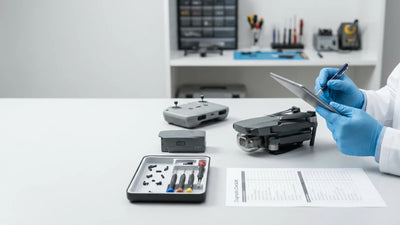
Will a DJI Drone from China Work in Kenya for Agricultural S - drone on repair bench with diagnostic tools nearby
  • Yes, DJI Agras drones purchased in China work in Kenya for agricultural spraying in 2025 — DJI's agricultural line (T50, T40, T25) uses the DJI Agriculture platform, which does not impose the same geofencing or region-lock restrictions found on consumer drones like the Mavic or Air series.
  • Firmware is switchable to international/global mode — units sourced from Shenzhen can be configured with global firmware via DJI Agriculture app, enabling full RTK and spray functionality across Kenyan farmland without forced location-based restrictions.
  • Pre-owned DJI Agras T40 (Grade A) starts at $8,950 USD — roughly 40–50% below new retail, fully inspected, with genuine OEM parts and a 180-day warranty from Reboot Hub.
  • DDP shipping from Shenzhen to Nairobi takes 10–14 days — all import duties, VAT, and customs clearance are included in the price Reboot Hub quotes, eliminating surprise fees at Jomo Kenyatta International Airport.
  • Kenya Civil Aviation Authority (KCAA) requires a Remote Aircraft Operator Certificate (ROC) for commercial spraying — the drone itself faces no hardware-based region block, but operators must comply with local registration and licensing.

Do DJI Agras Drones Have Region Locks in 2025?

The short answer: DJI's agricultural spraying drones — the Agras T50, T40, T25, and legacy T30 — operate on a fundamentally different software architecture than DJI's consumer and enterprise photography drones. Where a DJI Mavic 3 or Air 3S purchased in mainland China may encounter firmware-level restrictions when powered on outside China (including mandatory real-name verification tied to a Chinese phone number and potential flight altitude caps), the Agras line runs on DJI Agriculture, a platform designed for global commercial deployment from the outset.

Related: Stille Drohne für Indoor Hochzeit in der Kirche Deutschland:

In practice, an Agras T40 purchased in Shenzhen and shipped to a maize farm in Nakuru County will boot up normally, connect to RTK positioning via local base stations or the built-in GNSS receiver, and begin spraying operations without triggering a regional lockout. The firmware can be set to "Global" or "Non-Mainland China" mode during initial setup in the DJI Agriculture app (available on both iOS and Android). DJI has not applied the same transmission power restrictions or altitude ceilings to Agras drones that affect consumer models in certain territories. This is by design: agricultural users operate BVLOS (beyond visual line of sight) over large acreage, and DJI recognizes that a region-locked sprayer drone is commercially non-viable. That said, buyers should confirm the specific firmware version with their supplier. Reboot Hub pre-configures every Agras unit to international firmware before dispatch, a step that takes under 15 minutes but saves end users from troubleshooting on the ground in Kenya.

Related: CAAI Rules for Personal Import of a Used DJI Mini 3 Pro from

What Are the Best DJI Agricultural Drones for Kenyan Farms in 2025?

Kenya's agricultural landscape spans smallholder tea farms in Kericho (often under 2 hectares), medium-scale maize and wheat operations in the Rift Valley (10–50 hectares), and large commercial estates growing sugarcane, coffee, and horticultural exports. The DJI Agras lineup in 2025 offers three primary models that map neatly onto these use cases.

The DJI Agras T50 is the flagship. It carries a 40-liter liquid payload (or 50 kg of dry granular material with the spreading attachment), covers up to 21 hectares per hour at a spray width of 8 meters, and features dual atomized spraying discs with peristaltic pumps delivering 24 liters per minute. For a large-scale wheat farmer in Timau managing 200 hectares, one T50 running two battery cycles per day can cover the entire property in under a week. New retail pricing hovers around $19,800 USD (approximately HK$154,500). Pre-owned Grade A units from Reboot Hub — flown under 25 hours, zero visible marks — are priced at $12,500 USD.

The DJI Agras T40 remains the workhorse for mid-sized operations. Its 40-liter tank, 10-meter spray width, and active phased-array radar for terrain following make it ideal for undulating tea plantations in Nyeri where consistent altitude above crop canopy is critical. New T40 units retail for roughly $14,200 USD (HK$110,800). Reboot Hub's pre-owned T40 (Grade A+) starts at $8,950 USD, a 37% saving. For smaller farms, the DJI Agras T25 with a 20-liter payload and 7-meter spray width covers 12 hectares per hour and is priced at $5,800 USD pre-owned (Grade A) — a realistic entry point for a cooperative serving multiple smallholders.

Model Payload Coverage/Hour Spray Width New Price (USD) Reboot Hub Pre-owned (Grade A)
DJI Agras T50 40L liquid / 50kg dry 21 ha 8 m $19,800 $12,500
DJI Agras T40 40L liquid 15 ha 10 m $14,200 $8,950 (A+)
DJI Agras T25 20L liquid 12 ha 7 m $9,500 $5,800
DJI Agras T30 (Legacy) 30L liquid 16 ha 9 m Discontinued $4,200 (limited stock)
Pricing accurate as of Q2 2025. Pre-owned units include 180-day warranty, 40-point inspection, and DDP shipping.

How Does Firmware Configuration Affect Agras Drone Operation in Kenya?

Will a DJI Drone from China Work in Kenya for Agricultural S - laptop screen showing DJI firmware update software

Firmware is the single most common concern voiced by Kenyan buyers considering a China-sourced drone, and it deserves a detailed answer. DJI agricultural drones ship with region-specific firmware builds, but unlike consumer drones, the Agras series does not enforce a hard geographic lock based on the unit's initial activation country. The firmware determines three operational parameters: transmission power (which affects control range), RTK correction source compatibility, and the default map service loaded in the DJI Agriculture ground station app.

An Agras drone set to mainland China firmware defaults to the BeiDou satellite system as its primary GNSS constellation and uses Amap (AutoNavi) for mapping, which offers no usable detail for Kenyan terrain. When switched to global firmware — a 20-minute process using DJI Assistant 2 for Agriculture on a Windows laptop — the drone shifts to GPS+GLONASS+Galileo+BeiDou multi-constellation reception and integrates with map services that display Kenyan topography accurately. Transmission power on global firmware operates at FCC levels (up to 7 km control range in open terrain), which is fully legal under KCAA guidelines for licensed agricultural operators. The switching process does not void the warranty when performed correctly, and Reboot Hub handles this configuration before shipping every unit.

One nuance: DJI occasionally releases firmware updates that reset certain regional parameters. Kenyan operators should disable automatic firmware updates in the DJI Agriculture app and manually review release notes before applying any update. As of Q2 2025, firmware version 04.01.02.xx (released March 2025) has been tested and confirmed stable for East African operations by multiple commercial spraying services in Kenya, Uganda, and Tanzania.

What Are Kenya's Drone Regulations for Agricultural Spraying in 2025?

The Kenya Civil Aviation Authority (KCAA) published the Civil Aviation (Unmanned Aircraft Systems) Regulations, 2020 and has since issued amendments through 2024 that directly affect agricultural drone operators. The regulatory framework is functional, though operators must navigate three specific requirements. First, any drone used for commercial agricultural spraying — regardless of where it was purchased — must be registered with the KCAA at a cost of KSh 3,000 (approximately $23 USD) for the initial registration and KSh 80,000 ($620 USD) for the Remote Aircraft Operator Certificate (ROC), which is the commercial operating license. The ROC application requires proof of training, an operations manual, and evidence of insurance.

Second, the KCAA mandates that agricultural spraying drones weighing over 25 kg (which includes all Agras models when fully loaded) undergo a type-acceptance review. DJI Agras T40 and T50 have already been type-accepted, as documented in KCAA's updated UAS type-acceptance list published January 2025. This means a Kenya-bound Agras drone faces no additional airworthiness hurdle.

Third, operators must file a NOTAM (Notice to Airmen) request at least 48 hours before any spraying operation within 10 km of an aerodrome. For most farmland in Kenya's agricultural heartlands — Bomet, Eldoret, Kitale, Nanyuki — this is rarely a constraint, as spraying typically occurs well outside controlled airspace. The practical takeaway: Chinese-market Agras drones comply with KCAA technical standards without modification. The regulatory burden falls on the operator, not the hardware.

Why Buy from Reboot Hub?

Reboot Hub occupies a specific position in the agricultural drone supply chain that addresses the three friction points Kenyan buyers face when sourcing from China: quality assurance, firmware readiness, and landed-cost transparency. Every pre-owned DJI Agras drone sold through Reboot Hub undergoes a 40-point inspection at the company's Shenzhen facility, covering motor bearing play, ESC thermal performance, pump calibration accuracy, radar module sensitivity, battery cycle count, and frame integrity. Only genuine OEM replacement parts — sourced directly from DJI's authorized component distributors in Shenzhen — are used when a part fails inspection. No third-party batteries, no aftermarket spray pumps, no refurbished flight controllers labeled as "new."

Reboot Hub offers a 180-day warranty on all agricultural drones, double the industry-standard 90 days offered by most pre-owned resellers. The company's Hong Kong drop-off point for repairs (with chip-level diagnostics by MOHRSS Level 3-certified technicians) means a drone requiring service can be couriered to HK, repaired in 3–5 working days, and returned via DDP shipping — a turnaround that keeps a commercial spraying operation running during peak season. DDP (Delivered Duty Paid) shipping means the price quoted includes all Kenyan import duties (typically 16% VAT plus 2.5% import duty on agricultural equipment), customs brokerage fees, and last-mile delivery to the buyer's address in Nairobi, Eldoret, or any other Kenyan city. No hidden costs at JKIA customs.

Frequently Asked Questions

Will a DJI Drone from China Work in Kenya for Agricultural S - drone USB-C port connected for firmware transfer

Q: Will a DJI Agras drone bought in China bind to a Kenyan DJI Agriculture account?

A: Yes. The DJI Agriculture platform uses a global account system. You create an account using your Kenyan email address and phone number (+254), log into the DJI Agriculture app, and bind the drone's serial number. There is no requirement for a Chinese phone number or WeChat verification on the agricultural platform, unlike DJI's consumer drone ecosystem. The binding process takes under 5 minutes and establishes you as the registered operator for warranty and support purposes. Reboot Hub provides a step-by-step binding guide with every shipment.

Q: What is the total landed cost of a pre-owned Agras T40 shipped to Nairobi via DDP?

A: A Grade A+ DJI Agras T40 from Reboot Hub is priced at $8,950 USD. DDP shipping to Nairobi adds approximately $680 USD, which covers air freight (Shenzhen → Hong Kong → Nairobi, 10–14 days), Kenyan import duty (2.5% on agricultural equipment classified under HS Code 8807.10), 16% VAT, customs brokerage, and last-mile truck delivery. The total landed cost is roughly $9,630 USD. No additional fees are payable on arrival. The same unit new from a Nairobi-based DJI dealer costs approximately KSh 1,850,000 ($14,300 USD), making the pre-owned route a 33% saving.

Q: Can I use a DJI Agras drone for spraying without an RTK base station in rural Kenya?

Will a DJI Drone from China Work in Kenya for Agricultural S - controller displaying firmware update confirmation

A: Yes, though with a caveat. All Agras models (T25 through T50) feature a built-in GNSS receiver capable of standalone positioning with roughly 1.5-meter accuracy without an RTK correction source. For broadcast spraying of pesticides over maize or wheat, this is functionally adequate. However, for precision spot-spraying — common in horticulture and coffee — RTK correction delivering 2 cm accuracy is strongly recommended. In Kenya, RTK corrections can be sourced through the DJI D-RTK 2 mobile base station (priced at roughly $1,200 USD new, or $680 pre-owned from Reboot Hub) or via NTRIP services where cellular coverage permits. Safaricom's 4G network covers most agricultural regions and supports NTRIP caster connections reliably.

Q: How do I handle repairs if my Agras drone develops a fault in Kenya?

A: Reboot Hub's repair workflow is designed for international customers. The buyer contacts Reboot Hub's support team with a description and photos of the issue. If the problem requires physical repair, the drone is couriered (at Reboot Hub's expense during the 180-day warranty period) to the Hong Kong service center, where MOHRSS Level 3-certified technicians perform chip-level diagnostics and component replacement using genuine OEM parts. Turnaround is 3–5 working days from receipt. The repaired unit is shipped back via DDP. For minor issues — a clogged spray nozzle, a loose propeller — Reboot Hub's support team guides the operator through self-service fixes via video call, avoiding unnecessary shipping.

Q: Does the DJI Agras warranty apply globally, or only in the country of purchase?

A: DJI's official manufacturer warranty is region-specific. A drone purchased in mainland China carries a warranty valid only through DJI's China service centers. Kenyan buyers who purchase direct from Chinese e-commerce platforms often discover this limitation after a fault occurs. Reboot Hub addresses this gap by providing its own 180-day independent warranty that supplements any remaining DJI manufacturer coverage. Repairs under Reboot Hub's warranty are performed at the company's Shenzhen and Hong Kong facilities, and the warranty covers all major components including flight controller, ESCs, motors, radar modules, spray pumps, and batteries (battery warranty is 90 days).

Q: What training or certification is required to operate an agricultural drone in Kenya?

A: KCAA requires commercial agricultural drone operators to hold a Remote Aircraft Operator Certificate (ROC), which costs KSh 80,000 ($620 USD) and requires completion of an approved training course. Several Kenyan institutions now offer UAS training, including the Kenya School of Flying (Nairobi) and Avionics Kenya. The training typically covers air law, meteorology, flight planning, and practical spraying operations over 5–10 days at a cost of KSh 45,000–70,000 ($350–540 USD). Additionally, operators handling chemical pesticides must comply with Pest Control Products Board (PCPB) regulations regarding chemical handling and application.

Q: Are spare parts for DJI Agras drones readily available in Kenya?

A: The Kenyan market for agricultural drone spare parts is developing but remains limited as of 2025. A small number of Nairobi-based suppliers stock consumables — spray nozzles, peristaltic pump tubing, propellers, and batteries — for the Agras T40 and T30. However, less common components such as RTK modules, radar sensors, and ESCs typically require ordering from China or Hong Kong with a 7–14 day lead time. Reboot Hub maintains a spare parts inventory specifically for its customers and can express-ship critical components within 4–6 days via DHL. Many professional operators in Kenya mitigate downtime by purchasing a second pre-owned unit as a backup, a strategy made financially viable by Reboot Hub's pricing.

Q: How many battery cycles can I expect from a pre-owned Agras battery?

A: DJI's intelligent flight batteries for the Agras series (model DB800 for T40/T50, rated at 8,000 mAh) are specified for 600 charge cycles before capacity drops below 80% of the original rating. Reboot Hub's 40-point inspection includes a full battery health diagnostic using DJI's Battery Station software. Pre-owned units sold at Grade A or A+ include batteries with fewer than 80 cycles and a guaranteed capacity above 95% of factory specification. Each battery is priced at $480 USD new; Reboot Hub includes two batteries with every Agras purchase and offers additional pre-owned batteries at $260 USD each with a 30-day warranty.

Предыдущий пост
Следующий пост

Оставить комментарий

Обратите внимание: комментарии должны быть одобрены перед публикацией.

Спасибо за подписку!

Этот адрес электронной почты зарегистрирован!

Купить образ

Выберите варианты

Редактировать вариант
Back In Stock Notification
this is just a warning
Авторизоваться
Корзина
0 предметы
0%