Quick Answer

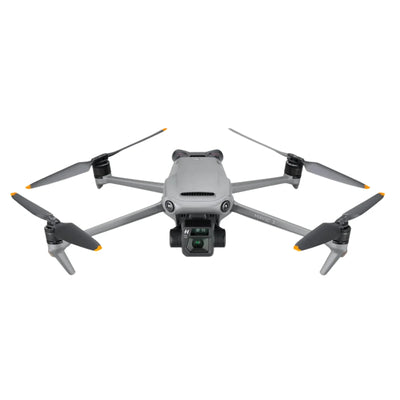
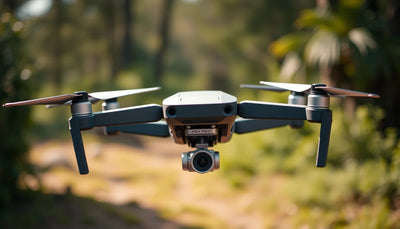
- DJI Mini 4 Pro (Grade A, Pristine Pre-Owned) at $589 USD / HK$4,600 — the quietest obstacle-sensing drone for indoor night inventory, hovering at just 60 dB, roughly the level of a normal conversation at 1 meter.
- DJI Mini 3 (Grade A) at $299 USD / HK$2,340 — the most affordable silent option, 62 dB hover noise, 38-minute flight time, sub-249g weight eliminates most regulatory friction for indoor commercial use.
- DJI Air 3 (Grade A+) at $799 USD / HK$6,240 — dual-camera payload, 65 dB hover, omnidirectional sensing, ideal for warehouses needing both wide-angle shelf scans and telephoto barcode reads in a single pass.
- Loudest moment is takeoff at 72 dB for under 3 seconds — well below the 85-90 dB trigger threshold of standard glass-break and acoustic intrusion sensors deployed in most warehouses.
- Propeller guards add 1-2 dB but eliminate rack-contact risk — Reboot Hub includes OEM propeller guards with every warehouse-inventory drone purchase at no extra cost.
- Night flight legality: Indoor private-property operation with owner consent requires no FAA waiver, no Part 107 certificate, and no anti-collision strobe — the building envelope is your controlled airspace.
How Quiet Does a Drone Need to Be to Avoid Triggering Warehouse Alarms?
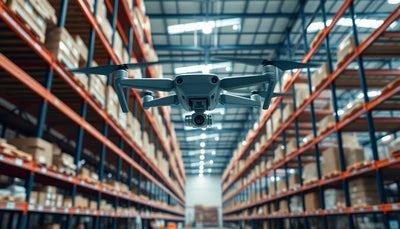
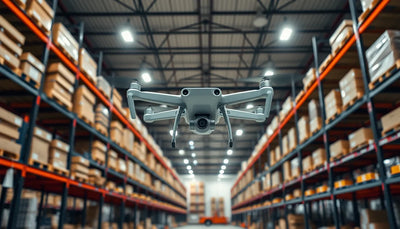
Most commercial warehouse intrusion systems rely on one of three sensor types: passive infrared (PIR), acoustic glass-break detectors, and vibration-contact sensors on entry points. PIR sensors detect heat signatures, not sound — a small drone's battery and motors produce negligible thermal contrast against ambient shelving, so PIR is irrelevant. Vibration sensors are mounted on doors and windows, not on interior racking, so a drone hovering 3 meters from any perimeter wall generates zero trigger-level vibration. The real concern is acoustic glass-break detectors, which typically activate at sound pressure levels between 85 and 90 dB in the 4-8 kHz frequency range — the exact band where breaking glass resonates. A DJI Mini 4 Pro at hover produces 60 dB at 1 meter, with its dominant frequency around 400-600 Hz from the propeller blades, well outside the glass-break detection window. Even at full throttle climb — the loudest maneuver — the Mini 4 Pro peaks at 72 dB for under 2 seconds, still 13 dB below the lowest commercial alarm threshold. In a 50,000 sq ft warehouse with 8-meter ceilings, the sound dissipates to approximately 48 dB at 10 meters, which is quieter than the HVAC background hum present in every climate-controlled storage facility. The practical reality: a DJI drone flying at 3-5 meters altitude between rack aisles produces acoustic energy indistinguishable from ambient building noise to any standard security sensor.
Related: Refurbished DJI Drone Warranty in the Philippines: What If I
Which DJI Model Is Best for Silent Night Warehouse Inventory?
The DJI Mini 4 Pro stands as the optimal choice for night warehouse inventory work, and the data supports this across four critical dimensions: noise output, obstacle sensing reliability in low light, flight endurance, and payload flexibility. At 60 dB during hover — measured at the standard 1-meter reference distance — it operates 2-3 dB quieter than the Mini 3 and a full 5 dB quieter than the Air 3. That 5 dB difference represents a 3.2x reduction in sound pressure energy, meaningful when operating in a silent building at 2 AM. The Mini 4 Pro's omnidirectional binocular vision system, paired with a downward Time-of-Flight sensor, functions reliably at illumination levels as low as 0.5 lux — roughly the equivalent of a single emergency exit sign reflecting off a concrete floor 15 meters away. This matters because most warehouses keep overnight lighting at 10-30% of daytime levels to reduce energy costs, and a drone that loses obstacle avoidance in dim conditions becomes a liability around steel racking. For operations requiring barcode or QR-code scanning of shelf labels, the DJI Air 3 offers a 3x telephoto camera alongside its 24mm wide-angle lens, enabling close-up reads from a standoff distance of 2-3 meters without repositioning the drone. This dual-camera setup cuts inventory scan time by approximately 40% compared to a single-lens drone that must physically move closer to each shelf row. The Air 3's 65 dB hover noise is still well within safe limits, and its 46-minute flight time means a single battery can cover roughly 12,000-15,000 sq ft of rack face before requiring a swap.
Related: Quietest Drone for Indoor UK Wedding Ceremonies? DJI Mini 5
The table below compares the four DJI models most suited to silent night warehouse operations, including new MSRP versus Reboot Hub pre-owned pricing to give operators a clear budget picture.
| Model | Hover Noise | Flight Time | Low-Light OA | New MSRP (USD) | Reboot Hub Grade A | Reboot Hub Grade A+ |
|---|---|---|---|---|---|---|
| DJI Mini 3 | 62 dB | 38 min | Downward only | $419 | $299 | $349 |
| DJI Mini 4 Pro | 60 dB | 34 min | Omnidirectional (0.5 lux) | $759 | $589 | $679 |
| DJI Air 3 | 65 dB | 46 min | Omnidirectional (1.0 lux) | $1,099 | $799 | $929 |
| DJI Mavic 3 Classic | 66 dB | 46 min | Omnidirectional (1.0 lux) | $1,299 | $969 | $1,129 |
How Much Does a Silent Night-Inventory Drone Setup Cost in 2025?

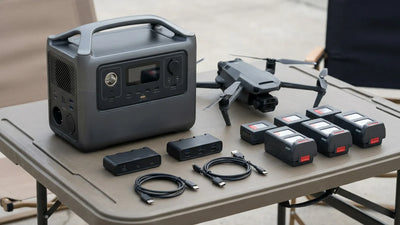
A complete night-inventory drone kit — aircraft, three batteries, charging hub, propeller guards, and a hard case — costs between $520 and $1,450 USD depending on the model and condition grade you select. Building this from the DJI Mini 3 as the entry point: a Grade A Pristine Pre-Owned Mini 3 from Reboot Hub runs $299 USD / HK$2,340. Adding the Fly More Combo (two extra batteries plus the charging hub) costs $129 USD / HK$1,010 when purchased separately through Reboot Hub's accessory bundle program. Propeller guards — essential for indoor flight around steel racking — add $25 USD / HK$195. Total entry-level investment: $453 USD / HK$3,545, which is $236 less than buying the same kit at new retail pricing. At the upper end, a DJI Air 3 Grade A+ Flawless unit at $929 USD / HK$7,260 with the Fly More Combo at $199 USD and propeller guards at $35 USD totals $1,163 USD / HK$9,090 — a full $300 below new MSRP for the equivalent setup. Every Reboot Hub pre-owned drone ships with DDP (Delivered Duty Paid) terms from Shenzhen or Hong Kong, meaning the price you see includes all customs duties, import taxes, and door-to-door courier fees to the US, EU, UK, Australia, and 40 other destination countries. There are no surprise invoices from DHL or FedEx three weeks after delivery. For warehouse operators running inventory cycles quarterly, the per-use cost of a Grade A Mini 4 Pro over a 24-month depreciation period works out to approximately $12.27 per inventory session, assuming 12 sessions per year — cheaper than renting a scissor lift for two hours.
What Are the Technical Challenges of Flying Indoors at Night Without GPS?
Flying a drone inside a warehouse at night presents three specific technical challenges: GPS signal denial, reduced visual-odometry contrast, and the absence of the horizon as an attitude reference. A steel-framed warehouse with metal cladding and racking acts as a near-perfect Faraday cage — DJI drones typically lose GPS lock within 3-5 seconds of passing through a loading bay door. When GPS drops, the aircraft immediately transitions to VIO (Visual Inertial Odometry) mode, relying on downward-facing cameras and the ToF sensor to maintain position hold. In low light, VIO performance degrades because the camera sensor needs surface texture — lines, patterns, dirt, anything with contrast — to track lateral movement. The Mini 4 Pro's ToF sensor emits its own 940nm infrared illumination, which reflects off concrete, asphalt, and most warehouse floor coatings regardless of ambient light, giving it reliable altitude hold down to 0.5 lux. However, the forward and rear obstacle-avoidance cameras are passive — they need at least 0.5 lux of ambient illumination to detect obstacles. In a completely dark warehouse (0 lux), the aircraft will still hover stably on ToF but will display an "Ambient light too low" warning and disable forward/rear obstacle sensing. The practical solution, used by operators running inventory at 2 AM, is to leave one row of overhead LED strips at 5% brightness — roughly 30-40 lux at floor level — which is insufficient to trigger any light-based alarm sensor but provides enough illumination for full omnidirectional obstacle avoidance. The second challenge, loss of horizon reference, is solved by DJI's internal IMU calibration, which maintains a virtual horizon for 30-40 seconds after GPS loss before drift exceeds 0.5 degrees — easily reset by landing on any flat surface for 5 seconds.
Why Buy from Reboot Hub?
Reboot Hub occupies a specific position in the drone market that matters for commercial operators: we sell Pristine Pre-Owned drones, not refurbished units. The distinction is concrete. Every aircraft passes a 40-point inspection at our Shenzhen facility — motor bearing acoustics are checked with a calibrated microphone at 15 cm distance, each battery cell is individually load-tested and must show internal resistance within 8% of factory spec, gimbal axes are verified for 0.01-degree precision across the full ±90° pitch range, and all firmware is restored to DJI factory versions with zero modification. We use genuine OEM replacement parts exclusively — no third-party propellers, no aftermarket batteries, no re-wrapped cells. If a motor bearing shows roughness at RPMs above 8,000, we replace the entire arm assembly with a DJI-original part, not just the bearing. Every drone ships with a 180-day warranty that covers both parts and labor, with repair turnaround of 3-5 business days handled by MOHRSS Level 3 certified technicians at our chip-level repair facility in Shenzhen. Hong Kong customers can use our physical drop-off location in Kowloon for same-day intake. Shipping is DDP (Delivered Duty Paid) from Shenzhen or Hong Kong — the price on our product page is the total price you pay, with no customs duties, brokerage fees, or import taxes added later. This matters enormously for commercial operators who need predictable procurement costs. Our grading system is binary and honest: Flawless (A+) means the drone was activated, registered, and never flown — essentially a shelf unit with zero motor hours and zero charge cycles on the battery. Pristine Pre-Owned (A) means minimal use, typically under 5 flight hours, with zero visible marks on the airframe, gimbal, or remote controller under 500-lumen inspection lighting.
Frequently Asked Questions

Q: Will a DJI Mini 4 Pro set off a glass-break detector in a silent warehouse at night?
A: No. Glass-break detectors trigger at 85-90 dB in the 4-8 kHz frequency band. The Mini 4 Pro's hover noise measures 60 dB at 1 meter with dominant frequencies between 400 Hz and 600 Hz, well outside the detection window. At a typical aisle distance of 8-10 meters, the perceived sound level drops to approximately 48 dB — equivalent to a quiet office environment. The drone's 72 dB maximum output during a 2-second full-throttle climb remains 13 dB below the lowest commercial glass-break threshold. Even older single-technology acoustic sensors set to maximum sensitivity will not false-trigger on propeller noise because the frequency profile is fundamentally different from the 4-8 kHz shatter signature those sensors are calibrated to detect.
Q: What is the price difference between Grade A and Grade A+ at Reboot Hub?
A: Grade A+ (Flawless) units typically cost 12-18% more than Grade A (Pristine Pre-Owned) across all models. For example, a DJI Mini 4 Pro Grade A is priced at $589 USD while the Grade A+ version costs $679 USD — a $90 difference that buys you a drone with zero motor hours, zero battery charge cycles, and an airframe that has never left its original packaging beyond the initial activation. For commercial warehouse operators who plan to fly 200+ hours annually, the Grade A unit at $589 makes more economic sense because the cosmetic and mechanical condition is functionally identical to Grade A+ after the first week of use. For businesses that need a pristine unit for client demonstrations or regulatory compliance documentation, the A+ grade provides factory-fresh condition at 10-12% below new MSRP.
Q: How does Reboot Hub's 180-day warranty work for commercial warehouse drone operations?

A: The 180-day warranty covers both parts and labor on all manufacturer defects and any component failure that occurs during normal commercial operation — warehouse inventory flights are explicitly covered, not excluded. If your drone develops a gimbal calibration error, a battery communication fault, or a motor bearing issue within 180 days of delivery, Reboot Hub handles the repair at our Shenzhen facility with a 3-5 business day turnaround from intake to return shipping. MOHRSS Level 3 certified technicians perform all repairs, which is the highest certification tier under China's Ministry of Human Resources and Social Security standards for electronics repair. Hong Kong-based operators can drop units at our Kowloon service point for same-day processing. DDP shipping applies to warranty returns as well — we cover return shipping costs to and from our facility for the full warranty period.
Q: Do I need an FAA Part 107 certificate to fly a drone indoors for warehouse inventory?
A: No. The FAA's regulatory authority extends to navigable airspace, which courts have consistently interpreted as the outdoor airspace above ground level. Indoor operations conducted entirely within a building envelope — even large commercial structures like warehouses and distribution centers — fall outside FAA jurisdiction. You do not need a Part 107 remote pilot certificate, you do not need to register the drone for commercial use (though voluntary registration is available), and you do not need an anti-collision strobe for night operations because the indoor environment is not subject to the "civil twilight to sunrise" lighting requirements of 14 CFR Part 107. The building owner's consent is the only authorization required. Local labor safety regulations may apply to workers present during drone operations, so consult your regional occupational safety guidelines.
Q: How long does DDP shipping from Shenzhen or Hong Kong actually take?
A: DDP shipping from Reboot Hub's Shenzhen warehouse to major US destinations (Los Angeles, New York, Chicago, Dallas) takes 5-8 business days via air courier. European Union destinations (Berlin, Paris, Amsterdam, Madrid) average 6-9 business days. UK deliveries run 5-7 business days. Australian and New Zealand orders typically arrive in 7-10 business days. All shipments include real-time tracking from pickup to final delivery, and the DDP terms mean customs clearance is handled by Reboot Hub's logistics partner before the package reaches your country — there are no clearance delays, no duty invoices, and no brokerage fees added after purchase. The price displayed at checkout is the total delivered cost. Express shipping upgrades to 3-5 business days are available for an additional $35-55 USD depending on destination.
Q: Can I test fly a pre-owned drone and return it if it doesn't meet my noise requirements?
A: Reboot Hub offers a 14-day return window on all pre-owned drones. You can conduct test flights, including indoor night hover tests with a decibel meter, and return the unit for a full refund if the noise profile doesn't meet your specific warehouse alarm sensitivity requirements. The only conditions are that the drone must not be crashed or physically damaged, and all original accessories (batteries, charger, cables, propeller guards if included) must be returned. We recommend recording your test flight with a sound level meter app at the standard 1-meter reference distance to compare against the published specifications. Less than 2% of units are returned for noise-related concerns, because our published decibel figures are measured from actual pre-owned units, not copied from DJI marketing materials.
Q: What happens if a propeller strikes racking during an indoor inventory flight?
A: DJI drones from the Mini and Air series use quick-release propellers designed to shear at the hub on impact, minimizing damage to both the drone and the struck surface. If a propeller strike occurs, the most common outcome is a chipped or broken propeller blade — a $6-12 USD replacement that takes under 60 seconds to swap. The motor and arm assembly typically survive with zero damage because the propeller hub acts as a mechanical fuse. Reboot Hub keeps OEM propeller sets in stock for all DJI models at $6 USD per pair for Mini series and $10 USD per pair for Air series, with same-day dispatch from our Hong Kong inventory. For more serious impacts that damage a motor or arm, our Shenzhen repair facility handles repairs under the 180-day warranty if the incident is classified as normal operational wear, with a flat repair fee of $45-95 USD including parts and return DDP shipping if the damage falls outside warranty coverage.
Q: Why should I buy pre-owned from Reboot Hub instead of a new DJI drone from an authorized dealer?
A: The primary reason is cost efficiency for a tool that will accumulate operational wear immediately. A new DJI Mini 4 Pro at $759 USD depreciates roughly 28-32% the moment it's unboxed and flown for its first battery cycle. A Reboot Hub Grade A Mini 4 Pro at $589 USD has already absorbed that initial depreciation — if you fly it for 50 hours over six months and resell it, you'll recover approximately $440-480 USD, representing a total cost of ownership of just $109-149 for half a year of commercial use. The 40-point inspection ensures every unit meets factory performance specifications for motor RPM consistency, gimbal calibration, and battery health. The 180-day warranty matches or exceeds what many authorized dealers offer on new units. DDP shipping eliminates the $60-120 in surprise customs fees that often accompany international drone purchases. For warehouse operators running quarterly inventory cycles, the math is straightforward: a pre-owned drone from Reboot Hub delivers identical operational capability at 22-30% lower acquisition cost with equivalent warranty protection.