Drone Camera Zoom Explained: Optical, Digital and Multi-Camera Views
Updated 1 October 2026. Source-based editorial analysis using the Matrice 4 Series manual v1.2 (April 2025) and maintenance guidance v1.0 (January 2025), where relevant. Calculations are illustrative, not flight-test results. Document editions are identified so readers can check their installed configuration.
Read the DJI Matrice 4E technical mapping guide

Optical zoom changes the optical image before capture; digital zoom enlarges information already captured. Switching between separate cameras is a third mechanism. These can look similar on a drone controller, but they do not provide identical information. For inspection work, evaluate the original image and the feature you need to identify, rather than the displayed zoom number alone.
What optical framing changes
A lens projects an image onto a sensor. Focal length, sensor size and working distance determine how much of the scene fits into that image. At a comparable distance, a narrower field of view can place a subject across more sensor pixels. That creates an opportunity to record finer detail, provided the optics, focus and conditions can resolve it. Edmund Optics explains the relationship between focal length, field of view and working distance.
This matters when the task is specific. Locating a component in a structure requires contextual coverage; reading a small marking on that component requires sufficient captured detail. Neither view replaces the other. A useful inspection record connects an overview to a close view so another person can identify both the location and the finding.
Matrice 4: distinguish camera selection from continuous optical zoom
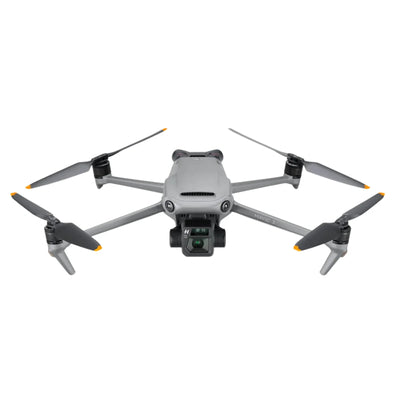
DJI lists separate wide, medium tele and telephoto cameras for the Matrice 4 series. Their published equivalent focal lengths are 24 mm, 70 mm and 168 mm. The wide-camera sensor also differs between the Matrice 4E and 4T. These are specifications for distinct camera systems, not proof that one lens continuously changes focal length through every intermediate setting. See the DJI Matrice 4 series specifications.
When comparing two files, record which camera made each one. Otherwise, a result attributed to a zoom setting could also reflect a different sensor, aperture, processing mode or exposure. A smooth interface transition is convenient for framing, but the inspection record should preserve the capture identity behind that transition.
| Mechanism | What changes | What to check |
|---|---|---|
| Continuous optical zoom | The lens changes focal length within its designed range. | Actual lens specification and image quality at the selected setting. |
| Camera switching | A different lens and sensor combination supplies the view. | Camera identity, exposure and original-file characteristics. |
| Digital enlargement | A smaller portion of captured information fills the output. | Whether the required feature exists clearly in the source image. |
What digital enlargement can and cannot do
Digital zoom can make an existing feature easier to see on a small display. It does not turn an unrecorded feature into a measurement. Canon's digital-zoom documentation illustrates the distinction between optical capture and magnified output, while noting increased visibility of noise and grain at greater enlargement. That source concerns a Canon camera, not a Matrice operating specification. Read Canon's digital-zoom explanation.
A simple pixel example
Suppose a marking occupies eight pixels across in the source image. Enlarging the display may represent that marking across many more output pixels, but the original eight-pixel sampling remains the starting information. This is an illustrative example, not a resolution claim for a particular aircraft. It helps explain why screen size alone is a weak acceptance criterion.
For reporting, keep the original file alongside any crop or enhanced version. Label transformations that could affect interpretation. If a processed image seems to reveal a critical crack, character or edge that is ambiguous in the original, treat that discrepancy as a reason for additional evidence rather than as a confirmed finding.
A manual-grounded way to compare zoom images
Our archived reference is the DJI Matrice 4 Series User Manual v1.2, April 2025. Its camera diagram identifies the wide, medium tele and tele cameras on both models, with additional thermal and near-infrared hardware on the 4T. See PDF p.29. A procurement comparison should preserve those identities rather than treating all views as output from a single interchangeable camera.
The relevant camera distinctions
The DJI specifications list these visible-light camera combinations: 4E wide, 4/3-inch and 20 MP; 4T wide, 1/1.3-inch and 48 MP; medium tele, 1/1.3-inch and 48 MP; tele, 1/1.5-inch and 48 MP. Equivalent focal lengths are 24, 70 and 168 mm for wide, medium tele and tele respectively. These separate cameras must not be described as a single continuously variable optical zoom lens.
A listed effective pixel count is not a promise that every selected mode produces that many output pixels or resolves that many independent details. Begin with the actual original file, then identify the camera and mode. The archived manual's interface separates camera selection from zoom control: R1/R2 control zoom on PDF p.63, while L1/L2 switch the lens on PDF p.64. That is a practical reason to log more than the displayed magnification.
Worked example: why a crop loses area rapidly
Illustrative arithmetic, not a claim about DJI's internal zoom pipeline: start with a hypothetical 4000 × 3000-pixel image. A crop enlarged two times in each linear dimension uses a 2000 × 1500-pixel region: 3 million source pixels, or one quarter of the original area. A four-times linear crop uses 1000 × 750 pixels: 750,000 source pixels, or one sixteenth of the original area.
The general relationship is retained area fraction = 1 divided by the square of the linear crop factor. Output software may save either crop at a larger pixel dimension, but that does not increase the amount of original sampled area. This model assumes one source image and a simple crop; it does not model camera switching, multi-frame processing or proprietary enhancement.
For a buyer, the useful question becomes: how many usable source pixels describe the required feature, and are its boundaries repeatable? File size, nominal megapixels and a large zoom number are insufficient substitutes. A label that is readable only after one aggressive enhancement deserves a different confidence statement from a label consistently readable in multiple originals.
Define the acceptance task before the demonstration
| Task | Capture evidence | Acceptance question |
|---|---|---|
| Locate an asset | Overview with surrounding context | Can another reviewer identify the correct asset? |
| Read an identifier | Original close image and a repeat capture | Are the required characters consistently distinguishable? |
| Assess a small feature | Originals plus clearly labeled crops | Does the feature persist without contradictory processing artifacts? |
| Compare cameras | Camera identity, mode and comparable conditions | Are differences attributable to the capture rather than an uncontrolled comparison? |
| Repeat an inspection | Route, framing and positioning records | Can the second visit document the same target meaningfully? |
These are proposed decision questions, not guaranteed detection distances or manufacturer thresholds. Define the actual required characters, feature or decision in the brief. It is much easier to approve a clear identifier than to argue afterward about whether an image appears sufficiently sharp.
A documented limit for repeat inspection workflows
The archived April 2025 manual describes AI Spot-Check with a zoom camera, photographs within a 10× zoom range, RTK enabled, and consistent RTK base-station coordinates between initial photography and re-flight. See PDF p.76. This is a workflow-specific historical requirement, not the camera's total zoom limit. Confirm behavior against the installed software before adopting the procedure.
Reboot Hub's interpretation is that repeatability needs both an image and its collection context. Preserve originals, ImageSource when present, a contextual overview, the selected mode and any enhancement history. The manual documents ImageSource on PDF p.90. If an export drops the field, keep a separate capture record instead of guessing later.
For a Matrice 4T sourcing discussion, ask the supplier to demonstrate your actual evidence task and supply the original files. A dramatic close view is useful communication; a defensible comparison additionally needs traceable camera identity and a clear criterion for success.

Sources and further reading
Read the DJI Matrice 4E technical mapping guide
Frequently asked questions
Does Matrice 4 use one continuous optical zoom lens?
The documented system has separate wide, medium tele and tele cameras. Do not infer one continuously variable optical lens from a smooth zoom interface. Identify the camera supplying each view and distinguish switching from digital enlargement.
Are the 4E and 4T wide cameras interchangeable in a comparison?
No. Their sensor and effective-pixel specifications differ. Compare the actual camera, capture mode and original file under comparable conditions rather than attributing every difference to the aircraft's zoom setting.
How much image area remains after a 4× digital crop?
In a simple crop model with four-times enlargement in each linear dimension, one sixteenth of the original area remains. This is geometry, not a description of every DJI zoom mode or its processing pipeline.
Does a 48 MP specification guarantee a readable inspection label?
No. Readability depends on how the label is sampled and resolved in the actual capture. Require the necessary characters to be consistently distinguishable in representative originals, with camera identity and conditions retained.
What does the archived manual say about AI Spot-Check zoom?
The April 2025 v1.2 manual specifies a zoom camera and photography within 10× for this workflow, with RTK enabled and consistent base-station coordinates for re-flight. This is a dated workflow condition, not a claim about the aircraft's maximum zoom.
What should accompany an enhanced inspection crop?
Keep the original, contextual overview, camera and mode record, and a clear account of processing. If a critical feature is ambiguous or inconsistent across originals, report that uncertainty rather than letting enlargement imply certainty.
Keep exploring
Further reading
From Cronica Reboot Hub

From Ghiduri de drone