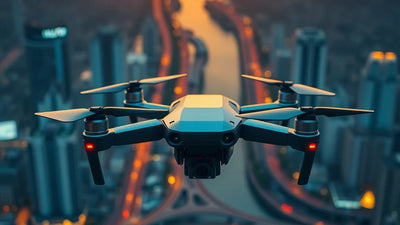
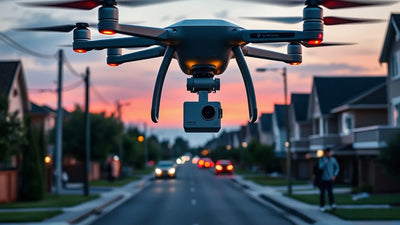
South Korea Takes the Lead: New Drone Traffic Policy Reshapes the Commercial Airspace
On June 11, 2026, South Korea’s Ministry of Land, Infrastructure and Transport (MOLIT) unveiled a landmark drone traffic management (UTM) policy, mandating real-time remote ID, strict BVLOS route authorization, and heavy fines for non‑compliance. Immediate disruption to commercial surveying, agricultural, and logistics operations. Operators face urgent fleet retrofits or airspace bans — a seismic shift for the second‑hand drone market.

Editorial notes
- This article combines named outside reporting with Reboot Hub's own analysis for drone buyers, fleet operators, repair customers, and pre-owned DJI market watchers.
- Source facts are separated from interpretation. When a report provides limited data, the article states that limitation and frames Reboot Hub's view as analysis.
- Reboot Hub has commercial links to drone products and repair services; those links are reader resources and do not determine the article's conclusion.
On June 11, 2026, South Korea’s Ministry of Land, Infrastructure and Transport (MOLIT) officially rolled out a comprehensive drone traffic management (UTM) framework, marking one of the most aggressive government interventions in the global UAV industry to date. The policy, reported earlier today by 매일경제, requires all drones operating within the country’s airspace to be registered, equipped with real‑time remote ID transmitters, and restricted to pre‑authorized BVLOS (Beyond Visual Line of Sight) corridors. The move is designed to integrate unmanned aircraft into South Korea’s existing air traffic control system, a step that regulators say is essential for scaling commercial drone operations.

The announcement sent shockwaves across the Asia‑Pacific drone community. South Korea is a major market for both new and refurbished drones, and its regulatory direction often influences policy in neighboring Japan, Taiwan, and even parts of Southeast Asia. For commercial operators — from precision agriculture specialists in Jeolla to infrastructure inspectors in Seoul — the new rules mean immediate operational constraints and mandatory hardware upgrades. The policy’s enforcement date is set for September 1, 2026, giving operators less than three months to comply.
Breaking Down the New UTM Framework
MOLIT’s UTM system, in development since 2024, creates a digital infrastructure that constantly tracks every airborne drone. Each unit must broadcast a unique identification signal (remote ID) that includes the operator’s registration number, the drone’s current GPS coordinates, altitude, velocity, and a “flight intent” vector. All data must be transmitted in real time to a central airspace management portal. Any drone failing to transmit — either due to hardware malfunction or deliberate tampering — will be automatically flagged, and the operator may face suspension or a fine of up to ₩50 million (roughly $37,500 USD).
Operator checklist
Turn policy news into a safer fleet decision.
Before changing aircraft, compare repair paths, available DJI inventory, and trade-in timing against the rule change.
Additionally, all BVLOS flights — which account for the vast majority of commercial surveying, mapping, and inspection missions — now require a digital route authorization submitted at least 48 hours in advance. The approval process includes a collision‑risk assessment against manned aircraft, weather windows, and ground‑hazard mapping. While MOLIT promises a “fast‑track” for routine missions in low‑risk zones, observers note that the paperwork burden could slow down operations for smaller firms and independent pilots.
The policy also introduces new equipment standards: all drones heavier than 250 grams must be equipped with a MOLIT‑certified remote ID module. These modules, tested by the Korea Institute of Aviation Safety Technology (KIAST), must be tamper‑proof and broadcast at a minimum power of 20 dBm. For older drone models — particularly second‑hand units that were originally manufactured without remote ID hardware — this creates a compliance barrier. Operators may either retrofit their existing fleet with certified add‑on modules or purchase newer, compliant hardware.
Immediate Impact on Commercial Pilots and the Second‑Hand Market
The regulatory shift carries profound consequences for the everyday drone pilot and the broader second‑hand drone ecosystem. For commercial operators, the pressure to upgrade is immediate. A drone that lacks remote ID or cannot easily be retrofitted is now effectively grounded for any revenue‑generating flight in South Korean airspace after September 1. This includes widely used refurbished models such as the DJI Phantom 4 Pro V2.0, the DJI Mavic 2 Enterprise Advanced, and even some early‑generation Matrice 300 RTK units. Operators who rely on affordable second‑hand gear to keep overhead low now face a difficult choice: invest in aftermarket remote ID modules (which may cost up to ₩300,000 per drone) or scrap their fleet and buy newer, natively compliant models.
For the used drone market, this policy will accelerate a shift in buyer preferences. Drones with full UTM compliance — such as the DJI Mavic 3 Enterprise, Matrice 350 RTK, or Autel Alpha — are likely to increase in value, while non‑compliant legacy units will drop sharply. Savvy buyers and sellers on platforms like Reboot Hub are already noticing the trend: a certified unit with remote ID commands a 15–20% premium over an uncertified equivalent. Investors in the second‑hand market should monitor this regulatory inflection point closely, as the window to offload non‑compliant inventory is closing fast.
Ready to Upgrade Your Fleet?
Browse our collection of inspected pre-owned DJI drones — inspected, flight-tested, and backed by a 6-month warranty. Save up to 40% versus retail.
What Does This Mean for Drone Manufacturers and Aftermarket Parts?
The new standard effectively creates a mandatory “remote ID ecosystem.” For manufacturers like DJI, Autel Robotics, and Skydio, the policy reinforces their existing efforts to embed remote ID into new hardware. DJI, for instance, has produced native‑remote‑ID versions of its Matrice 350 RTK since 2024, but many older units — including the popular Mavic 2 series — were discontinued before such features became standard. For owners of those legacy units, the only path forward is retrofitting with a third‑party remote ID module certified by KIAST. Companies like Dronetag and uAvionix already sell such modules, but availability in South Korea may initially be constrained, driving up prices and creating a short‑term market squeeze.
For the aftermarket repair and refurbishment industry, this is both a challenge and an opportunity. A drone repair technician who can integrate a certified remote ID module, verify its broadcast compliance, and log the update in the national registry will be in high demand. Reboot Hub, as a platform offering professional DJI repair services, is positioned to help operators navigate this transition. Upgrading a fleet’s firmware, installing compliant transmitters, and performing post‑retrofit flight tests are services that many smaller operators lack the technical capacity to handle internally.
The policy also carries implications for drone resale value. A drone that has been professionally retrofitted with an approved remote ID module will command a higher price than one left as‑is. This dynamic is already visible on Reboot Hub’s marketplace, where listings for refurbished Matrice 300 RTK units explicitly note “UTM Ready” with a price premium in line with installation cost. We anticipate that by the end of 2026, any drone listed without remote ID compliance will be considered a “grounded asset” by smart buyers.
Q: How does this policy compare to FAA Part 107 remote ID requirements?
While the FAA’s Remote ID rule (Part 89) also requires broadcast modules, South Korea’s policy is more stringent in several key areas. First, the FAA allows both broadcast and network‑based remote ID; South Korea mandates only broadcast‑based, real‑time transmission. Second, the FAA exempts drones under 250 grams, while South Korea sets a lower threshold of 250 grams but applies the rule to all drones used commercially regardless of weight. Third, the penalty structure in South Korea — potential suspension and fines up to ₩50 million — is substantially higher than the FAA’s civil penalties (up to $32,139 per violation). Furthermore, the South Korean system integrates directly with national air traffic control, meaning a drone that deviates from its approved BVLOS corridor could trigger an immediate intercept by manned enforcement aircraft.
Q: Will this policy affect the export of used drones from South Korea?
Potentially. A drone that has been physically modified with a South Korean remote ID module may still be exportable, but it must be converted back to an unregistered state or the module must be removed. Buyers in other countries — especially those with their own remote ID rules — will need to verify compatibility. This creates friction for cross‑border transactions. For international buyers looking at the South Korean second‑hand market, it’s safest to purchase drones that have not yet been retrofitted, or to work with a trusted refurbisher like Reboot Hub that can de‑configure the unit for global use.
Q: Is there any waiver or grace period for smaller operators?
MOLIT has stated that a six‑month grace period will apply exclusively to hobbyist pilots who fly only within visual line of sight (VLOS) in designated non‑controlled zones. Commercial operators — including those with fewer than five drones — must comply fully by September 1, 2026. No blanket waiver exists for small businesses. However, MOLIT is offering a subsidy program of up to ₩500,000 per drone for operators who install approved remote ID modules before the deadline. The subsidy is capped at two drones per business, which may still leave operators with larger fleets facing significant costs.
As the September deadline approaches, the drone industry’s attention is riveted on this regulatory milestone. South Korea’s aggressive rollout of a nationwide UTM system is a harbinger of what other countries may soon adopt. For commercial pilots, the message is unmistakable: the era of unregulated drone airspace is ending. The only smart move is to upgrade your fleet now — whether via a retrofit or a purchase of pre-owned DJI drones that already meet the new standard. At Reboot Hub, we are working around the clock to test, certify, and offer compliant inventory, and to help our customers with professional upgrades. The future of flight is managed, and the future is here.
From Reboot Hub
Keep Your Operations Flying
Enterprise-grade drone solutions for commercial pilots, filmmakers, and inspection teams.
Pre-owned Fleet
Fully inspected DJI drones with 6-month warranty. Save up to 40%.
Browse Inventory ->