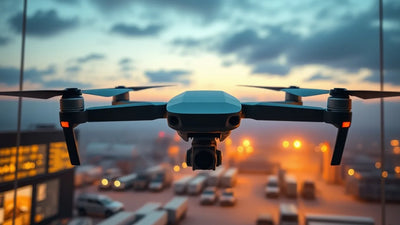
Red Cat’s Quaze Acquisition: Wireless Power Removes the Last Drone Endurance Barrier
Red Cat Holdings acquires Quaze Technologies to integrate wireless power transfer into its Teevee and all-domain drone systems, eliminating the single greatest constraint on persistent BVLOS operations. This move directly challenges legacy battery-swap logistics and opens the door for indefinite airborne loitering in defense ISR missions. For commercial operators, the technology signals a paradigm shift in fleet endurance, with immediate implications for the used drone market as older battery-dependent platforms face obsolescence.

Editorial notes
- This article combines named outside reporting with Reboot Hub's own analysis for drone buyers, fleet operators, repair customers, and pre-owned DJI market watchers.
- Source facts are separated from interpretation. When a report provides limited data, the article states that limitation and frames Reboot Hub's view as analysis.
- Reboot Hub has commercial links to drone products and repair services; those links are reader resources and do not determine the article's conclusion.
In a move that redefines the operational ceiling for tactical unmanned systems, Red Cat Holdings has officially closed its acquisition of Quaze Technologies. Announced on May 21, 2026, the deal integrates Quaze’s patented wireless power transfer (WPT) technology directly into Red Cat’s all-domain drone ecosystem, including the flagship Teevee platform. For defense analysts, commercial operators, and the broader drone industry, this is not a routine merger—it is a fundamental removal of the single most persistent bottleneck in unmanned aviation: endurance.
The acquisition addresses a problem that has plagued drone operators since the dawn of the industry: the tyranny of the battery. Whether flying a DJI Mavic 3 for a mapping mission or a Red Cat Teevee for a persistent ISR (Intelligence, Surveillance, and Reconnaissance) operation, every pilot has faced the countdown clock of diminishing voltage. Quaze’s wireless power solution changes that equation entirely, offering the potential for drones to loiter indefinitely without landing for battery swaps or wired charging.

What the Quaze Acquisition Means for Red Cat’s Defense Portfolio
Red Cat’s acquisition of Quaze Technologies is a strategic masterstroke in the defense drone sector. The company’s Teevee drone, already a favorite among U.S. and allied military units for its rapid deployment and thermal imaging capabilities, has been hamstrung by flight times typically under 40 minutes under combat loads. By embedding Quaze’s wireless power receivers into the airframe and pairing them with ground-based transmitters, Red Cat can now offer a persistent airborne sensor platform that never needs to return to base for a recharge.
Fleet readiness
Keep DJI hardware available without overbuying new units.
Use this news as a planning signal for inspected DJI aircraft, repair support, and trade-in timing.
This capability is a game-changer for BVLOS (Beyond Visual Line of Sight) operations. Under FAA Part 107 waivers and DoD exemptions, drones have been limited by battery endurance. With wireless power, a Teevee could theoretically orbit a target for hours or days, receiving power via directed RF beams or inductive pads placed at forward operating bases. The implications for force protection, border surveillance, and counter-UAS operations are profound. Red Cat effectively renders the concept of “drone endurance” obsolete in the tactical domain.

Furthermore, this acquisition aligns Red Cat with the Pentagon’s broader push for autonomous logistics and reduced human footprint. The ability to recharge drones without manual intervention reduces the need for ground crews in contested environments. It also allows for automated launch and recovery systems that can keep a fleet of drones airborne around the clock, a capability that directly supports the U.S. Army’s Future Tactical Unmanned Aircraft System (FTUAS) requirements.

Ready to Upgrade Your Fleet?
Browse our collection of inspected pre-owned DJI drones — inspected, flight-tested, and backed by a 6-month warranty. Save up to 40% versus retail.
How Wireless Power Disrupts the Commercial and Second-Hand Drone Market
Ready to Upgrade Your Fleet?
Browse our collection of inspected pre-owned DJI drones — inspected, flight-tested, and backed by a 6-month warranty. Save up to 40% versus retail.
While the primary narrative around Red Cat’s Quaze acquisition is defense-focused, the commercial downstream effects are equally significant. For everyday drone pilots and commercial operators who rely on platforms like the DJI Matrice 350 RTK or the Autel EVO Max 4T, the concept of wireless power transfer represents a looming paradigm shift. Today, the vast majority of commercial drones—including those used for precision agriculture, infrastructure inspection, and public safety—are battery-dependent. A typical flight mission lasts 25 to 45 minutes, after which the drone must land for a battery swap or recharge. This cycle limits productivity, increases labor costs, and creates operational gaps.
Quaze’s technology, if adapted for commercial use, could eliminate those gaps. Imagine a DJI Mavic 3E conducting a photogrammetry mission over a construction site, returning to a wireless charging pad every 30 minutes for a five-minute top-up, then resuming its flight path without human intervention. The efficiency gains for mapping, surveying, and inspection workflows would be dramatic. For public safety agencies using drones for search and rescue, the ability to maintain a persistent aerial view without landing for battery swaps could mean the difference between life and death.
This technological leap also has a profound impact on the used drone market. As wireless power becomes a standard feature on new defense and commercial platforms, older battery-dependent drones will face accelerated depreciation. Operators looking to upgrade their fleets will increasingly seek out pre-owned platforms that are compatible with wireless charging infrastructure. At Reboot Hub, we are already seeing increased demand for pre-owned DJI drones that can be retrofitted or replaced with next-generation systems. The secondary market is a bellwether for industry trends, and the Quaze acquisition signals that endurance is no longer a spec sheet metric—it is a core operational requirement.
What Does This Mean for BVLOS Operations and Regulatory Compliance?
One of the most significant hurdles to widespread BVLOS adoption has been the risk of battery failure mid-mission. The FAA’s Part 107 waiver process for BVLOS requires operators to demonstrate robust contingency plans for loss of power. Wireless power transfer, as pioneered by Quaze and now owned by Red Cat, offers a direct solution: drones can receive power in-flight or during automated landings, effectively eliminating the power failure risk. This could accelerate the FAA’s approval of BVLOS waivers for both defense and commercial operations.
For operators in the United States, this is a critical development. The FAA’s 2024-2026 roadmap for advanced air mobility explicitly calls for technologies that enhance safety and reliability. Wireless power fits squarely into that framework. Red Cat’s acquisition positions the company to lead the charge in setting industry standards for persistent drone operations, potentially influencing future regulations around autonomous recharging and continuous flight.
In Europe, EASA is similarly focused on enabling BVLOS for infrastructure inspection and emergency services. The ability to demonstrate a drone that can operate indefinitely without human intervention for battery swaps aligns with EASA’s vision of automated U-space operations. Red Cat’s technology, while initially defense-oriented, could see rapid adoption in European commercial markets once regulatory frameworks catch up.
What Does the Red Cat-Quaze Acquisition Mean for Drone Pilots and Fleet Managers?
For professional drone pilots and fleet managers, the immediate takeaway is clear: the days of planning missions around battery life are numbered. While wireless power is not yet ubiquitous in commercial drones, the Red Cat acquisition signals that the technology is mature enough for prime-time deployment. Fleet managers should begin evaluating their current hardware for compatibility with wireless charging systems. This includes assessing the physical mounting points on airframes, the power draw of existing payloads, and the potential for retrofitting older drones.
For pilots operating under Part 107, the ability to maintain a drone on station for extended periods opens new revenue streams. Persistent aerial monitoring for security, environmental monitoring, and large-scale infrastructure surveillance becomes economically viable. The cost of a single wireless charging pad could be recouped in a few weeks of reduced labor costs from manual battery swaps.
Moreover, the second-hand market will see a bifurcation. Drones that are wireless-power-ready will command a premium, while older models will flood the market at discounted prices. For budget-conscious operators, this is an opportunity to acquire high-quality pre-owned DJI drones at steep discounts. At Reboot Hub, we offer a curated selection of pre-owned drones that have been fully inspected and flight-tested, ensuring that even if your current platform lacks wireless power, it remains a reliable workhorse for standard missions.
Technical Deep Dive: How Quaze’s Wireless Power Works
Quaze Technologies has developed a proprietary wireless power transfer system that uses resonant inductive coupling and directed RF energy. Unlike conventional inductive charging pads that require precise alignment, Quaze’s system can transfer power over distances of up to several meters with high efficiency. This allows drones to land on a charging pad without millimeter-level precision, or even to receive power while hovering. The system operates in the ISM band and is designed to be immune to interference from common drone electronics.
The integration into Red Cat’s Teevee drone involves embedding a lightweight receiver coil into the landing skids and connecting it to the existing battery management system. The ground transmitter can be a portable unit deployed in the field or a fixed installation at a base. The system is designed to be modular, meaning it can be adapted to other drone platforms, including those from DJI, Autel, and Skydio, if Red Cat chooses to license the technology.
This modularity is key to the technology’s potential impact on the broader drone ecosystem. If Red Cat opens the Quaze platform to third-party manufacturers, we could see a rapid proliferation of wireless charging infrastructure across the industry. For now, the technology is exclusive to Red Cat’s defense portfolio, but the company has hinted at future commercial licensing agreements.
Market Impact and Competitive Landscape
Red Cat’s acquisition of Quaze puts pressure on competitors like Skydio, Autel, and DJI to accelerate their own wireless power research. DJI has experimented with wireless charging for its Matrice series, but has not yet brought a commercial product to market. Skydio has focused on autonomous docking stations, but these still require physical battery swaps. Red Cat’s move leapfrogs both approaches by eliminating the need for any physical contact.
In the defense sector, Red Cat now offers a unique value proposition: a drone that can stay airborne indefinitely as long as it remains within range of a wireless power source. This capability is unmatched by any current competitor and positions Red Cat as a frontrunner for upcoming DoD contracts requiring persistent ISR. The company’s stock has already seen a bump following the announcement, and analysts predict further gains as the technology is demonstrated in field exercises.
For the commercial sector, the message is clear: wireless power is the next frontier. Operators who invest in compatible hardware now will gain a competitive advantage as the technology matures. Those who delay risk being left behind with obsolete battery-dependent fleets.
Frequently Asked Questions
Will this acquisition affect the price of used DJI drones?
Yes. As wireless power becomes a standard feature on new defense and commercial platforms, older battery-dependent drones will see accelerated depreciation. This creates a buyer’s market for pre-owned DJI drones, which can be acquired at significant discounts from platforms like Reboot Hub. However, operators should factor in the cost of eventual upgrades to wireless-compatible systems.
Can Quaze’s wireless power be retrofitted to existing drones?
Technically, yes. Quaze’s receiver modules are designed to be lightweight and modular, meaning they can be attached to landing gear or undercarriage of most commercial drones. However, Red Cat has not yet announced a retrofitting program for non-Red Cat platforms. For now, the technology is integrated into the Teevee drone. Third-party retrofitting may become available if Red Cat licenses the technology.
How does this affect FAA Part 107 BVLOS waivers?
Wireless power directly addresses the FAA’s primary safety concern for BVLOS operations: power failure. By demonstrating a drone that can recharge autonomously without human intervention, operators can submit stronger waiver applications. The FAA has historically been cautious about BVLOS, but technologies that eliminate the battery failure risk are likely to accelerate approval timelines. Red Cat’s acquisition could set a precedent for how the FAA evaluates persistent flight systems.
As the drone industry continues to evolve, staying ahead of technological shifts is critical. At Reboot Hub, we monitor these developments closely to offer our customers the best advice and inventory. Whether you are looking to upgrade to a wireless-compatible platform or need professional DJI repair services for your current fleet, our team is here to help. The Red Cat-Quaze acquisition marks a turning point in drone endurance. The question is no longer how long your drone can fly—it is how long you need it to stay in the air.
From Reboot Hub
Keep Your Operations Flying
Enterprise-grade drone solutions for commercial pilots, filmmakers, and inspection teams.
Pre-owned Fleet
Fully inspected DJI drones with 6-month warranty. Save up to 40%.
Browse Inventory ->