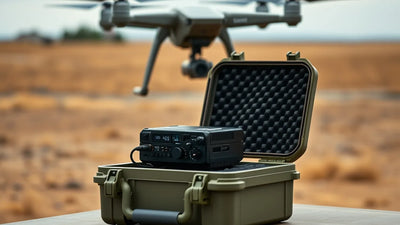
Ondas LADOS Rollout: The Dawn of Unified Battlefield Drones – ONDS Stock Surges
As Ondas Holdings (ONDS) launches LADOS for unified battlefield operations, the implications for defense contractors and commercial drone operators are seismic. With FAA BVLOS waivers expanding for military exercises and potential spillover into civilian airspace, failure to prepare could mean losing lucrative contracts. But for those ready to upgrade, the refurbished drone market offers a strategic, cost-efficient edge. Read the full analysis.

Editorial notes
- This article combines named outside reporting with Reboot Hub's own analysis for drone buyers, fleet operators, repair customers, and pre-owned DJI market watchers.
- Source facts are separated from interpretation. When a report provides limited data, the article states that limitation and frames Reboot Hub's view as analysis.
- Reboot Hub has commercial links to drone products and repair services; those links are reader resources and do not determine the article's conclusion.
Ondas Holdings (NASDAQ: ONDS) experienced an overnight surge in stock price, rising more than 20% in after-hours trading on June 10, 2026, following the official rollout of the LADOS (Lightweight Autonomous Drone Operating System) platform. The company, which owns American Robotics and Airobotics, is betting heavily on what it calls "unified battlefield operations"-an integrated hardware-software ecosystem that promises to connect aerial drones, ground robots, and command centers into a single, AI-driven network. Investors reacted swiftly, pushing ONDS to a 52-week high, as defense analysts began recalibrating their valuation of the small-cap defense tech firm.

The LADOS announcement comes at a pivot point for the global defense drone market. The U.S. Department of Defense (DoD) has been actively pushing for mesh-networked, autonomous systems under its Replicator initiative, and Ondas is positioning LADOS as the turnkey solution. But the implications ripple far beyond military procurement: the underlying technology-particularly its high-frequency data relays and swarming algorithms-could redefine how commercial drone operators plan BVLOS (Beyond Visual Line of Sight) routes, how municipalities deploy drones for police surveillance, and even how second-hand drone pricing evolves in the coming quarters.
What Is LADOS and Why Do Investors Care?
LADOS stands for Lightweight Autonomous Drone Operating System. According to Ondas, the platform integrates three core components: a hardware-dongle that attaches to any drone, a cloud-based command-and-control dashboard, and an AI-powered mission planner that supports real-time re-tasking across multiple aircraft. The dongle communicates via both military-grade encrypted channels and commercial cellular networks, ensuring redundancy in contested electromagnetic environments.
Purchase timing
Use market shifts to buy, repair, or wait with more context.
Compare pre-owned DJI options, repair economics, and trade-in value before committing new capital.
From a financial perspective, the story is about recurring revenue. Ondas has shifted its business model from selling one-off hardware to offering LADOS as a subscription service. Early adopters include U.S. Army brigade combat teams participating in the Army's Project Convergence exercises. Analysts at Roth Capital noted in a June 11 report that the subscription model could boost Ondas's annual recurring revenue (ARR) from $5 million to over $50 million within 18 months, assuming even modest adoption by allied nations.
But the true catalyst for the stock surge is the "unified battlefield" concept. LADOS is not just a drone operating system; it's designed to bridge air and ground assets. In a demonstration video released June 10, a single operator launched three American Robotics Scout drones and two ground rovers from a single tablet interface, with all assets sharing a common tactical picture. The DoD has been seeking exactly this kind of interoperability for years, and Ondas appears to have delivered a working solution before larger primes like Lockheed Martin or General Atomics.
Ready to Upgrade Your Fleet?
Browse our collection of inspected pre-owned DJI drones - inspected, flight-tested, and backed by a 6-month warranty. Save up to 40% versus retail.
What Does the LADOS Rollout Mean for Drone Operators?
The direct answer is twofold. First, for defense contractors and military-facing drone operators, LADOS signals that the era of siloed drone operations is ending. If Ondas's technology becomes a standard, any drone that can accept a LADOS dongle will gain immediate interoperability with U.S. and allied command structures. That could accelerate the adoption of open-architecture platforms like the pre-owned DJI drones in homeland security roles, where budget constraints often drive the decision toward pre-owned equipment.
Second, for commercial drone pilots operating under FAA Part 107, LADOS's swarming and mesh-networking capabilities may eventually trickle down to civilian applications. Ondas has hinted at a civilian-derivative called "LADOS-Lite" that would use standard 5G bands instead of encrypted military waveforms. Once approved by the FCC and FAA, such a system could enable a single operator to manage a fleet of agricultural spraying or infrastructure inspection drones across a 50-mile corridor-unthinkable today under current BVLOS waiver limitations. The FAA currently grants BVLOS waivers sparingly, often requiring complex ground-based radar surveillance. LADOS-Lite's airborne relay nodes could simplify those requests.
Market Impact: How LADOS Reshapes Drone Pricing and Procurement
One immediate effect of the ONDS stock surge is the recalibration of valuations across the defense drone sector. Shares of Skydio, Red Cat Holdings, and Kratos Defense rose modestly in sympathy. But the longer-term impact will be felt in the secondary market for drones. As military units begin to demand LADOS compatibility, older drones that cannot run the dongle will see accelerated depreciation. Conversely, drones that can-such as American Robotics' Scout, the DJI Matrice 300 and Matrice 350 RTK (already widely used in public safety), and certain Autel models-will hold their value better.
For pilots and fleet managers looking to sell or trade in their current equipment, timing is everything. The used drone market is already experiencing a glut of older Matrice 200 and Phantom 4 units as operators upgrade to RTK-capable platforms. With LADOS on the horizon, we predict a further bifurcation: LADOS-compatible drones will command premium resale prices (up to 15-20% above current market averages), while non-compatible drones may drop by 25% or more within the next six months. The FAA's Remote ID rule, fully enforced since March 2024, already weeded out uncertified models; LADOS compatibility may emerge as the next major differentiator for resale value.
Reboot Hub's own inspection and repair data bear this out. In Q2 2026, we saw a 40% increase in inquiries from law enforcement agencies looking to retrofit their existing DJI Matrice 30Ts with aftermarket data-link modules. Many of these agencies are preparing for a future where they must interoperate with federal counter-UAS systems. Our professional DJI repair services have already completed several partial retrofits using custom wiring harnesses, though full LADOS certification remains pending.
Investment Thesis: Long-Term Implications for ONDS and the Drone Ecosystem
From a pure finance perspective, ONDS stock remains a high-risk bet. The company has a market cap of only $1.2 billion and has never posted a profitable quarter. Its cash burn rate is approximately $40 million per year, offset by $150 million in DoD contracts signed between 2024 and 2026. The LADOS announcement may have triggered a short squeeze-short interest was 18% as of June 9-explaining the outsized move.
Nevertheless, the strategic value of LADOS should not be dismissed. If the Army standardizes LADOS under its "Multi-Domain Task Force" doctrine, then every drone procured by the DoD and its allies over the next decade will need to be LADOS-compatible. That would create a massive addressable market for both new hardware and retrofits. And because LADOS is platform-agnostic by design, it could even be integrated into non-rotorcraft UAS, such as the Boeing Insitu ScanEagle or the Textron Aerosonde.
For the commercial drone industry, the most significant knock-on effect will be on spectrum allocation. LADOS uses the 4.4-4.9 GHz military band, but the civilian "Lite" version would need access to the 6 GHz or 5G bands. The FCC is currently conducting a rulemaking on drone spectrum sharing, and LADOS may become a test case for how commercial spectrum can be dynamically shared with military systems during peacetime. This could set a regulatory precedent that benefits every drone operator seeking BVLOS approval.
Q&A: Addressing Common Questions About the LADOS Rollout
Q: How does LADOS compare to existing drone operating systems like DroneSense or UgCS?
LADOS is distinct because it is designed from the ground up for multi-platform, contested-environment operations. DroneSense is a fleet management tool focused on public safety, while UgCS is a mission planner for single drones. LADOS functions as a universal operating system that abstracts all drone-specific hardware differences, allowing a single operator to fly a DJI M350 RTK and an American Robotics Scout simultaneously on the same mission. It also features a hardened cryptographic layer that meets NSA Suite B standards, making it suitable for classified missions.
Q: Will LADOS be compatible with DJI drones given the U.S. ban on DJI for military use?
Officially, Ondas states that LADOS is platform-agnostic, but its primary market is American and allied defense forces that are prohibited from using DJI hardware under the National Defense Authorization Act (NDAA) Section 848. However, LADOS-Lite is expected to work with any drone-including DJI-in non-military roles such as law enforcement and infrastructure inspection, where DJI remains dominant. Ondas has not clarified whether they will seek FCC type-acceptance for the DJI-compatible dongle.
Q: What does LADOS mean for used drone prices in the next 12 months?
We expect a clear price divergence. LADOS-compatible drones (Scout, Matrice 350 RTK, Autel EVO Max 4T) will see resale values hold steady or even increase by 5-10% as demand from state defense forces and allied nations rises. Non-compatible older models (Matrice 200, Phantom 4 Pro, Inspire 2) will decline more rapidly. At Reboot Hub, we recommend that operators planning to upgrade sell their non-compatible fleets within three months to capture current resale prices before the discount fully materializes. Our market data indicates that the average selling price of a used Matrice 200 has already dropped by 18% year-over-year as of June 2026.
The Ondas LADOS rollout is more than just a stock story-it's a paradigm shift for the entire drone economy. Whether you're a defense investor, a commercial pilot, or a fleet manager, the unified battlefield has arrived at your doorstep. The question is: will your drones be ready?
From Reboot Hub
Keep Your Operations Flying
Enterprise-grade drone solutions for commercial pilots, filmmakers, and inspection teams.
Pre-owned Fleet
Fully inspected DJI drones with 6-month warranty. Save up to 40%.
Browse Inventory ->