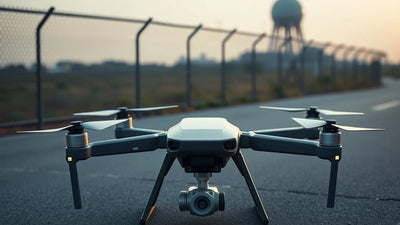
Human Kidneys Go BVLOS: The Medical Drone Frontier is Here
A coalition between NASA Langley, UNOS, and LifeNet Health just proved the unthinkable: BVLOS drone delivery of human donor kidneys for transplant. This isn't a concept test—it's a regulatory and operational jackhammer that cracks open a multi-billion-dollar medical logistics market. For commercial Part 107 operators and fleet managers, the shift from curiosity to urgency is immediate. If your heavy-lift drone isn't ready for high-value bio-cargo, your competitors already are.

Editorial notes
- This article combines named outside reporting with Reboot Hub's own analysis for drone buyers, fleet operators, repair customers, and pre-owned DJI market watchers.
- Source facts are separated from interpretation. When a report provides limited data, the article states that limitation and frames Reboot Hub's view as analysis.
- Reboot Hub has commercial links to drone products and repair services; those links are reader resources and do not determine the article's conclusion.
June 15, 2026 — The line between science fiction and commercial drone operations just blurred into a concrete red line. In a landmark demonstration that could rewrite the economics of transplant logistics, NASA Langley Research Center, the United Network for Organ Sharing (UNOS), and LifeNet Health have completed the world’s first fully autonomous BVLOS (Beyond Visual Line of Sight) drone flights carrying viable human donor kidneys. The test, conducted at NASA’s Hampton, Virginia facility, involved custom heavy-lift aircraft ferrying temperature-controlled organ transport containers across a 20-mile simulated route that included urban obstacles and controlled airspace handoffs.

But this isn’t just a medical breakthrough. It’s a regulatory event with immediate commercial implications. For drone operators, fleet owners, and anyone trading in the used drone market, the message is clear: the era of high-value, time-critical cargo delivery by drone is no longer theoretical. The same platforms that fly survey missions and crop assessments today — DJI Matrice 600s, Freefly Alta Xs, and custom-built BVLOS rigs — just became candidates for a vastly more lucrative revenue stream.
Inside the Test: How NASA and UNOS Pulled Off the Impossible
The flights were conducted under a specific FAA exemption granted for medical research, waiving standard Part 107 visual-line-of-sight requirements. According to Dr. Sarah Kellerman, principal investigator at NASA Langley, the team flew three separate sorties over two weeks in late May 2026. Each flight carried a pair of de-identified donor kidneys packed in LifeNet Health’s proprietary Hypothermic Transport System, which maintains tissue viability for up to 48 hours. The drones themselves were modified heavy-lift hexacopters with redundant flight controllers and a fail-safe parachute system — critical for FAA approval.
Enterprise procurement
Turn this market signal into a fleet requirement.
Discuss mission profile, quantities, configuration, delivery, and lifecycle support with Reboot Hub.
The route included a simulated transfer from a Level 1 trauma center helipad to a virtual organ-receiving hospital. Handover of airspace control from a ground-based radar station to a network of ADS-B repeaters allowed the drone to fly fully autonomous beyond line of sight. “The BVLOS element is the real headline,” said UNOS logistics director Mark Henson. “Organ transport windows are tight — kidneys survive about 24 to 36 hours outside the body. Cutting drive times from 90 minutes to 20 by bypassing traffic is a game-changer for transplant survival rates.”
What This Means for Transplant Networks and Drone Regulations
Q: What does the NASA-UNOS test mean for transplant networks?
A: It validates that drones can handle the most delicate of cargos: viable human tissue. UNOS has already signalled interest in a phase-two study involving live transplant coordination with actual recipients. That means the next frontier is not just BVLOS, but flight into congested urban airspace at night — a scenario the FAA is currently evaluating via its BEYOND program.
Q: What does this mean for the drone industry?
A: It creates a proven use case for high-asset-value logistics. If a $50,000 drone can safely deliver a kidney worth $400,000 (the estimated cost of a deceased donor kidney transplant), the ROI per flight is astronomical. This will accelerate demand for certified BVLOS platforms, redundant payload systems, and temperature-monitoring integration. It also pressures the FAA to fast-track Part 135 certification for medical cargo drones.
Ready to Upgrade Your Fleet?
Browse our collection of inspected pre-owned DJI drones — inspected, flight-tested, and backed by a 6-month warranty. Save up to 40% versus retail.
Commercial Impact: The Medical Cargo Drone Market Blasts Off
For everyday drone pilots and commercial operators, this news matters on a very practical level. The same heavy-lift platforms used for aerial surveying or cinematography can potentially be repurposed — or upgraded — for medical logistics. But the certification bar is high. The drones used in the NASA-UNOS test were equipped with triple-redundant flight controllers, dual GPS/INS modules, and real-time telemetry to a ground control station. That level of hardware maturity isn’t common on the second-hand market, and that’s where the opportunity lies.
Demand for pre-owned but high-capability aircraft — like the DJI M600 Pro or the Freefly Alta X — is likely to surge as smaller logistics startups look to enter the medical delivery space without the $100,000+ price tag of a new certified platform. This is a direct signal for those tracking the used drone market. A well-maintained, radar-equipped M600 that once flew mapping missions could become the keystone of a rural kidney delivery network. The secondary market will need to start factoring in BVLOS readiness — ADS-B out, payload redundancy, and thermal management — as value differentiators.
Moreover, the repair ecosystem will adapt. Facilities offering professional DJI repair services will see increasing demand for gimbal calibrations, vibration dampening upgrades, and redundant power system overhauls. The medical cargo segment doesn't tolerate downtime; a flying kidney cooler needs a 99.9% mission completion rate.
Regulatory Ripple Effects: What Comes Next Under the FAA?
The FAA’s stance on BVLOS has been evolving slowly, but a success of this magnitude — involving a federal agency (NASA) and a private nonprofit (UNOS) — is a powerful lobbying tool. The agency currently requires a waiver under 14 CFR § 107.35 or a Part 135 certificate for any BVLOS revenue operation. The NASA test was conducted under a research exemption, but the data will almost certainly be used to petition for a more streamlined path. Expect the FAA to issue a Notice of Proposed Rulemaking (NPRM) on medical BVLOS within 12 months.
For operators, this means the clock is ticking on upgrading hardware and training. Those who invest now in ADS-B Out transponders, low-visibility lighting packages, and redundant communications will be first in line for waivers. The test also highlighted the importance of secure data links — the drones used encrypted LTE and satellite backup. That’s not standard on consumer aircraft, but third-party retrofit kits are already appearing.
Seismic Shift for the Second-Hand Drone Market
The immediate financial implication is straightforward: the value of high-end used drones capable of medical logistics will hold or appreciate relative to standard survey drones. A used DJI M600 in good condition with a working ground station, retractable landing gear, and no crash history — currently trading around $4,500–$6,000 on secondary markets — could command a premium of 20–30% if it's certified for BVLOS retrofits. The NASA test essentially adds a new asset class to the pre-owned market: the medical-grade capable drone.
At Reboot Hub, we’re already seeing an uptick in inquiries from logistics startups looking for pre-owned DJI drones that can be upgraded with payload lockers and third-party avionics. This isn’t a niche — it’s the beginning of a parallel market where airframe reliability and redundancy matter more than camera resolution or flight time.
Frequently Asked Questions
Were the kidneys actually used for transplant?
No. The kidneys used in the test were de-identified and sourced from LifeNet Health’s tissue bank. They were never intended for transplantation. The purpose was to verify that the drone’s vibration, temperature, and pressure profiles remained within acceptable medical standards throughout the BVLOS flight. A follow-up study with transplant-ready organs is planned for 2027.
What specific drone models were used in the test?
The coalition did not release the exact model names, citing proprietary partnerships. However, NASA has previously worked with the Freefly Alta X and DJI M600 variants for cargo tests. The aircraft were described as "heavy-lift multirotors with triple-redundant flight controllers and customized payload bays." It is likely that commercial-off-the-shelf platforms were heavily modified with radio and navigation upgrades.
How does this affect commercial drone operators right now?
For operators holding Part 107 certificates, the immediate effect is zero — but the medium-term effect is massive. You can expect FAA advisory circulars and industry workshops within months. More importantly, if you intend to compete in the medical logistics space, begin planning for Part 135 certification or at minimum a BVLOS waiver. Invest in aircraft that support modular payloads and redundant flight systems. The second-hand market is your fastest path to a capable platform, as new certified drones can take 12+ months for delivery.
This analysis is brought to you by the editorial team at Reboot Hub, your independent source for real-world drone industry intelligence and premium pre-owned equipment.
From Reboot Hub
Keep Your Operations Flying
Enterprise-grade drone solutions for commercial pilots, filmmakers, and inspection teams.
Pre-owned Fleet
Fully inspected DJI drones with 6-month warranty. Save up to 40%.
Browse Inventory ->