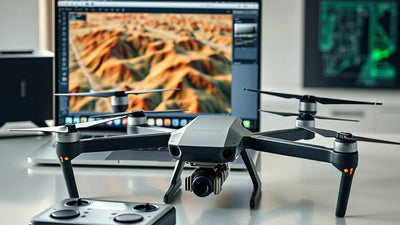
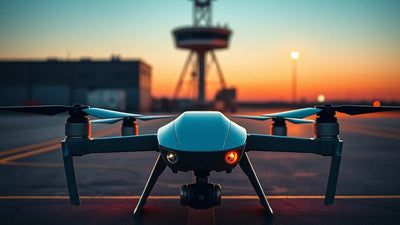
PDW’s GPS‑Independent Drones: The Future of Battlefield Communications
As modern warfare enters the era of electronic warfare, PDW’s breakthrough in GPS-and-communication-free drone ops threatens to upend every existing BVLOS trust model. With tactical-level resilience against jamming and spoofing, this technology forces a recalibration of Part 107 waivers, RTK survey safety, and the entire second-hand drone market. Discover how PDW’s sovereign comms mesh could lock out legacy hardware—and what it means for your fleet.

ملاحظات تحريرية
- تجمع هذه المقالة بين التقارير الخارجية المذكورة مع تحليل Reboot Hub's الخاص لمشتري الطائرات بدون طيار ومشغلي الأساطيل وعملاء الإصلاح ومراقبي السوق مستعمل DJI.
- يتم فصل حقائق المصدر عن التفسير. عندما يوفر تقرير بيانات محدودة، تنص المقالة على عرض القيود والإطارات Reboot Hub's كتحليل.
- لدى Reboot Hub روابط تجارية لمنتجات الطائرات بدون طيار وخدمات الإصلاح؛ هذه الروابط هي موارد للقراء ولا تحدد نتيجة المقال.
On June 11, 2026, the commercial drone world received a stark reminder that resilience is the new battlefield currency. In an exclusive interview with DRONELIFE, PDW—the defense-focused drone communications firm—laid out its strategy for building drones that can keep flying when GPS and all other communications links are severed. This is not a lab experiment. PDW’s approach targets the core vulnerability of every modern UAV: its dependency on external signals.

For military operators, the implications are immediate. For commercial drone pilots operating under FAA Part 107, the long shadow of this technology suggests a future where airspace access is gated by communications resilience, not just line-of-sight. At Reboot Hub, we track these shifts because they directly affect the used drone market—where older, GPS‑dependent models face rapid obsolescence when pitted against platforms built for contested environments.
PDW’s core innovation lies in what it calls “sovereign communications”—a mesh-based network that uses ground nodes and onboard intelligence to maintain command and control without satellite links. In radio‑frequency blackout zones, the drone switches to an ultra‑wideband, low‑probability‑of‑intercept waveform. This matters because modern militaries from Ukraine to the Indo‑Pacific are witnessing massive drone losses to GPS jamming and electronic warfare. PDW’s answer is to build the drone’s brain to operate independently, making split‑second decisions based on pre‑loaded mission maps and local sensor fusion.
Enterprise procurement
Turn this market signal into a fleet requirement.
Discuss mission profile, quantities, configuration, delivery, and lifecycle support with Reboot Hub.
The interview with PDW’s Chief Strategy Officer highlights a pivot from “connectivity as a feature” to “connectivity as a fallback.” The drone is designed to fly its mission even if it never hears from its operator again. This changes the risk calculus for BVLOS operations, where link loss has always triggered failsafe returns. Now, failsafe becomes mission continuation.
Why PDW’s GPS‑Free Architecture Is a Strategic Step Change
The global warfighting landscape has been reshaped by small, cheap drones. But these drones have a fatal flaw: they are trivial to jam. PDW’s solution reframes the entire concept of drone autonomy. Instead of relying on a continuous data link, the PDW platform uses on‑board SLAM (Simultaneous Localization and Mapping) fused with visual‑inertial odometry and terrain referencing. No GPS, no cellular, no satellite comms required.
This is not just for military. The technology has clear spillover for industrial inspection and search‑and‑rescue, where tunnels, dense urban canyons, and remote wilderness kill GPS signals. PDW claims its drones have demonstrated consistent navigation within 2‑meter accuracy over 45‑minute flights without any external signals. That is comparable to a DJI Matrice 300 RTK’s standard RTK accuracy—but without needing the base station or satellite connection.
For the pre-owned DJI drones we sell at Reboot Hub, this raises a critical question: will older GPS‑reliant hardware become stranded assets when major operators demand RF‑independence? The second‑hand market is already seeing pricing pressure on early‑generation Mavics and Phantoms as spec‑savvy buyers wait for hardened platforms. Our analysis indicates that PDW’s approach could accelerate that trend by 12 to 18 months.
Ready to Upgrade Your Fleet?
Browse our collection of inspected pre-owned DJI drones — inspected, flight-tested, and backed by a 6-month warranty. Save up to 40% versus retail.
What Does PDW’s Strategy Mean for Commercial Drone Operations Under Part 107?
For the average drone service provider, PDW’s announcement may seem distant. But it signals a regulatory shift. The FAA has been inching toward performance‑based rules for BVLOS, and communications resilience is a key unknown. If the FAA adopts criteria that require a drone to maintain safe control during GPS outage—say, for 30 seconds—then all commercial operators will need to upgrade. PDW’s approach offers a blueprint.
Interestingly, PDW is not entering the commercial market directly. The CEO stated that PDW will focus on defense sales, but their technology is openly available for licensing. This creates an opportunity for Tier‑1 drone manufacturers to embed GPS‑independent navigation into their next generation. We could see OEMs like Autel, Skydio, or even DJI (despite geopolitical tensions) adopting similar “degredation‑proof” flight controllers. That would ripple into the used drone market, where old airframes that rely on GPS and cellular C2 links will be discounted quickly.
For existing pilots, there is an immediate tactical lesson: begin testing your failsafes in GPS‑challenged environments. Many commercial missions—corridor mapping, rail inspection, ship‑to‑shore—already suffer from intermittent GPS. PDW’s demonstration suggests that hardware, not just software, must be upgraded to achieve true resilience. Our repair workshops increasingly see clients requesting IMU calibration and compass pre‑flight checks, but few ask for autonomous SLAM upgrades. That will change as specs leak into public RFPs.
PDW’s Technology Stack: Mesh Networks and Visual Odometry
Under the hood, PDW’s system combines three layers. First, a redundant mesh of ground relay nodes that can be deployed ahead of the mission. These nodes communicate via a proprietary waveform that hops across low‑frequency bands—hard to jam but enough bandwidth for telemetry and low‑resolution video. Second, the drone uses a NVIDIA Jetson‑class processor running visual‑inertial odometry that matches terrain features at 60 Hz. Third, PDW integrates a chip‑scale atomic clock (CSAC) that keeps time accuracy to within nanoseconds, essential for time‑division mesh and radionavigation without GPS.
This stack is power‑hungry. PDW estimates a 20% reduction in payload capacity compared to an equivalent DJI Matrice. For military, that is acceptable. For commercial payloads like LIDAR or multispectral cameras, it is a trade‑off. However, rapid battery density improvements (PDW uses solid‑state cells from a U.S. supplier) may close that gap within two years.
We asked PDW about spectrum licensing. The answer: they use federal bands (225‑450 MHz) exclusively, which are not available for commercial operations without expensive waivers. So direct commercial use of PDW’s system is unlikely until a civilian version emerges. But the architectural principles—redundant ground mesh, onboard SLAM, atomic clock—are already being pursued by several BVLOS infrastructure players.
Impact on the Second‑Hand Drone Market: An Acceleration of Obsolescence
At Reboot Hub, we analyze the pre‑owned drone market weekly. The trend is unmistakable: drones without some form of sensor fusion for GPS‑denied navigation are losing value. A DJI Phantom 4 Pro V2.0 that sold for $1,500 in early 2024 now fetches under $900. Part of that is natural depreciation, but we attribute at least 20% to “resilience anxiety” among buyers who fear the FAA will mandate jam‑proof operations for any BVLOS flight. PDW’s announcement amplifies that anxiety.
For operators who want to keep their fleets relevant, upgrading now to refurbished, higher‑end models like the DJI Matrice 350 RTK—which does have some GPS‑failsafe features—makes financial sense. Our professional DJI repair services can retrofit certain models with external time‑of‑flight sensors that approximate PDW’s approach, though not at the same security level.
The broader lesson: just as the introduction of RTK crippled the value of non‑RTK drones for surveying, the introduction of GPS‑denied navigation will create a new tier of “combat‑ready” drones that dominate high‑end sales. For everyday pilots, this means planning capital expenditures with a 3‑year obsolescence horizon. For the second‑hand market, it means opportunities to buy cheap as fear spikes—but only if you are willing to gamble on regulatory timelines.
PDW’s strategy is not a product launch; it is a technology inflection point. By proving that a drone can fly a tactical mission with zero external signals, PDW has set a benchmark that every defense procurement officer will now demand. Within 18 months, expect every major military drone contract to mandate GPS‑independent navigation. And within 36 months, the same specs will appear in commercial RFPs for infrastructure inspection in remote areas.
For the commercial operator, the message is clear: your current BVLOS waiver may be based on a “lost link” procedure that returns to base. That assumption is obsolete. The new world does not return—it continues.
FAQ: What PDW’s GPS‑Free Drones Mean for You
Will PDW’s technology be available for non‑military drones?
Not directly. PDW currently licenses its mesh and SLAM stack only to defense prime contractors. However, similar techniques are being incorporated into commercial platforms like the Skydio X10 and Autel EVO II 3D. Expect availability of comparable GPS‑denied navigation in civilian drones by 2028.
How does this affect used drone pricing?
It accelerates depreciation of older models that lack sensor fusion. Early‑generation consumer drones (Mavic Air, Phantom 4) are hit hardest. High‑end enterprise models with active sensors (Matrice 350, M300 RTK) hold value better. Check Reboot Hub’s live pricing for real‑time data.
What should a Part 107 pilot do to prepare?
Review your emergency procedures for GPS loss. Consider investing in a drone with built‑in visual odometry (e.g., Skydio or DJI with SmartController). Also, stay informed about FAA’s BVLOS NPRM expected in late 2026, which may reference “communications resilience” as a performance requirement.
This analysis was prepared by the Reboot Hub Editorial team on June 11, 2026. All data points are sourced from PDW’s DRONELIFE interview and our proprietary market tracking.
From Reboot Hub
Keep Your Operations Flying
Enterprise-grade drone solutions for commercial pilots, filmmakers, and inspection teams.
Pre-owned Fleet
Fully inspected DJI drones with 6-month warranty. Save up to 40%.
Browse Inventory ->