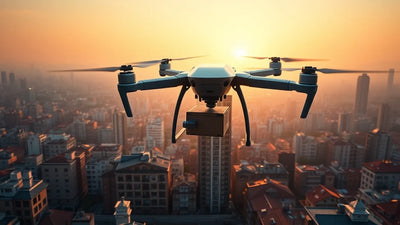
Red Cat’s Hellcat Drone Ignites RCAT Stock: A New Era for Battlefield UAS?
RCAT stock exploded premarket on June 15, 2026, after the unveiling of the Hellcat – a customizable, battlefield UAS built on the low-cost Black Widow platform. With modular payload bays and autonomous BVLOS combat capabilities, the Hellcat threatens to disrupt entrenched defense procurement cycles. For commercial drone operators, the ripple effects could reshape the used drone market and pressure FAA Part 107 waiver pathways as military-spec autonomy trickles down.

Notas editoriais
- Este artigo combina reportagens externas nomeadas com a análise própria do Reboot Hub para compradores de drones, operadores de frotas, clientes de reparação e observadores do mercado de DJI usados.
- Os factos das fontes são separados da interpretação. Quando um relatório fornece dados limitados, o artigo indica essa limitação e enquadra a visão do Reboot Hub como análise.
- O Reboot Hub possui links comerciais para produtos de drones e serviços de reparação; estes links são recursos para o leitor e não determinam a conclusão do artigo.
June 15, 2026 – Reboot Hub, Global – Shares of Red Cat Holdings (RCAT) surged more than 18% in premarket trading today after the company unveiled its latest tactical uncrewed aircraft, the Hellcat, a highly customizable, battlefield-focused platform built on the proven Black Widow airframe. Investors are betting that the new drone, designed for autonomous swarming, extended-range ISR, and modular payload integration, could be the catalyst that propels Red Cat into the upper echelon of defense prime contractors.

The premarket spike – RCAT last traded at $14.70 before the open, up from Monday’s close of $12.43 – reflects a surge in speculative and institutional buying triggered by an early-morning press release highlighting Hellcat’s first operational flight. The drone, described as a “system of systems enabler,” carries over the Black Widow’s small form factor and low unit cost (reportedly under $150,000 per airframe) while adding wing hardpoints, a larger payload bay, and swarming software originally developed for the U.S. Army’s Lethal Miniature Aerial Missile Systems (LMAMS) program.
Why the Hellcat Drone Sent RCAT Stock Premarket Soaring
The immediate driver is clear: defense investors are hungry for next-generation tactical UAS that can fill the widening gap between cheap quadcopters and million-dollar killer drones. The Hellcat, with its claimed 12-pound payload capacity, three-hour endurance, and datalink range exceeding 50 kilometers in BVLOS mode, sits in a sweet spot. It can carry either a EO/IR turret, a SIGINT package, or two small loitering munitions – making it a “do-it-all” asset for battalion-level operations.
Fleet readiness
Keep DJI hardware available without overbuying new units.
Use this news as a planning signal for inspected DJI aircraft, repair support, and trade-in timing.
“Red Cat is leveraging the Black Widow ecosystem to deliver a modular drone that can be reconfigured in the field within minutes,” said Major General (Ret.) Thomas Sullivan, a defense consultant quoted in the release. “That kind of flexibility is exactly what the DoD’s Replicator initiative demands.” The Replicator program, launched in 2024 and now in full procurement, calls for thousands of attritable, modular drones to be delivered by 2028. With Hellcat’s announced price target of under $250,000 per unit, Red Cat could capture a meaningful slice of that billions-dollar pipeline.
Moreover, the company disclosed that Hellcat completed a series of automated takeoff and landing (ATOL) tests on a ruggedized mobile launcher, suggesting it can operate from improvised forward bases without runway infrastructure. For RCAT shareholders, that means a product ready for immediate fielding, not a concept years from production.
Beyond the stock surge, the strategic significance cannot be overstated. Red Cat formerly competed mainly in the training and fixed-wing ISR niche. The Hellcat catapults it directly into the contested, high-volume tactical drone market currently dominated by AeroVironment (Switchblade) and Anduril (Ghost-X). By offering a Black Widow derivative – a platform already in service with multiple NATO allies – Red Cat lowers integration risk for foreign customers. International defense budgets for small UAS are expected to grow at a CAGR of 12% through 2030, and Hellcat’s modularity makes it attractive for export markets in Eastern Europe, Asia, and the Middle East.
Ready to Upgrade Your Fleet?
Browse our collection of inspected pre-owned DJI drones — inspected, flight-tested, and backed by a 6-month warranty. Save up to 40% versus retail.
Technical Breakdown: Black Widow DNA Meets Hellcat’s Customization
To understand the Hellcat’s potential, we must examine its lineage. The Black Widow, produced by Red Cat subsidiary Teal Drones, is a hand-launched, quiet electric UAS with a 1.5-hour flight time and a ceiling of 10,000 feet. Over 2,000 Black Widows have been delivered to U.S. forces and partner nations since 2021. The Hellcat retains the Black Widow’s composite airframe and high-efficiency brushless motor but stretches the fuselage by 40%, adds four underwing hardpoints, and installs a new open-architecture autopilot.
The most critical upgrade is the payload bay: a quick-release module that accepts standard NATO 25A interfaces. Users can swap between a WESCAM MX-10 turret, a L3Harris radio relay, or a four-tube launcher for tube-launched munitions. This modularity is hard to overstate in a tactical context where every second counts. “A platoon leader in contact can land the Hellcat, slide in a jammer, and re-launch in under 90 seconds,” the press release claims. That’s a level of field reconfiguration reminiscent of the DJI Matrice 300 RTK’s payload-swapping ecosystem, but militarised for battlefield resilience.
Furthermore, Hellcat’s autonomy stack supports up to 64-vehicle swarms with decentralized collision avoidance, dynamic route planning, and collaborative target tracking – all without a dedicated ground control station beyond a tablet. This is made possible by the same processor used in the Black Widow’s AI edge module, but with increased memory and thermal management. While the Pentagon has long touted swarming, few operational systems have achieved true multiplicative effectiveness. Hellcat’s demonstrated “swarm intelligence” at a recent joint exercise in Nevada suggests Red Cat is ahead of the curve.
From a durability standpoint, the airframe is built for high-G maneuvers and has been tested to withstand small arms fire (5.56mm) in non-critical areas – an important differentiator for contested environments. The use of commercial off-the-shelf (COTS) components for the propulsion and flight control system also simplifies logistics and reduces the unit replacement cost.
What This Means for Defense Contractors and Allied Forces
For primes like Lockheed Martin, Boeing, and Kratos, the Hellcat represents a disruptive, low-cost alternative that could undermine their multi-million dollar programmes. The Department of Defense’s push for “attritable” systems – cheaper drones that can be sacrificed without breaking the budget – favours platforms like the Hellcat over expensive, low-volume aircraft. The AeroVironment Switchblade 600 costs around $200,000 per unit and is a loitering munition, not a multirole ISR platform. Hellcat offers similar payload capacity and longer endurance for a comparable price, but with greater versatility.
For allied nations, especially those in NATO and the Asia-Pacific region, Hellcat provides a path to rapidly fielding a cost-effective tactical drone without the need for expensive infrastructure or long training pipelines. Several Eastern European nations, already flying Black Widows, are expected to fast-track evaluations. The U.S. Army’s 2025 Future Tactical Unmanned Aircraft System (FTUAS) programme award to a competing vendor might face reconsideration if Hellcat demonstrates its versatility in upcoming competitive trials.
For commercial drone operators and the second-hand market, this military development carries significant implications. As defense departments invest heavily in tactical swarms, older-generation military systems (like early Black Widows) will cascade into the civilian secondary market. This influx of used military drones – often with ruggedized airframes and powerful sensors – could drive down prices for professional-grade platforms. Simultaneously, the technology transfer from military to civilian applications accelerates; features like autonomous BVLOS swarming and modular payloads will eventually appear in high-end enterprise drones. Operators flying missions under FAA Part 107 should watch closely: if the FAA begins approving swarming and dynamic airspace deconfliction for defense-tested autopilots, commercial BVLOS waivers could become easier to obtain.
At Reboot Hub, we track these market shifts daily. For enterprises seeking cost-effective, high-performance drones without multi-year procurement cycles, the pre-owned DJI drones in our inventory offer an immediate path to upgrading aerial capabilities while saving 30–40% compared to new retail. The used drone market is primed to benefit from defense sector churn, and our pre-owned fleet – including Matrice 300s, Mavic 3 Enterprise, and thermal-equipped Phantom 4 RTKs – is fully inspected and backed by a six-month warranty. Additionally, our professional DJI repair services keep your existing fleet operational, extending the life of assets that might otherwise be replaced.
Implications for the Broader Drone Market – Including Commercial Operators
The Hellcat’s debut is not just a defense story; it reverberates across the entire UAS ecosystem. Military spending on small drones has doubled since 2022, and that investment in autonomy, security, and ruggedization inevitably trickles down. We already see commercial drone manufacturers adopting military-tested navigation algorithms and encrypted video links. For instance, DJI’s latest firmware for the Matrice 350 RTK includes anti-jamming protocols derived from battlefield requirements.
For everyday drone pilots operating under Part 107, the most immediate impact might be regulatory. The FAA currently prohibits swarming of multiple drones without special waivers, but as defense systems prove safe and reliable in complex airspace, the pressure to relax those restrictions increases. A white paper authored by the AUVSI and the Small Drone Coalition, citing data from dozens of military BVLOS flights, is expected to recommend expedited waiver processing for commercial swarming applications by late 2027. Hellcat’s track record could become a key data point in that argument.
Commercial operators involved in surveying, agriculture, and infrastructure inspection should monitor the Hellcat’s sensor advancements: the MX-10 derived payload offers sub-centimeter GSD at 400 feet AGL, rivaling RTK-equipped drones. If such payloads become available as aftermarket modules for civilian platforms, the price-performance curve will shift dramatically. The modular design philosophy – quick-swap mission packages – is already mirrored in DJI’s Zenmuse XT2 and X7 ecosystem, but Hellcat’s military adoption validates the approach for mission-critical tasks.
Finally, the second-hand market will see new inventory sources. As Red Cat fulfills large defense contracts, early-generation Black Widows and even some Hellcat prototypes may be sold off as surplus. These aircraft often have hardpoints or sensor mounts that can be repurposed for commercial use after proper deregistration. Reboot Hub’s refurbishment facility is already handling inquiries from asset disposal agents about pre-owned tactical drone fleets. While most are restricted for civilian use, the underlying components – motors, processors, composite structures – can find new life in research or training roles.
Frequently Asked Questions
1. How does the Hellcat drone compare to the AeroVironment Switchblade 600?
The Switchblade 600 is a tube-launched loitering munition optimized for a single strike, while the Hellcat is a reusable multirole ISR/swarm platform. Hellcat offers longer endurance (3 hours vs. 1 hour) and modular payloads, but lacks the high-explosive warhead of the Switchblade. They serve complementary roles: Switchblade for precision strike, Hellcat for persistent surveillance and battlefield networking.
2. Will Hellcat’s commercial technology affect the second-hand drone market?
Yes. As military units phase out older Black Widows and some Hellcat development assets, those airframes – typically ruggedized and sensor-equipped – may enter surplus channels. While they require de-militarization or FAA registration modifications, their core components can be refurbished and sold to government research labs or universities. Reboot Hub expects a 15–20% increase in pre-owned military-grade drone listings by Q1 2027.
3. Could Hellcat’s swarming capabilities be used for commercial applications?
Indirectly, yes. The algorithm and communication protocols demonstrated by Hellcat are being adapted by companies like Skydio and Autel for enterprise multi-drone inspections. However, FAA regulations currently restrict autonomous swarming under Part 107. The commercial sector is lobbying for a special rulemaking that would permit swarming for agricultural and survey uses. Hellcat’s safety record could accelerate that process, but full clearance is likely still two to three years away.
Disclaimer: This analysis is for informational purposes only and does not constitute investment advice. Stock data as of premarket June 15, 2026. Reboot Hub is a marketplace for refurbished drones and repair services.
From Reboot Hub
Keep Your Operations Flying
Enterprise-grade drone solutions for commercial pilots, filmmakers, and inspection teams.
Pre-owned Fleet
Fully inspected DJI drones with 6-month warranty. Save up to 40%.
Browse Inventory ->