Mercedes-Benz and TYTAN Technologies Forge Defense Drone Alliance at ILA 2026
Mercedes-Benz and TYTAN Technologies have signed a Memorandum of Understanding at ILA 2026 to co-develop next-generation unmanned aerial systems for military applications. This alliance threatens to disrupt the defense drone supply chain, impacting Part 107 operators and forcing second-hand market reassessments. Immediate compliance risks and airspace integration challenges loom for commercial fleets.

Notas editoriais
- Este artigo combina reportagens externas nomeadas com a análise própria do Reboot Hub para compradores de drones, operadores de frotas, clientes de reparação e observadores do mercado de DJI usados.
- Os factos das fontes são separados da interpretação. Quando um relatório fornece dados limitados, o artigo indica essa limitação e enquadra a visão do Reboot Hub como análise.
- O Reboot Hub possui links comerciais para produtos de drones e serviços de reparação; estes links são recursos para o leitor e não determinam a conclusão do artigo.
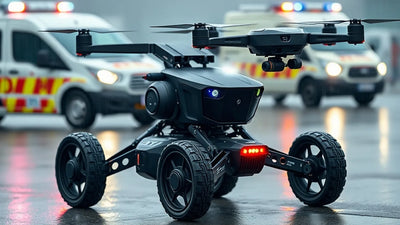
Berlin, June 16, 2026 — On the floor of ILA Berlin 2026, a partnership with the potential to reshape the defense drone landscape was quietly formalized. Mercedes-Benz AG, a name synonymous with automotive engineering excellence, and TYTAN Technologies, a fast-rising defense technology firm specializing in unmanned systems and counter-UAS solutions, signed a Memorandum of Understanding (MOU) to jointly develop advanced unmanned aerial systems (UAS) for military reconnaissance, logistics, and surveillance missions. The signing took place in the presence of senior officials from the Federal Ministry of Defence, signaling strong government backing for the initiative.

While the exact technical specifications remain under wraps, early briefings suggest the collaboration will leverage Mercedes-Benz's expertise in hydrogen fuel-cell propulsion, autonomous driving-grade sensor fusion, and modular vehicle architectures, combined with TYTAN's field-proven airframe designs and AI-driven mission autonomy. The result could be a new class of long-endurance, low-signature drones designed for contested environments. For the global drone industry — already grappling with shifting geopolitical alliances, export controls, and the rise of Chinese competitors — this MOU marks yet another inflection point.
The MOU Announcement at ILA 2026: A Strategic Shift
ILA Berlin 2026 has long been the stage for major aerospace announcements, but the Mercedes-Benz–TYTAN MOU stands out for its unusual pairing. TYTAN Technologies, headquartered in the United States, has made a name for itself with counter-UAS systems like the DroneHunter — an interceptor drone designed to capture rogue UAVs — and a portfolio of ISR (intelligence, surveillance, reconnaissance) platforms. Mercedes-Benz, meanwhile, brings decades of experience in mass production, supply chain resilience, and advanced mobility — skills that are directly transferable to the military drone arms race.
Fleet readiness
Keep DJI hardware available without overbuying new units.
Use this news as a planning signal for inspected DJI aircraft, repair support, and trade-in timing.
The MOU explicitly focuses on multi-role UAS that can be deployed from ground vehicles, reflecting a trend toward integrated manned-unmanned teaming (MUM-T). The German defence procurement office is already exploring projects like the Future Combat Air System (FCAS), and this MOU could dovetail into the land component of that vision. With NATO countries under pressure to reduce reliance on Chinese-manufactured drone components — particularly DJI platforms — the timing is perfect for a "trusted" Western alternative born in Germany and backed by a premium automotive OEM.
What This Means for Defense and Commercial Drone Markets
The immediate commercial impact will be felt in the defense contracting space. Mercedes-Benz’s involvement signals the maturation of the drone industry as a serious industrial sector, no longer solely driven by startups and specialist integrators. The financial muscle and manufacturing capacity of a company like Mercedes can scale production far beyond the capabilities of traditional drone OEMs. This could drive down unit costs for military-grade UAS, while simultaneously raising the baseline performance level for endurance, payload capacity, and electronic warfare resilience.
From a market intelligence perspective, we anticipate a repricing of shares for publicly traded drone companies — especially those focused on small-to-medium tactical drones. The MOU also puts pressure on legacy defence primes like Rheinmetall and Hensoldt to accelerate their own UAS partnerships. For investors, the message is clear: defence drone hardware is becoming a high-volume, high-value industry, and the manufacturing incumbents are moving in.
Ready to Upgrade Your Fleet?
Browse our collection of inspected pre-owned DJI drones — inspected, flight-tested, and backed by a 6-month warranty. Save up to 40% versus retail.
Implications for Operators and the Second-Hand Drone Market
For commercial drone pilots flying under Part 107 in the United States or equivalent regulations in Europe, this deal may seem distant — but its ripples will reach your fleet. As governments tighten drone procurement policies to exclude foreign adversaries, legacy platforms — especially DJI models — are increasingly being banned from use in public safety and critical infrastructure operations. The emergence of a high-end automotive–defense consortium producing "Made in Germany" UAS will accelerate that trend. Operators who rely on DJI Phantom or Matrice series for government contracts may find themselves forced to requalify on new platforms within two to three years.
This directly impacts the used drone market in a dual way. First, demand for second-hand DJI units from private users may spike as government agencies divest from Chinese-origin hardware, creating a glut of high-quality used inventory. Second, a parallel market will emerge for pre-owned Western military-grade drones — but those platforms will require expensive maintenance and software updates that only certified service centers can provide. The cost of ownership for a demilitarized TYTAN system could easily surpass that of a refurbished DJI Matrice. Savvy operators should plan ahead.
Q: What does this MOU mean for commercial drone businesses that fly DJI drones today? If your client base includes local government, law enforcement, or utility companies, expect compliance questionnaires to start asking about supply-chain trust. The EU’s evolving UAS regulation framework, combined with the German-American nature of this MOU, will likely push federal-level contracts toward "secure" platforms. The second-hand market for DJI drones may see a price correction as institutional buyers exit, but private videographers and hobbyists may benefit from lower prices.
Q: Will this partnership produce drones that compete with DJI’s product lineup? Not directly in the short term. The likely first products will be high-cost, high-endurance systems for military ISR and logistics (e.g., hydrogen fuel-cell drones capable of 8+ hour flights). That’s not a threat to the DJI Mini or Mavic series. However, if the consortium later adapts technology for commercial security or agriculture, it could become a serious competitor in the $30,000+ segment where DJI has the Matrice 350.
Q: How should drone fleet operators prepare for the coming shift? Diversify your platform portfolio now. Consider acquiring professional DJI repair services to extend the life of your existing fleet while you evaluate western alternatives. Also, monitor the Motor Insurance and Air Navigation Services regulations — any new UAS entering the market may require new insurance and maintenance protocols.
The Road Ahead: Compliance, Technology, and Fleet Upgrades
The Mercedes-Benz–TYTAN MOU is more than a press release; it is a signal that the drone industry’s center of gravity is shifting from consumer-grade platforms toward defense-grade, automotive-quality hardware built under strict export-control regimes. For the European Union, this partnership could be a cornerstone of “Strategic Autonomy” in UAS manufacturing. For operators, every new regulation — from EASA’s U-space requirements to the EU Directive on Drone Cybersecurity — will be written with these platforms in mind.
Reboot Hub’s analysis suggests that within 18 to 24 months, we will see a prototype demonstrator from the alliance, likely a hydrogen-powered tactical drone with a 200 km range and secure datalink. Fleet managers should begin financial planning: retiring DJI Matrice 300/350 units and replacing them with compliant alternatives could cost €40,000–€60,000 per unit. However, the used drone market will absorb your outgoing hardware — and Reboot Hub’s trade-in program helps offset that cost.
As the regulatory environment hardens, maintenance cycles will become more stringent. The days of swapping a proprietary DJI Smart Controller battery without documentation are numbered. Military-grade platforms will demand full component traceability and certified repair personnel. Reboot Hub already offers professional DJI repair services using genuine parts — a model that will become the baseline for all future fleet management. The transition may be expensive, but it is also an opportunity to invest in equipment that holds its value better on the second-hand market.
In conclusion, the Mercedes-Benz–TYTAN MOU is a harbinger of the industrial-scale, Western-allied drone supply chain that is emerging. Whether you fly a Phantom for real estate photography or manage a fleet of Matrice 350s for power-line inspections, this partnership will eventually touch your operations — through regulation, platform availability, or market pricing. Staying ahead means buying smart, servicing professionally, and diversifying now.
FAQ
Will the Mercedes-TYTAN drones be available for civilian purchase?
Initially, the MOU targets defence procurement. However, the partnership may later develop a commercial variant for critical infrastructure monitoring, likely under strict export and end-user controls.
How will this affect the trade-in value of my DJI drone?
We expect a short-term softening for enterprise DJI models as institutional buyers shift to "secure" platforms. However, demand from private users and overseas markets (where DJI remains dominant) should stabilize prices within 12 months.
Does Reboot Hub accept trade-ins for military-grade drones?
Yes. Reboot Hub’s trade-in program covers both consumer and professional drones. While we specialize in pre-owned DJI drones, we also facilitate buyouts of other brands through our partnerships. Contact our team for a quote.
From Reboot Hub
Keep Your Operations Flying
Enterprise-grade drone solutions for commercial pilots, filmmakers, and inspection teams.
Pre-owned Fleet
Fully inspected DJI drones with 6-month warranty. Save up to 40%.
Browse Inventory ->