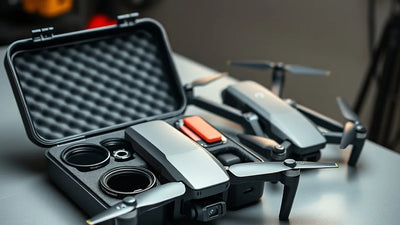
Insta360 Luna Ultra: Leica-Co-Engineered Gimbal Camera Challenges DJI Pocket Series
Insta360’s Luna Ultra, co-engineered with Leica, shatters the pocket gimbal camera market with a 1-inch sensor and 8K video. For drone operators using onboard gimbals for aerial mapping and inspection, this signals a paradigm shift in payload weight, GSD accuracy, and post-processing workflows. Commercial UAV pilots under Part 107 must assess compatibility with existing flight stacks and weight limits. Reboot Hub analyzes the immediate disruption to the second-hand DJI Pocket market and what this means for future drone-mounted camera systems.

Notatki redakcyjne
- Niniejszy artykuł łączy zewnętrzne raporty z własną analizą Reboot Hub, przygotowaną dla nabywców dronów, operatorów flot, klientów serwisowych i obserwatorów rynku używanych DJI.
- Fakty źródłowe są oddzielone od interpretacji. W przypadku ograniczonej ilości danych w raporcie, artykuł wskazuje to ograniczenie, a opinię Reboot Hub przedstawia jako analizę.
- Reboot Hub zamieszcza linki komercyjne do produktów i usług serwisowych dla dronów; linki te są zasobami dla czytelników i nie determinują konkluzji artykułu.
On June 11, 2026, Insta360 officially unveiled the Luna Ultra, a Leica co-engineered gimbal camera that immediately reshapes the landscape of compact stabilized imaging. With a large 1-inch CMOS sensor, native 8K video recording, onboard AI-powered subject tracking, and a built-in three-axis stabilization system-all housed in a device small enough to slip into a pocket-the Luna Ultra directly challenges DJI's long-dominant Pocket series. For the commercial UAV industry, where every gram of payload and every frame of stabilized footage counts, this is far more than a consumer gadget release. It is a harbinger of new possibilities in aerial cinematography, mapping, and inspection workflows.

The drone market has historically borrowed heavily from ground-based camera innovations. Compact gimbals from the DJI Pocket line have been adapted by third-party engineers for lightweight aerial platforms, enabling operators to capture cinema-quality b-roll without dedicated heavy payloads. The Luna Ultra, with its Leica optical heritage and higher resolution ceiling, threatens to upend that ecosystem. For commercial drone operators flying under FAA Part 107 or equivalent regulations, the implications touch every layer of operation-from aircraft weight and balance to data pipeline compatibility and post-processing throughput. Reboot Hub, as a trusted source for second-hand drone valuations and professional repair services, has closely tracked this launch. Below, we break down what the Luna Ultra means for pilots, fleet managers, and the pre-owned market.
The Luna Ultra at a Glance: Key Specs and Design
At the core of the Luna Ultra is a 1-inch type sensor co-developed with Leica Camera AG. This sensor size matches the DJI Pocket 3's sensor but pushes resolution to 8K at up to 30 frames per second, with 4K 120 fps available for high-frame-rate capture. The gimbal offers 360-degree pan, 180-degree tilt, and 120-degree roll with intelligent follow modes that leverage computer vision algorithms trained on thousands of hours of footage. Insta360 claims the AI tracking works even in low-light conditions down to 1 lux, a notable improvement over the Pocket series.
Reader resources
Turn this drone news into a practical next step.
Compare inspected pre-owned DJI drones, repair options, and trade-in timing before the market moves again.
Physically, the device weighs 198 grams and measures 112 x 56 x 28 mm. That makes it slightly heavier and thicker than the DJI Pocket 3 (179 g), but the difference is negligible for most drone payload bays. The Luna Ultra is also IP68-rated against dust and water, further widening its use cases in adverse weather. A built-in 1.5-inch articulating touchscreen provides real-time framing, while the optional modular transmitter supports 5.8 GHz video feed up to 10 km for remote operation-a detail that immediately catches the eye of drone operators accustomed to long-range FPV setups.
Implications for Commercial UAV Operators and Aerial Cinematography
For commercial UAV pilots, the Luna Ultra's 8K resolution and 1-inch sensor directly impact ground sample distance (GSD) in aerial mapping. When paired with a lightweight drone, the camera can achieve GSD values below 1 cm per pixel from altitudes around 50 meters, rivaling dedicated mapping payloads like the DJI Zenmuse P1. However, the Luna Ultra is not a drop-in replacement. It lacks the RTK-level geotagging and timestamps required for photogrammetric accuracy without external post-processing. For inspection workflows-especially in energy, infrastructure, and bridge assessments-the high dynamic range and 10-bit color depth provide superior defect visibility in shadowed areas.
Additionally, the AI tracking system enables autonomous subject follow for dynamic shots: a drone pilot can set the Luna Ultra on a target (e.g., a moving vehicle or a person) and let the gimbal handle framing while the aircraft follows a pre-planned route. This reduces pilot workload and improves consistency for cinematic B-roll. Yet operators must verify compatibility with their flight controller and gimbal mount weight ratings. Many mid-range drones like the DJI Matrice 350 RTK have payload limits that can accommodate the Luna Ultra, but older M200 or Phantom 4 series may struggle with the additional mass and shape.
Ready to Upgrade Your Fleet?
Browse our collection of inspected pre-owned DJI drones - inspected, flight-tested, and backed by a 6-month warranty. Save up to 40% versus retail.
What Does the Luna Ultra Mean for the Second-Hand Drone Market?
As a commercial UAV analyst specializing in pre-owned equipment, Reboot Hub sees an immediate ripple effect on the valuation and demand for DJI Pocket-series cameras and their associated mounting kits. The Luna Ultra's Leica branding alone commands a premium; second-hand DJI Pocket 3 units that once held steady at $350-$450 may see a 10-15% depreciation in the coming weeks as early adopters liquidate inventory to fund the upgrade. More broadly, this launch pressures DJI to accelerate its own next-generation Pocket 4 development, which could further destabilize prices of older models.
For drone operators looking to sell a DJI Pocket 3, the window to maximize returns is narrowing. Sellers with units in excellent condition-especially those with original packaging and extra batteries-should list aggressively on platforms like Reboot Hub's marketplace. Conversely, buyers seeking a budget-friendly stabilized camera for less demanding aerial work will find bargains. The used drone market, where gimbal cameras are frequently bundled with aircraft, will also shift: bundles that include a Pocket 3 may need price adjustments to remain competitive against a Luna Ultra-equipped build. Reboot Hub's team is already tracking these price movements across 30+ vendors to provide real-time valuation updates.
Regulatory, Workflow, and Strategic Considerations
Every new camera payload introduced to the commercial UAV ecosystem must pass muster with aviation authorities. The Luna Ultra weighs under 200 grams, which in many jurisdictions exempts it from additional registration requirements if operated as a standalone ground device. However, when mounted on a drone, the total system weight reclassifies the aircraft. Pilots flying under Part 107 must ensure the combined takeoff weight stays under 55 lbs (25 kg) and that the camera does not alter the drone's center of gravity beyond safe limits. Insta360 has not yet published mounting plates or weight distribution diagrams-early adopters should conduct careful balance tests before flight.
On the data side, 8K video at high bitrates demands fast storage and robust post-processing workflows. The Luna Ultra supports microSD cards up to 2 TB and offers USB-C transfer at 10 Gbps. For operators who rely on cloud-based processing tools, the file sizes will require either higher bandwidth or local caching. This is particularly relevant for mapping missions where multiple flights are stitched into orthomosaics. The increased resolution can improve GSD and final map clarity, but only if the processing pipeline can handle the computational load. Drone service providers (DSPs) should evaluate their current hardware against the Luna Ultra's output before committing to fleet-wide adoption.
For everyday pilots and commercial operators who prefer buying pre-owned or refurbished equipment, the Luna Ultra launch reinforces a key strategy: timing the market. Buying a DJI Pocket 3 now at a discount could be smarter than paying retail for a first-gen Luna Ultra that may still have software bugs. Reboot Hub's pre-owned DJI drones include tested gimbals that can be swapped or upgraded as needed. Meanwhile, our professional DJI repair services ensure that even older models remain flightworthy and capable of competing with newer hardware. The second-hand market often lags behind new releases, creating opportunities for value-conscious operators who understand the lifecycle of drone accessories.
In the broader context, the Luna Ultra signals that the convergence of pocket gimbal cameras and drone payloads is accelerating. As stabilization technology miniaturizes and AI tracking becomes standard, the line between consumer sub-250g drones and professional-grade platforms will blur further. Manufacturers like Insta360 may soon release dedicated drone-mounted versions of their cameras, bypassing the need for third-party mounts. That would disrupt the aftermarket accessory ecosystem and force traditional drone makers like DJI to either integrate better cameras or open their platforms to modular payloads. Either scenario favors operators who stay informed and invest in versatile, repairable equipment.
FAQ
Will the Insta360 Luna Ultra work with my DJI drone?
Currently, no official mount kit exists for DJI drones. Third-party adapters may appear in the coming weeks, but operators must ensure the mounted Luna Ultra does not exceed the aircraft's payload capacity or interfere with balance. Always perform a pre-flight weight and center-of-gravity test.
How does the Luna Ultra compare to DJI Pocket 3 for aerial mapping?
The Luna Ultra offers higher resolution (8K vs 4K) and a 1-inch sensor on par with the Pocket 3. However, it lacks onboard RTK or precise timestamping, so external software is needed for photogrammetry. For visual inspection and cinematic work, it outperforms due to better dynamic range and Leica optics.
Is now a good time to buy a used DJI Pocket 3?
Yes, because prices are expected to drop as early adopters sell to fund Luna Ultra purchases. However, check the condition and warranty options. Reboot Hub offers inspected, flight-tested refurbished DJI Pocket units with a 6-month warranty, providing better value and support than random marketplace listings.
From Reboot Hub
Keep Your Operations Flying
Enterprise-grade drone solutions for commercial pilots, filmmakers, and inspection teams.
Pre-owned Fleet
Fully inspected DJI drones with 6-month warranty. Save up to 40%.
Browse Inventory ->