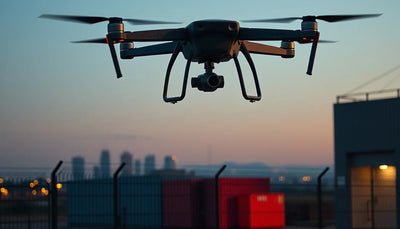
F1 FPV Drone Broadcast: Seven Reliability Gates for Live Events
What the 2026 Austrian Grand Prix drone angle proves, what remains unknown, and Reboot Hub's seven-gate framework for permissions, containment, RF, failover and live-production readiness.

Reboot Hub Industry Analysis
What the Austrian GP Drone Shot Actually Proves
Quick answer: Formula 1's official social channel published a drone-eye view from the 2026 Austrian Grand Prix, and contemporaneous reporting identified an FPV angle in the live race feed. This is evidence that an FPV camera can add a valuable moving perspective inside a tightly managed broadcast operation. It is not evidence that any consumer FPV aircraft, pilot or video link is ready for a crowded live event. The transferable lesson is the operating system around the shot: permission, containment, people, RF, failover and editorial control.
Evidence boundary: Reboot Hub did not have access to Formula 1's aircraft, pilot, RF plan, production switcher or operational authorisation. The aircraft model, camera, control link, image link, latency, flight corridor and event-specific permissions were not identified in the reviewed first-party material. This analysis therefore separates observed broadcast use from the systems that any operator would still need to validate.
Market context
Turn market news into a buy, repair, or trade-in decision.
Compare pre-owned availability, resale timing, and repair economics before the market moves again.

What can be verified
The official Formula 1 account published a fast aerial pass from the Red Bull Ring as a "drone-eye view." Formula 1's official result records the Austrian Grand Prix at Spielberg from June 26 to 28, 2026. DroneXL, which reported while watching the race feed, placed the featured FPV angle on lap 11 and said the footage appeared live and again on replay. Those sources establish the event and the use of the angle, but they do not identify the complete technical system.
The strongest transferable production evidence predates this race. In a May 2025 interview with SVG Europe, Formula 1 executive director of TV production Dean Locke described F1 operating internal drone systems, testing RF and 5G systems, and selecting shots and locations around safety, licensing and insurance constraints. He also described drones as an additional perspective rather than a replacement for established aerial systems.
Important distinction: a visually successful shot proves that a production team obtained a usable image. It does not, by itself, reveal the aircraft's reliability, legal basis, ground-risk controls, link margin or failure containment.
What the public evidence does not establish
No confirmed aircraft or camera
The reviewed first-party material does not name the aircraft, camera, stabilisation method, transmission hardware or pilot. Assigning a model from the appearance of a broadcast clip would be speculation.
No public latency or RF figures
A clip in a programme feed does not disclose glass-to-glass latency, RF path diversity, interference margin, return-video quality or how the feed entered the production switcher.
No permission details
The reviewed sources do not publish the event-specific aviation authorisation, airspace coordination, flight geography or ground-risk mitigation used at Spielberg.
No general product endorsement
A successful specialist operation does not validate a retail FPV system for concerts, races, public roads or other venues. Mission context and local approval remain decisive.
Reboot Hub Aerial Broadcast Reliability Gate
This seven-gate framework converts a dramatic camera angle into a procurement and operations decision. A project should not advance to a live audience until every gate has named evidence, an owner and a stop condition.
Why a crowded race is not an open-category FPV job
EASA states that operations over assemblies of people are not allowed in the open category. It also explains that FPV use in the open category requires an unmanned-aircraft observer beside the remote pilot who keeps direct sight of the aircraft. EASA's FPV guidance says races or events with spectators fall into the specific category. The exact authorisation path depends on the operation and jurisdiction, but the public-event setting cannot be reduced to normal recreational FPV rules.
This matters beyond Formula 1. A venue ticket, public notice or client request does not automatically turn spectators into involved persons. The operational design must address where the aircraft can go after propulsion, command-link or navigation failure, not only where the pilot intends to fly it.
A practical pre-production sequence
- Define the editorial shot first. Specify the subject, movement, duration, usable camera window and fallback angle before choosing an aircraft.
- Classify the operation. Map people, vehicles, structures, airspace, operating volume and contingency volume, then identify the permission route.
- Build the RF plan at the venue. Test the actual control and image paths alongside event communications, broadcast links and local spectrum use.
- Freeze and inspect the aircraft configuration. Record the installed camera, antennas, batteries, props, software and repairs so rehearsal evidence applies to the live system.
- Rehearse normal and abnormal states. Include launch, camera handoff, lost image, degraded control, abort, recovery and continuation without the drone feed.
- Log the result. Retain configuration, battery, flight, RF, incident and production notes so the next deployment starts from evidence rather than memory.
Procurement questions that matter more than top speed
A buyer preparing for live production should ask for a demonstrated end-to-end workflow rather than a maximum-speed headline. The evidence package should show installed endurance, video-link behavior at the venue, camera output into the production chain, safe failure behavior, parts and battery traceability, and the operating limitations that remain after testing.
- What is the measured video latency from camera to production input?
- Which link failures produce an immediate abort, and who calls it?
- How is the aircraft contained if thrust, video or command degrades?
- Can the programme continue cleanly without the drone shot?
- Which maintenance event invalidates the previous flight-test evidence?
Frequently asked questions
Did Formula 1 identify the drone used at the 2026 Austrian Grand Prix?
Not in the first-party materials reviewed for this analysis. The official F1 clip establishes a drone-eye perspective, while event reporting describes the FPV use. The aircraft, camera, pilot and complete production chain should be treated as unconfirmed unless Formula 1 or its operator publishes them.
Does the broadcast prove FPV is safe over spectators?
No. A broadcast image does not reveal the flight geography or safety case. EASA says open-category operations may not fly over assemblies of people, and spectator events can require the specific-category route and operational authorisation.
Is camera quality the main purchasing criterion?
No. Camera output matters, but a live system also needs legal approval, containment, reliable command and image paths, tested failure behavior, maintenance evidence and a production fallback.
Can an operator copy the F1 shot at another event?
Not from the public clip alone. The route, crowd geometry, airspace, permissions, aircraft, link plan and production system must be designed for the new venue.
Related Reboot Hub reference assets
Use the MTS Radar for structured market and technology signals, the Drone News hub for current industry coverage, the Drone Wiki for model and systems reference, and Reboot Hub Data for published datasets and methodology. For hardware triage boundaries, see the source-backed gimbal calibration guide.
Sources and methodology
This page applies an evidence ladder. Official event records and regulator guidance establish dates and rules. Formula 1's official social post establishes the published camera angle. A direct production interview documents F1's broader drone-production approach. DroneXL is used only as contemporaneous observation of where the angle appeared in the race feed. Unknown system details remain labelled as unknown.
- Formula 1 official drone-eye-view post, June 28, 2026
- Formula 1 official 2026 Austrian Grand Prix result
- SVG Europe interview with F1 TV production executive Dean Locke
- EASA guidance on FPV, VLOS and observers
- EASA FPV and spectator-event guidance
- EASA Easy Access Rules for unmanned aircraft systems
- DroneXL contemporaneous report on the Austrian GP broadcast angle
How to cite this analysis
Suggested citation: Reboot Hub Editorial. "F1 FPV Drone Broadcast: Seven Reliability Gates for Live Events." Reboot Hub Industry Hotspot Analysis. Reviewed July 15, 2026.
Canonical URL: https://reboot-hub.com/blogs/industry-hotspot-analysis/f1-puts-fpv-drone-live-on-air-what-it-means-for-commercial-operators
Disclosure: Reboot Hub is an independent drone service, commerce and technical-information company. It is not affiliated with Formula 1, the FIA, EASA, Oracle Red Bull Racing or DJI. No manufacturer or event organiser reviewed or sponsored this analysis.