The Sensor Arms Race Heats Up: Flock Safety's Alpha Camera Takes Aim at Police Drone Dominance
Flock Safety has launched a bold marketing campaign for its Alpha Drone as First Responder (DFR) aircraft, claiming its camera payload carries "more sensors than any rival" and the "most powerful zoom" in the category. This escalation in the sensor arms race has immediate implications for law enforcement procurement, competitive dynamics against DJI and Skydio, and the resale value of older drone systems. For commercial operators and public safety agencies operating under FAA Part 107 or BVLOS waivers, this signals a new standard for aerial surveillance that threatens to render current fleets obsolete. Reboot Hub analyzes the technology, the market disruption, and what this means for your next fleet upgrade.

Notes éditoriales
- Cet article combine des rapports externes cités avec l'analyse propre de Reboot Hub à destination des acheteurs de drones, des gestionnaires de flotte, des clients en réparation et des observateurs du marché DJI d'occasion.
- Les faits sources sont séparés de l'interprétation. Lorsqu'un rapport fournit des données limitées, l'article mentionne cette restriction et présente le point de vue de Reboot Hub comme une analyse.
- Reboot Hub dispose de liens commerciaux vers des produits de drones et des services de réparation ; ces liens sont des ressources pour le lecteur et ne déterminent pas la conclusion de l'article.
The Drone as First Responder (DFR) market is no longer just about flight time or airframe durability. It is now a battle of payloads. On June 3, 2026, Flock Safety fired a major salvo in this war, releasing a high-production marketing video that positions its American-made Alpha aircraft not as a flying platform, but as a "sensor" first and foremost. The slickly produced clip, which has already circulated through law enforcement procurement channels, explicitly claims the Alpha's camera carries more sensors than any rival DFR camera and the most powerful zoom lens in the category.
This is not a minor spec bump. It is a declaration of intent. Flock Safety is betting that the future of public safety drone operations hinges entirely on optical intelligence, not just flight logistics. For the commercial drone industry, the second-hand market, and every operator flying a DJI Matrice or a Skydio X10, this announcement sends a clear, uncomfortable signal: the hardware you bought two years ago may already be classified as legacy equipment.
What Flock Safety is Actually Claiming
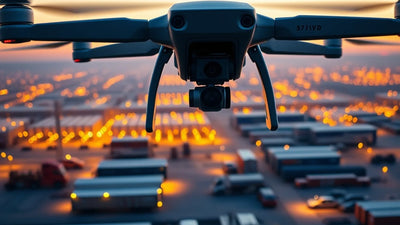
Flock Safety has built its reputation on license plate recognition (LPR) cameras fixed to street poles. The Alpha drone represents a pivot into mobile, airborne surveillance. The new marketing campaign focuses almost exclusively on the camera's capabilities. According to the video, the Alpha's payload integrates multiple sensor modalities into a single, stabilized gimbal, including a high-resolution daylight camera, a thermal imager, and a dedicated LPR camera. The headline feature, however, is the optical zoom, which Flock claims is unmatched in the DFR category.
Fleet readiness
Keep DJI hardware available without overbuying new units.
Use this news as a planning signal for inspected DJI aircraft, repair support, and trade-in timing.
While the company has not released specific millimeter or digital zoom ratios, industry speculation points to a lens system capable of identifying a license plate from over 300 meters away at night. If true, this would dramatically alter the standard operating procedures for police drone units. An Alpha could hover at a legal altitude, observe a scene without intruding on privacy, and still gather evidence-grade imagery. This capability directly addresses the legal and public perception challenges that have plagued police drone programs.
The Sensor Arms Race: DJI vs. Skydio vs. Flock Safety
To understand the gravity of this move, one must look at the competitive landscape. DJI has long dominated the payload market with its Zenmuse series, particularly the H20 and H20T sensors used on the Matrice 300 and 350 RTK. Skydio, with its X10, has emphasized autonomous flight and obstacle avoidance, with its camera being "good enough" for most DFR missions. Flock Safety is now challenging both by making the camera the primary selling point, not the flight computer.
The implication for police departments is clear: if you are spending $30,000 to $60,000 on a DFR system, you are no longer buying a drone that carries a camera. You are buying a camera that happens to fly. This shift in framing could force DJI and Skydio to accelerate their own sensor development, potentially making current generation payloads obsolete faster than the typical 3-5 year replacement cycle.
Ready to Upgrade Your Fleet?
Browse our collection of inspected pre-owned DJI drones - inspected, flight-tested, and backed by a 6-month warranty. Save up to 40% versus retail.
What Does This Mean for Commercial Drone Operators and the Second-Hand Market?
This is the critical question for our readers at Reboot Hub. The Flock Safety Alpha is a purpose-built public safety drone, but its technology trickles down. When a police department upgrades to an Alpha, it floods the secondary market with older, but still capable, drones. We are already seeing an influx of DJI Matrice 300 RTKs and Matrice 30Ts hitting the refurbished market as agencies seek to offload them before their residual value drops further.
For commercial operators in surveying, construction, and inspection, this is a golden opportunity. A Matrice 300 RTK with a Zenmuse H20T, which retailed for over $20,000 three years ago, can now be found as a refurbishment-labeled DJI drone for a fraction of the price. The sensor technology on these units is still more than adequate for 90% of commercial missions, including thermal inspection, orthomosaic mapping, and precision agriculture.
However, the Flock Safety announcement accelerates the depreciation curve. If the Alpha's camera is truly as advanced as claimed, it sets a new benchmark for sensor quality. Commercial clients who demand "police-grade" evidence will start expecting similar resolution from their mapping drones. This means that operators who rely on older payloads may need to factor in an upgrade sooner than planned. The used drone market is currently a buyer's paradise, but that window may close as newer sensor technology becomes the baseline expectation for all professional aerial work.
The Technical Breakdown: Why the Alpha Camera Matters
Let's get into the technical weeds. The claim of "most powerful zoom" in the DFR category implies a lens with a focal length far exceeding the 20x or 30x optical zoom common on the DJI H20 series. A 40x or even 60x optical zoom would allow the Alpha to maintain a standoff distance of over 500 meters while still capturing legally admissible license plate images. This is a game-changer for BVLOS operations, where the drone must stay far from the incident to comply with FAA visual observer requirements.
Furthermore, Flock's integration of a dedicated LPR sensor directly into the gimbal, rather than relying on software processing of a wide-angle camera, suggests a hardware-level optimization for law enforcement. This reduces latency and improves accuracy in low-light conditions. For agencies operating under strict privacy mandates, the ability to capture only license plates without recording surrounding faces or property could be a major selling point.
The Alpha is also American-made, which is a critical factor for agencies receiving federal grants under programs that restrict the use of drones from "foreign adversaries." This gives Flock Safety a direct line to the U.S. Department of Homeland Security and state-level homeland security grants, which are increasingly requiring a "Blue UAS" or equivalent certification.
Impact on the Drone as First Responder (DFR) Ecosystem
The DFR model is spreading rapidly across the United States. Cities like Chula Vista, California, have proven that dispatching a drone instead of a patrol car can reduce response times from minutes to seconds. The bottleneck has always been the sensor. A drone that can identify a suspect's clothing, a vehicle's make and model, and a license plate from a safe altitude is infinitely more useful than one that simply provides a bird's-eye view of a scene.
Flock Safety's aggressive marketing of the Alpha's sensor suite is designed to exploit this exact need. They are not selling a drone; they are selling a solution to the "information gap" that first responders face. By claiming to have the best sensor, Flock is implicitly stating that other DFR drones are flying blind by comparison. This creates a powerful FOMO (Fear Of Missing Out) effect among police chiefs and city council members who are approving these budgets.
What This Means for Your Fleet: A Practical Analysis
For commercial operators, the immediate takeaway is not to panic, but to plan strategically. If you are flying a DJI Matrice 300 RTK with an H20T, you still have a world-class system. The Flock Alpha is a specialized tool for a specific mission profile. However, if you are a public safety agency or a security contractor, the calculus is different. You may need to evaluate whether your current system can match the Alpha's claimed zoom and sensor fusion capabilities.
If you decide to upgrade, do not let your old equipment gather dust. Reboot Hub specializes in turning that obsolete hardware into capital. When you trade in your older drone, it gets inspected, repaired if necessary, and sold as a refurbishment-labeled DJI drone to a commercial operator who needs a reliable workhorse without the new-equipment price tag. This keeps the drone ecosystem circular and sustainable.
Furthermore, for those who want to extend the life of their current fleet, our professional DJI repair services can bring a Matrice 350 or Mavic 3 Enterprise back to factory specifications. A well-maintained older drone with a top-tier sensor is still a formidable tool, even in the age of the Alpha.
Conclusion: The Arms Race is Just Beginning
Flock Safety's new marketing push for the Alpha camera is a watershed moment. It signals that the drone industry has fully transitioned from a "flight-first" to a "sensor-first" paradigm. For law enforcement, this means better evidence and safer operations. For commercial operators, it means a flood of high-quality used drones on the market and a clear roadmap for future upgrades.
At Reboot Hub, we are watching this space closely. The sensor arms race will only intensify. Whether you are buying, selling, or repairing, staying informed is your greatest asset. The Alpha may be the camera to beat today, but in this industry, the next challenger is always just around the corner.
Frequently Asked Questions
Is the Flock Safety Alpha drone available for commercial purchase?
Currently, the Flock Safety Alpha is marketed primarily to law enforcement and public safety agencies. Commercial availability is limited, but the technology it introduces will inevitably influence future commercial products from all major drone manufacturers.
How does the Alpha camera compare to the DJI Zenmuse H20 series?
While specific specifications are not fully public, Flock Safety claims the Alpha has more total sensors and a more powerful optical zoom than any rival DFR camera, which would likely include the H20T. However, the H20N, DJI's night-vision variant, remains a strong competitor for low-light operations.
Will this announcement lower the price of used DJI drones?
Yes. As police departments and security firms upgrade to newer systems like the Alpha, they will offload their existing fleets. This increases supply in the second-hand market, driving down prices for buyers. Reboot Hub is the best place to find these deals on inspected pre-owned equipment.
--
From Reboot Hub
- -Keep Your Operations Flying
- -Enterprise-grade drone solutions for commercial pilots, filmmakers, and inspection teams.
- -Pre-owned Fleet
- - - -Fully inspected DJI drones with 6-month warranty. Save up to 40%.
- - - - Browse Inventory -> - - -Expert Repair
- - - -Professional diagnostics with genuine OEM parts. Same-day estimates.
- - - - Book a Repair -> - - -Spare Parts
- - - -Batteries, propellers, gimbals -- premium OEM components, fast shipping.
- - - - Shop Parts -> - - -