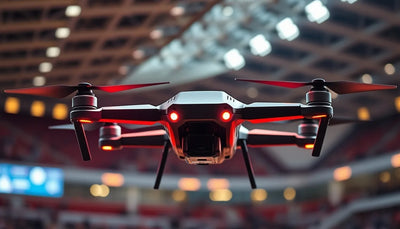
CIIE Signals Shift from Drone Demos to Validated Commercial Work
The China International Import Expo is showing a clear pivot from drone performance spectacles toward embodied intelligence and low-altitude economy applications that must prove real operational value. Buyers and fleet planners should watch which use cases survive validation.

Quick answer
The China International Import Expo is showing embodied intelligence and low-altitude economy technology moving from performance demonstrations into a validation phase focused on real commercial work.
- CIIE observations point to a shift from staged drone shows toward practical operational use cases.
- Embodied intelligence and low-altitude economy applications are now being tested for commercial viability.
- The development signals that buyers and fleet operators should prioritize proven, validated use cases over demonstration claims.
- Source attribution: CLS Telegraph industry report from the CIIE.
Evidence: DJI ROMO official robot vacuum page · DJI Support ROMO beginner guide
Market context
Turn market news into a buy, repair, or trade-in decision.
Compare pre-owned availability, resale timing, and repair economics before the market moves again.

The China International Import Expo is producing a quieter but commercially significant signal this year: embodied intelligence and low-altitude economy technology are moving out of the performance phase and into a validation phase. According to a CLS Telegraph industry report from the expo, the emphasis has shifted from "performance" to "real work," meaning vendors and operators are now under pressure to demonstrate that drones, ground robots, and related autonomous systems can deliver measurable operational value rather than staged spectacle.
For commercial drone buyers, fleet operators, and repair customers, that shift matters more than any single product launch. A validation phase changes how equipment is evaluated, how budgets are justified, and how quickly unproven platforms lose resale value. The report does not name specific models or technical specifications, but the directional change is clear enough to inform procurement and fleet planning decisions.
The CIIE signal: from demonstration to validation
The CLS Telegraph report frames the current moment as a transition. Embodied intelligence, which includes robots and autonomous systems that interact with the physical world, and the low-altitude economy, which covers commercial drone operations, logistics, inspection, and related services, are no longer being judged primarily on whether they can impress an audience. They are being judged on whether they can hold up under real operational conditions.
That is a meaningful distinction for anyone who has watched the commercial drone market mature over the past several years. Early industry events often emphasized acrobatic flight, synchronized light shows, or carefully scripted delivery demonstrations. The CIIE observations suggest that attention is now turning to reliability, repeatability, maintenance costs, and integration into existing workflows. Reboot Hub analysis: this is consistent with a broader commercial drone market pattern in which early enthusiasm gives way to harder questions about total cost of ownership and serviceability.
Why validation matters for fleet planning and procurement
Reboot Hub analysis: When a technology category enters a validation phase, the buying calculus changes. Fleet managers are less likely to purchase based on promotional claims and more likely to ask for pilot program data, uptime records, spare parts availability, and repair turnaround times. The CLS Telegraph report does not provide specific procurement data, but the framing implies that vendors are now being asked to prove operational readiness rather than simply showcase capability.
For commercial operators, this is a useful reminder to slow down procurement cycles and require evidence of sustained performance before committing to new platforms. A drone that performs well in a controlled demonstration may still struggle with dust, moisture, battery degradation, or repeated takeoff and landing cycles in the field. Validation means testing those failure points before scaling a fleet.
What this means for drone owners and the market
The shift toward validated commercial work has direct implications for the pre-owned DJI market and for repair economics. When enterprise buyers become more cautious about unproven platforms, demand tends to consolidate around models with established service histories and accessible spare parts. DJI's dominance in the commercial and enterprise drone segment means that pre-owned DJI airframes often retain stronger residual value than less common platforms, simply because repair networks, OEM-pulled parts, and operator familiarity are more mature.
For individual owners and small fleet operators, the validation-phase signal reinforces the value of buying equipment that can be serviced rather than equipment that can only be replaced. A drone with a documented maintenance history and genuine OEM spare parts availability is a safer operational asset than a newer but less supported platform. Operators who are evaluating their next purchase can use the Reboot Hub Drone Wiki to research platform reliability, repair considerations, and ownership costs before committing to a new or pre-owned unit. For owners evaluating service and lifecycle risk, Drone Wiki explains the relevant repair, parts, resale, or operational path.
The low-altitude economy's validation phase may also affect how quickly certain drone categories depreciate. If a vendor's platform fails to prove itself in real commercial workflows, its secondary market value can drop quickly. By contrast, platforms that accumulate verified operational hours and maintain parts availability tend to hold value better. Buyers in the pre-owned market should therefore pay close attention to which platforms are actually being used in validated commercial operations, not just which platforms generate the most marketing attention.
Commercial implications beyond the expo floor
The CIIE observations point to a broader market discipline that is already visible in logistics, infrastructure inspection, agriculture, and public safety drone programs. Operators in these sectors are increasingly required to document flight hours, maintenance intervals, and incident rates. That documentation becomes the basis for renewing contracts, expanding fleets, and justifying capital expenditure. A validation-phase market rewards operators who treat drones as depreciable, serviceable industrial assets rather than as disposable gadgets.
Repair and parts availability become more important in this environment. When a drone is grounded, the cost is not just the repair bill; it is the lost revenue from a halted inspection contract, a delayed delivery route, or an idle survey crew. Operators who plan for maintenance, keep spare parts on hand, and choose platforms with reliable service channels are better positioned to survive the validation phase than those who optimize only for upfront purchase price.
The CLS Telegraph report does not specify which embodied intelligence or low-altitude economy applications are closest to passing validation, and Reboot Hub cannot independently confirm specific vendor claims from the expo. However, the directional signal is commercially useful: buyers should expect vendors to face harder questions about uptime, serviceability, and real-world performance. That is a healthy development for the market, even if it makes the sales cycle longer and more demanding.
FAQ
Frequently asked questions
What does the CIIE report say about drones and embodied intelligence?
The CLS Telegraph report from the China International Import Expo indicates that embodied intelligence and low-altitude economy technology are moving from performance demonstrations into a validation phase focused on real commercial work.
How should fleet managers respond to the validation-phase shift?
Fleet managers should require documented operational performance, maintenance history, and spare parts availability before scaling purchases. The shift toward validation means procurement decisions should prioritize proven reliability over promotional demonstrations.
Does this affect the pre-owned DJI drone market?
Reboot Hub analysis: Yes. As buyers consolidate around platforms with established service histories and accessible parts, pre-owned DJI drones with documented maintenance and genuine OEM spare parts support are likely to remain more attractive than less supported platforms.
Which sources support this update?
The visible evidence links identify DJI ROMO official robot vacuum page and DJI Support ROMO beginner guide; each source is used only for the claim it directly supports.
What remains subject to change?
Retail pricing, availability, product bundles and regulatory timelines can change. Readers should verify the latest terms with the named retailer, manufacturer or regulator before acting.
How should buyers or operators use this analysis?
Use the verified facts as a starting point, then compare mission fit, lifecycle support, maintenance needs and current procurement terms before making a purchase or fleet decision.
Sources consultées
- Source material - primary source
- DJI ROMO official robot vacuum page - official product page
- DJI Support ROMO beginner guide - official support guide
Reboot Hub Editorial propose des analyses d'achat, de réparation, de revente et d'exploitation pour les propriétaires de drones. Si vous constatez une erreur, contactez-nous pour une demande de correction conformément à notre politique éditoriale.