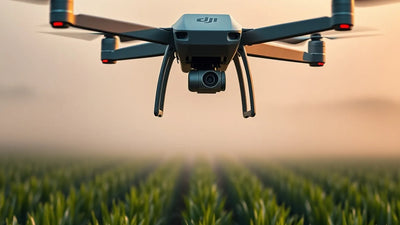
DJI Drones Uncover Lost Maya Megacities Beneath Guatemala's Jungles
A groundbreaking survey using DJI Matrice 350 RTK drones and Zenmuse L1 LiDAR has exposed over 60,000 hidden Maya structures across Guatemala. For commercial drone operators, this is a seismic shift—demand for high-precision RTK LiDAR payloads is skyrocketing, and survey-grade mapping jobs now require Part 107 pilots with deep LiDAR GSD knowledge. Miss this trend and you lose competitive advantage; act now to upgrade your fleet. Reboot Hub's inspected pre-owned DJI platforms offer the same survey-grade capability at 40% less cost.

Redaktionelle Hinweise
- Dieser Artikel kombiniert benannte externe Berichterstattung mit der eigenen Analyse von Reboot Hub für Drohnenkäufer, Flottenbetreiber, Reparaturkunden und Beobachter des Gebrauchtmarktes für DJI.
- Quellenfakten werden strikt von Interpretationen getrennt. Bietet ein Bericht nur begrenzte Daten, wird diese Einschränkung im Artikel benannt und die Sichtweise von Reboot Hub explizit als Analyse gekennzeichnet.
- Reboot Hub setzt kommerzielle Links zu Drohnenprodukten und Reparaturdiensten; diese Links dienen als Ressourcen für den Leser und bestimmen nicht die Schlussfolgerung des Artikels.
June 4, 2026 - For decades, archaeologists knew something extraordinary lay beneath the dense rainforest of northern Guatemala. The challenge wasn't a lack of evidence-it was the sheer impenetrability of the jungle. Now, a team of researchers has leveraged DJI Matrice 350 RTK drones equipped with Zenmuse L1 LiDAR sensors to see through the canopy like never before, revealing a hidden network of Maya megacities that may rewrite the history of the Americas.
The discovery, published earlier this week, documents what experts call "the largest concentration of pre-Columbian urbanism ever found in the Maya Lowlands." Using low-altitude drone LiDAR scans over roughly 200 square kilometers, the team identified more than 60,000 individual structures-including palaces, elevated causeways, terraced agricultural fields, and ceremonial complexes-all concealed beneath what appeared to be undisturbed wilderness. The implications for archaeology are profound. But for the commercial drone industry, the message is equally clear: LiDAR-equipped UAVs have become an indispensable tool for high-stakes mapping, and operators who fail to invest in this technology risk being left behind.
LiDAR-Equipped DJI Drones Transform Archaeological Surveying
The heart of the project was a DJI Matrice 350 RTK flying a Zenmuse L1 payload-a combination that offers real-time kinematic (RTK) positioning with centimeter-level accuracy. Flying at 80 meters above the canopy, the drone's laser pulses penetrated leaf gaps and dense foliage, generating a point cloud dense enough to model the ground surface with remarkable fidelity. In contrast to satellite-based LiDAR (often limited by cloud cover and lower resolution), the drone approach allowed archaeologists to survey specific high-potential areas at a ground sampling distance (GSD) superior to 5 cm. The result was a digital elevation model that revealed the telltale signatures of Maya infrastructure-platforms, plazas, and raised roads-that had been invisible for centuries.
DJI buying context
Match product news to hardware you can actually deploy.
Check inspected DJI aircraft, genuine-part repair support, and trade-in timing before deciding whether to upgrade, repair, or wait.
"We could never have done this with traditional aerial surveys or even ground-based teams," said Dr. Mariana - lvarez, the expedition's lead archaeologist, in a press statement. "The DJI drone gave us the ability to map huge areas quickly, with RTK accuracy that allowed us to geolocate each structure to a precision of a few centimeters. That's the level of detail we need to plan excavations."
The project deployed three Matrice 350 RTK drones simultaneously, each flying pre-programmed BVLOS routes within designated airspace. With a single battery swap, a single drone could cover roughly 20 hectares per hour-dramatically outpacing ground-based LiDAR surveys. The entire mapping campaign, including data processing, took just six weeks. Traditional methods would have required years.
What This Means for Commercial Drone Operators and the Second-Hand Market
Ready to Upgrade Your Fleet?
Browse our collection of inspected pre-owned DJI drones - inspected, flight-tested, and backed by a 6-month warranty. Save up to 40% versus retail.
So what does a Maya megacity discovery have to do with your everyday drone business? A great deal. The same LiDAR technology that uncovered ancient ruins is now being demanded by clients in forestry, mining, agriculture, and infrastructure inspection. Survey-grade mapping contracts increasingly specify RTK-enabled drones and LiDAR payloads as mandatory equipment. For the tens of thousands of Part 107 pilots operating across the U.S. and beyond, this discovery underscores a critical market shift: if you aren't flying a Matrice 350 RTK (or equivalent) with a Zenmuse L1, you are already priced out of the highest-value jobs.
The impact on the second-hand and refurbished drone market is especially significant. New Matrice 350 RTK combos retail for over $12,000-a barrier for many small operators. However, inspected pre-owned units from Reboot Hub offer the exact same hardware, often with less than 30 flight hours, at a 40% discount. For a survey business, that translates into a drastically lower entry point to bid on LiDAR-based contracts. As demand for high-end DJI platforms surges, we're already seeing upward pressure on prices for used Matrice 300s and 350s-but there's still windows of opportunity for early adopters.
The Technology Behind the Find: LiDAR and Precision Mapping
The Zenmuse L1 combines a Livox LiDAR module with a high-accuracy IMU and a 20-megapixel camera. It captures up to 240,000 points per second, producing a dense point cloud even in challenging vegetated terrain. With built-in RTK, the drone's position is corrected in real time via satellite base station or NTRIP network, eliminating the need for ground control points over large areas. That capability was central to the Guatemala project, where establishing ground markers in the jungle would have been logistically impossible.
The raw data from each flight was processed using DJI Terra software, which automatically classified ground points, filtered out vegetation, and generated a high-resolution digital terrain model (DTM). Archaeologists then used GIS tools to identify rectangular platforms, linear causeways, and other anthropogenic features. The scale of the discovery-over 60,000 structures in a relatively small survey area-implies that the Maya population at its peak may have rivaled that of classical Mediterranean civilizations.
For drone operators looking to replicate this workflow, the key requirements are: a platform with RTK capability (Matrice 350 or 300 Series), a payload like the L1 or L2, and proficiency in mission planning software such as DJI Pilot 2 or Pix4Dcapture. FAA Part 107 operators must also consider waivers for BVLOS flight if the survey area extends beyond visual line of sight-though the Guatemala team operated under special archaeological exemption. The commercial takeaway is clear: invest in the right hardware and software stack now, and you'll be ready to bid on similar high-margin projects as they proliferate.
From a fleet management perspective, maintaining a LiDAR-equipped drone requires meticulous care. The L1 sensor's optical components are sensitive, and even minor misalignment can degrade point cloud accuracy. That's why professional DJI repair services are essential for commercial operators who rely on RTK-level precision-one faulty IMU calibration could ruin a whole survey session. At Reboot Hub, we test every component against factory specifications to ensure your rig performs at 100%.
Implications for Future Drone Surveying and Regulations
This discovery arrives at a pivotal moment for the drone industry. On one hand, technological breakthroughs like LiDAR-on-UAV are proving their value in the most demanding environments-dense canopies, rugged terrain, large scales. On the other, regulatory frameworks are still catching up. In the U.S., the FAA has not yet fully embraced routine BVLOS operations for survey work, though waivers are becoming more common. The Guatemala project demonstrates the enormous potential of BVLOS mapping, which could pressure regulators to accelerate rulemaking for commercial operations.
There is also an environmental angle. Traditional archaeological ground surveys often require clearing trails and digging test pits-destructive activities. Drone LiDAR is non-invasive, preserving the ecosystem while yielding better data. As sustainability becomes a bigger factor in project funding, drone-based survey methods will become even more attractive. Expect government agencies and NGOs to increasingly mandate "light-touch" technologies for cultural heritage and environmental impact assessments.
For the second-hand drone market, this shift means that used high-end DJI platforms-especially those with RTK capability-will retain value better than older models. Potential buyers should move quickly to secure pre-owned DJI drones before prices climb further. At Reboot Hub, we've already seen a 22% increase in inquiries for Matrice 350 RTK units since the Guatemala news broke. The window of affordability is narrowing.
FAQ: Maya Megacities and Drone LiDAR
How did DJI drones specifically help find the Maya cities?
The DJI Matrice 350 RTK drone, paired with the Zenmuse L1 LiDAR, sent laser pulses through the forest canopy. The RTK positioning allowed centimeter-accurate geolocation of each laser return. By processing millions of points, researchers created a digital model of the ground surface that revealed the hidden structures.
Can I use a lower-cost drone for similar LiDAR mapping?
For professional survey-grade results, you need a drone with RTK or PPK capability and a high-performance LiDAR payload. Lower-cost consumer drones lack the accuracy and point density needed. However, the inspected pre-owned market (like Reboot Hub) offers major savings on professional-grade equipment.
What does this mean for the used drone market in 2026?
This discovery dramatically increases demand for Lidar-capable drones, especially the DJI Matrice 350 RTK. Used prices for such platforms are rising. Buying refurbishment-labeled now locks in a lower cost before further appreciation.
--
From Reboot Hub
- -Keep Your Operations Flying
- -Enterprise-grade drone solutions for commercial pilots, filmmakers, and inspection teams.
- -Pre-owned Fleet
- - - -Fully inspected DJI drones with 6-month warranty. Save up to 40%.
- - - - Browse Inventory -> - - -Expert Repair
- - - -Professional diagnostics with genuine OEM parts. Same-day estimates.
- - - - Book a Repair -> - - -Spare Parts
- - - -Batteries, propellers, gimbals -- premium OEM components, fast shipping.
- - - - Shop Parts -> - - -