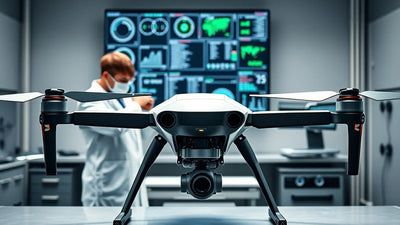
Taiwan’s Bold Play: Becoming the World’s China-Free Drone Hub
Taiwan’s aggressive push to become a China-free drone manufacturing hub could redraw global supply chains, forcing U.S. commercial operators to re-evaluate fleet sourcing for NDAA compliance, BVLOS authorizations, and mission-critical data security — with immediate implications for the second-hand market.

Editorial notes
- This article combines named outside reporting with Reboot Hub's own analysis for drone buyers, fleet operators, repair customers, and pre-owned DJI market watchers.
- Source facts are separated from interpretation. When a report provides limited data, the article states that limitation and frames Reboot Hub's view as analysis.
- Reboot Hub has commercial links to drone products and repair services; those links are reader resources and do not determine the article's conclusion.
The global drone industry has long been a tale of two supply chains: one dominated by Chinese manufacturing, the other scrambling for alternatives. On June 7, 2026, Taiwan formally threw its hat into the ring with a bold strategic initiative to position itself as the world’s premier “China-free” drone hub. Citing trust, resilience, and geopolitical security, Taiwanese officials are betting that escalating tensions between Washington and Beijing will push commercial and defense buyers to source hardware outside of mainland China. The move, reported by The Straits Times, marks a defining moment for the commercial UAV sector — one that could reshape procurement strategies for years to come.

For years, DJI — the Shenzhen-based giant — has commanded an estimated 70% share of the global consumer and enterprise drone market. But a wave of U.S. government bans, including NDAA Section 848 restrictions on Chinese-made drones for federal agencies, and growing concerns over data sovereignty have created a vacuum. Taiwan, with its mature semiconductor ecosystem and long history of electronics manufacturing, is positioning hardware that is both geopolitically neutral and technically robust. But what does this mean for the average commercial drone operator, the fleet manager running daily mapping missions, or the pilot looking for a reliable second-hand platform?
The Geopolitical Urgency Behind Taiwan’s Drone Gambit
The announcement comes at a time when the U.S. government is tightening rules around the use of foreign-made drones, particularly those with components sourced from China. The FAA’s recent updates to Part 107 waivers for BVLOS operations now explicitly require operators to certify that no sensitive data is transmitted to servers located in adversary nations. This has put immense pressure on companies like Skydio, Autel Robotics, and smaller U.S.-based manufacturers to scale production. Yet none have been able to match DJI’s pricing or ecosystem breadth. Taiwan’s advanced manufacturing infrastructure — honed over decades as the world’s top chipmaker — offers a compelling middle ground.
Fleet readiness
Keep DJI hardware available without overbuying new units.
Use this news as a planning signal for inspected DJI aircraft, repair support, and trade-in timing.
According to the Straits Times report, Taiwan plans to leverage its existing expertise in precision engineering and open-architecture designs to produce drones that are interoperable with NATO-standard protocols. The island’s government is offering tax incentives and direct investment in R&D centers focused on secure flight controllers, encrypted datalinks, and domestically sourced sensors. Early prototypes are already being tested by Taiwanese defense contractors, with an eye toward export to allies like Japan, Australia, and European nations.
What the Taiwan Drone Hub Means for U.S. Commercial Operators
Ready to Upgrade Your Fleet?
Browse our collection of inspected pre-owned DJI drones — inspected, flight-tested, and backed by a 6-month warranty. Save up to 40% versus retail.
For the fleet operator flying DJI Mavic 3 Enterprise or Matrice 350 RTK on daily survey jobs, the Taiwan hub raises an immediate question: should I hold onto my existing Chinese-made equipment, or start planning a transition? The answer depends on your customer base. If you fly mostly private land surveying or agricultural mapping, the geopolitical shift may not affect your Part 107 operations today. However, any client with federal funding — such as DOT contracts, USDA programs, or state infrastructure projects — is increasingly requiring NDAA-compliant hardware. That means moving away from DJI and toward platforms built with trustworthy supply chains.
The Taiwan initiative could serve as a bridge. By using Taiwanese components and final assembly, manufacturers can offer drones that are priced closer to Chinese alternatives but with full security guarantees. Early indications suggest Taiwanese-made mid-range platforms could undercut current Western alternatives by 15–20%, making them a viable upgrade path for cost-conscious commercial operators.
What about the second-hand and refurbished market? Here the impact is more nuanced. As large fleets start switching to Taiwan-based platforms, their used DJI drones will flood the resale market. This creates an opportunity for budget-conscious pilots who don’t require NDAA compliance. The influx of pre-owned DJI Inspire 3 and Matrice 300 RTK units will drive prices down, making professional-grade surveying accessible to more operators. But at the same time, demand for fully NDAA-compliant used drones — still a very small segment — could command a premium. For the smart operator, this is a good time to monitor the refurbishment-labeled drone market for deals while Taiwan's ecosystem matures.
Taiwan vs. The World: Can It Really Compete?
The global drone supply chain is notoriously complex. A single DJI drone contains components from 30+ suppliers across China, Japan, South Korea, and the US. Building a completely China-free drone from scratch is expensive. Taiwan’s advantage lies in its existing semiconductor and precision manufacturing infrastructure — companies like TSMC, Foxconn, and Pegatron have long produced high-end electronics for Apple and other Western firms. The challenge is scaling drone-specific subsystems: motors, ESCs, gimbals, and flight controllers that are not currently mass-produced outside China.
To address this, Taiwan’s Ministry of Economic Affairs has announced a ¥30 billion (US$950 million) fund to support domestic drone startups and existing electronics manufacturers in developing modular drone components. The goal is to produce a full-stack, open-architecture drone platform that can be assembled by any certified integrator — reducing reliance on a single vendor. This is similar to the strategy that made Taiwan dominant in PC and smartphone manufacturing.
Early reports from defense expos suggest that Taiwanese prototypes are already performing well in flight endurance and payload capacity, matching the DJI Matrice 400 series in key metrics. However, software ecosystems remain a weak point. DJI’s Pilot app, SDK, and third-party integrations are deeply entrenched. No Taiwanese manufacturer has yet offered a comparable development environment. This gap means that early adopters will need to invest more in software integration, custom Ground Control Stations, or migrating to open-source solutions like ArduPilot.
Regulatory Ripple Effects and the Second-Hand Opportunity
Beyond hardware, the Taiwan hub could accelerate regulatory changes worldwide. The U.S. Department of Defense has already banned DJI for internal use, but the FAA has resisted a full commercial ban due to the lack of alternatives. If Taiwanese drones achieve NDAA compliance and competitive pricing, the FAA may finally feel comfortable phasing out Chinese-made units in critical infrastructure inspections, power line surveys, and public safety operations.
This gradual shift will create a multi-year transition period. During that time, demand for both new Taiwanese drones and inspected pre-owned DJI units will coexist. Operators who upgrade early may recoup value through the resale market, while those who delay may see their Chinese-made drones lose value as policies stiffen. This is exactly the kind of environment where the used drone market thrives — offering liquidity and choice.
At Reboot Hub, we are already seeing inquiries from fleet managers wanting to sell bulk lots of DJI Phantom 4 RTK units to fund purchases of Taiwanese prototypes. While the Taiwanese ecosystem is still 12–18 months away from volume production, forward-looking operators are preparing budgets and aligning with suppliers. For those currently flying DJI equipment, there is no immediate need to panic. However, we recommend starting a conversation about future fleet composition. Our professional DJI repair services can extend the life of your current DJI fleet while you evaluate the Taiwanese alternatives.
FAQ: Taiwan’s China-Free Drone Hub
When will Taiwanese drones be available for commercial purchase?
Based on current announcements, mass production of first-generation Taiwanese drone platforms is expected in early 2028. However, evaluation units and early-adopter programs for enterprise customers may begin as early as mid-2027. Taiwan’s government is prioritizing defense contracts first, but commercial variants are in the pipeline.
Will Taiwanese drones be compatible with DJI accessories and batteries?
No. The Taiwan initiative is building on an open-architecture standard, meaning batteries, payload mounts, and accessories will follow new form factors. They will not be backward-compatible with DJI equipment. This makes it a full ecosystem transition, not a swap-in replacement.
Should I sell my DJI drone now or wait?
If you are flying for a client that requires NDAA compliance, you should plan to transition within the next two years. Waiting too long could see your DJI units depreciate faster as supply of used units grows. However, if you fly non-restricted missions, current DJI drones remain excellent tools. Monitor the used market for buying opportunities as early adopters trade up.
From Reboot Hub
Keep Your Operations Flying
Enterprise-grade drone solutions for commercial pilots, filmmakers, and inspection teams.
Pre-owned Fleet
Fully inspected DJI drones with 6-month warranty. Save up to 40%.
Browse Inventory ->