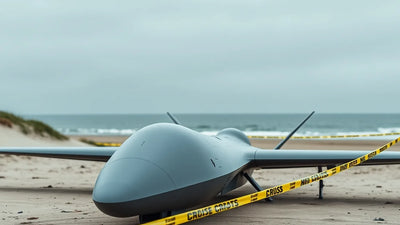
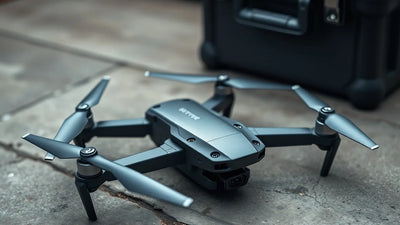
Manna Battles Fingal Council: Drone Delivery Hub Refused Despite Trinity Noise Study
Fingal County Council rejected Manna's Coolmine drone delivery hub on May 19, 2026, citing noise concerns — but Manna has fired back with a Trinity College Dublin acoustic study and a battery of WHO, EU, EASA, ISO, and EPA standards. For commercial operators relying on BVLOS approvals and urban air mobility, this ruling sets a chilling precedent that could delay last-mile drone logistics across the EU. The decision threatens hundreds of jobs and millions in investment unless planning frameworks align with certified noise data. Reboot Hub breaks down the science, the politics, and the market implications for second-hand drone buyers and fleet operators.

Editorial notes
- This article combines named outside reporting with Reboot Hub's own analysis for drone buyers, fleet operators, repair customers, and pre-owned DJI market watchers.
- Source facts are separated from interpretation. When a report provides limited data, the article states that limitation and frames Reboot Hub's view as analysis.
- Reboot Hub has commercial links to drone products and repair services; those links are reader resources and do not determine the article's conclusion.
In a ruling that has sent shockwaves through the European urban air mobility sector, Fingal County Council on May 19, 2026, refused planning permission for Manna's drone delivery hub in Coolmine, Dublin. The decision, which the company has publicly denounced as scientifically unfounded, has triggered a high-stakes battle between the Irish drone logistics pioneer and local planning authorities. Manna's official response, delivered to DroneXL on June 18, leans heavily on a previously unpublished acoustic study from Trinity College Dublin and a comprehensive suite of international noise standards from the World Health Organization, the European Union, EASA, ISO, and the Irish Environmental Protection Agency.

For the drone industry - particularly operators seeking Beyond Visual Line of Sight (BVLOS) approvals and urban hub placements - the Coolmine case is more than a local zoning dispute. It is a bellwether for how legacy planning frameworks interact with new aviation technologies. And it raises a critical question: can a drone delivery operator that meets every known scientific noise threshold still be blocked by subjective local concerns?
The Coolmine Refusal: What Exactly Happened?
Fingal County Council's planning department rejected Manna's proposal for a drone delivery hub in a retail park near Coolmine, County Dublin. The proposed hub would have supported last-mile drone delivery of food, groceries, and pharmaceuticals within a 3-5 km radius. According to the council's decision notice, the primary ground for refusal was "potential noise nuisance to adjacent residential properties," despite the company having submitted extensive noise modelling and mitigation plans.
Enterprise procurement
Turn this market signal into a fleet requirement.
Discuss mission profile, quantities, configuration, delivery, and lifecycle support with Reboot Hub.
Manna's response, published on June 18, draws on a Trinity College Dublin acoustic study that measured the company's drone noise at distances equivalent to those of the nearest homes. The study reportedly found that Manna's drones produce noise levels well below the thresholds set by the WHO's Environmental Noise Guidelines for Europe (2018), the EU's Environmental Noise Directive (2002/49/EC), EASA's certification specifications for noise (CS-23 and CS-27), ISO 3744 for acoustic measurement, and the EPA's own industrial noise guidance.
"We are frankly baffled by a decision that appears to ignore objective, peer-reviewed science," said a Manna spokesperson. "Every relevant standard - from the WHO down to the local EPA - confirms our operations are well within acceptable noise limits. This sets a dangerous precedent for innovation in Ireland and across Europe."
Reboot Hub notes that this refusal comes just weeks after Manna secured a ?40 million investment round to expand across the UK and continental Europe. The company's Coolmine hub was a key node in its Irish expansion strategy. Local residents' groups had expressed concerns about "constant buzzing" from delivery flights, though Manna maintained that its operations would be limited to daytime hours and that the hub would service high-demand retail outlets within a low-density residential area.
Noise Science Under the Microscope: Why the Trinity Study Matters
The Trinity College Dublin study is central to Manna's defence. According to details shared with DroneXL, the study involved placing calibrated microphones at multiple distances and angles from a Manna drone operating at typical delivery altitudes (40-70 m AGL). The results, which Manna has said it will publish in full, showed that maximum noise levels at 50 m distance were between 45 and 50 dBA - roughly equivalent to a quiet conversation or background household noise.
For context, the WHO's Environmental Noise Guidelines for Europe recommends that outdoor noise levels should not exceed 55 dBA Lden (day-evening-night index) to prevent health impacts. The EU's Environmental Noise Directive uses similar benchmarks. EASA's certification process for drone noise - still under development for small UAS - currently references ISO 3744 methodology, which Manna says its tests adhered to.
Yet the council's refusal suggests that even compliant noise levels are not enough when local residents feel disturbed. This raises a fundamental tension in drone regulation: does scientific compliance guarantee planning permission? Or can subjective "nuisance" override certified data? For commercial operators, the answer will determine whether urban drone hubs are a realistic business proposition or a mirage.
Ready to Upgrade Your Fleet?
Browse our collection of inspected pre-owned DJI drones - inspected, flight-tested, and backed by a 6-month warranty. Save up to 40% versus retail.
What Does the Coolmine Refusal Mean for Drone Delivery Operations in Europe?
The obvious impact is on Manna's own expansion timeline. The company had hoped to use Coolmine as a template for future hubs in the Dublin region and beyond. Now, every subsequent application will face heightened scrutiny - not just on noise, but on all grounds where local opposition can muster evidence. The precedent is: even if you meet every standard, you can still be denied.
For the wider industry, the refusal underscores the gap between aviation regulation (where EASA and national authorities like the Irish Aviation Authority set technical standards) and local planning law (where councils apply broader amenity criteria). Drone delivery operators are suddenly caught in a regulatory trap: they need BVLOS permission from the IAA to fly, but they also need planning permission to build hubs. The two processes are not aligned.
Commercial operators using drones for surveying, inspection, and mapping - which do not require fixed hubs - may feel the spillover effects. If local councils begin to tighten noise-based planning conditions on all drone operations, even temporary launch points for construction site inspections could be challenged. This is particularly relevant for pilots operating DJI Matrice 300 RTK or DJI Mavic 3E platforms, which are commonly used for infrastructure monitoring. These models generate similar noise profiles to delivery drones at close range, and a council that rejects a delivery hub might next question a construction drone's base station.
For the second-hand drone market, the implications are more nuanced but no less real. Uncertainty in the commercial drone logistics sector may depress demand for high-end delivery-specific airframes, but could simultaneously boost demand for multi-role platforms that can be adapted for less contentious operations. Reboot Hub tracks these trends daily, and we recommend that fleet managers monitor local planning decisions as carefully as they do FAA Part 107 or EASA regulation updates.
Market Impact: What This Means for Drone Pilots, Commercial Operators, and the Second-Hand Drone Market
The Coolmine refusal sends a strong signal to investors and operators: don't assume regulatory alignment. This creates both risk and opportunity. On the risk side, companies that had bet on Irish drone delivery hubs may need to pivot to less residential locations or reassess their cost models. On the opportunity side, the refusal could spur lobbying for updated national legislation that explicitly ties planning decisions to certified noise data - a move that would ultimately strengthen the industry's hand.
For everyday drone pilots - especially those flying DJI Phantom, Mavic, or Inspire models for commercial work - the direct impact is limited. But the indirect impact is significant: if local councils become more restrictive about where drones can take off and land, even for non-delivery purposes, commercial mapping jobs near residential areas could face new bureaucratic hurdles.
For the second-hand market, the key variable is fleet turnover. If Manna and similar companies scale back their Irish operations, we may see an influx of lightly used delivery drones - potentially DJI FlyCart 30s or other cargo platforms - hit the resale market. Conversely, if drone delivery becomes politically untenable in suburban Europe, investment may shift toward high-end inspection and surveying drones, which are less politically sensitive. Reboot Hub's marketplace already reflects this divergence, with increased demand for rugged survey platforms like the DJI Matrice 350 RTK alongside steady interest in refurbished Mavic 3E units. For operators looking to enter or expand in the market, now is the time to evaluate local planning climates alongside hardware needs.
We also note that the regulatory uncertainty may drive some commercial operators to delay fleet purchases, waiting for clarity on where drone operations will be permitted. This could create a temporary oversupply of used drones, pushing down prices - a potential advantage for budget-conscious buyers. Reboot Hub's inventory of pre-owned DJI drones offers a cost-effective entry point for operators who want to hedge their bets. Similarly, owners of active fleets can take advantage of the market softness by upgrading through our used drone market, where supply is currently outpacing demand.
For those needing to keep existing equipment airworthy amid shifting operational zones, our professional DJI repair services ensure fast turnaround with genuine parts, a critical capability when every flight hour counts.
Global Precedents and the Path Forward
The Coolmine case is not an isolated incident. In the United States, drone delivery operators have faced similar local pushback, notably in small towns where residents complain of noise even when FAA Part 107 operators maintain compliance. The difference is that in the US, the FAA has preempted local government from regulating drone flight in navigable airspace, though landing zones and takeoff points remain under local zoning control. In the European Union, the situation is more fragmented: EASA sets technical rules, but land-use planning remains a member state (and often local council) competence.
Manna's strategy - to publicly release the Trinity study and engage with higher-level planning bodies - may prompt the Irish government to issue a ministerial directive or update the Planning and Development Act to incorporate drone hub noise standards. Such a move would align Ireland with more advanced frameworks like those in Singapore or Norway, where drone noise is regulated by national aviation authorities rather than local councils.
EASA, for its part, is working on a standardised noise measurement methodology for small UAS as part of its "U-space" regulatory package. If adopted, this could give drone operators a single, hard datum to present at planning hearings, potentially avoiding the subjective "nuisance" trap. But until that methodology is finalised - likely in 2027 - operators remain vulnerable.
Frequently Asked Questions
1. Was Manna's Coolmine hub refused solely on noise grounds?
According to the council's decision notice, the primary reason was "potential noise nuisance to adjacent residential properties." However, Manna's response indicates they also addressed visual amenity and traffic concerns. The noise issue was the decisive factor, which is why the Trinity study is central to their rebuttal.
2. Can Manna appeal the decision?
Yes. Manna can appeal to An Bord Plean - la, the national planning appeals board, within four weeks of the decision date. They have already signalled their intent to do so. The appeals process typically takes 3 to 6 months, during which time the hub cannot operate.
3. How does this affect second-hand drone prices?
Short-term, the uncertainty may depress demand for delivery-specific drones, while increasing interest in multi-role platforms. However, because Manna operates a custom fleet rather than off-the-shelf drones, the immediate effect on the general second-hand market is indirect. We recommend watching for a potential supply glut of used cargo drones if delivery operators scale back their Irish operations.
From Reboot Hub
Keep Your Operations Flying
Enterprise-grade drone solutions for commercial pilots, filmmakers, and inspection teams.
Pre-owned Fleet
Fully inspected DJI drones with 6-month warranty. Save up to 40%.
Browse Inventory ->