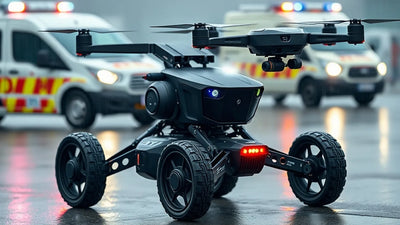
Mercedes-Benz and Tytan Technologies Arm the G-Class with Drone Interceptors at ILA 2026
With Mercedes-Benz and Tytan Technologies signing a pact at ILA 2026 to mount drone-killing systems on the G-Class and Sprinter, the counter-UAS market enters a new era. For commercial operators running BVLOS missions under EASA regulations, this signals tightened airspace enforcement and potential compliance costs that could redraw drone flight maps across Europe.

ملاحظات تحريرية
- تجمع هذه المقالة بين التقارير الخارجية المذكورة مع تحليل Reboot Hub's الخاص لمشتري الطائرات بدون طيار ومشغلي الأساطيل وعملاء الإصلاح ومراقبي السوق مستعمل DJI.
- يتم فصل حقائق المصدر عن التفسير. عندما يوفر تقرير بيانات محدودة، تنص المقالة على عرض القيود والإطارات Reboot Hub's كتحليل.
- لدى Reboot Hub روابط تجارية لمنتجات الطائرات بدون طيار وخدمات الإصلاح؛ هذه الروابط هي موارد للقراء ولا تحدد نتيجة المقال.
Today, June 12, 2026, at the ILA Berlin Air Show, Mercedes-Benz signed a landmark memorandum of understanding with Munich-based counter-drone startup Tytan Technologies. The agreement, witnessed by Germany’s federal economics minister, commits the Stuttgart automaker to develop vehicle-mounted anti-drone systems built on the military-grade G-Class SUV and the Sprinter van. This deal marks a pivotal moment in the evolution of mobile counter-UAS (C-UAS) platforms, merging automotive industrial power with agile defense technology.

The partnership directly addresses a growing threat: small drones—often commercial quadcopters modified for nefarious use—that have become the weapon of choice for asymmetric adversaries, smugglers, and even hobbyists straying into restricted airspace. Tytan Technologies, founded in 2021, has rapidly gained reputation for its kinetic and directed-energy interceptor systems that can detect, track, and neutralize drones at ranges exceeding 2 kilometers. By integrating these systems into Mercedes-Benz’s rugged G-Class platform, the two companies aim to deliver a rapidly deployable solution for military convoys, border patrol, critical infrastructure protection, and VIP security.
Mercedes-Benz and Tytan: A New Alliance in Anti-Drone Defense
The agreement formalizes a collaboration that had been rumored since early 2025. Mercedes-Benz, already a supplier of militarized vehicles to NATO forces, sees the C-UAS market as a natural extension of its defense portfolio. Tytan’s modular interceptor payloads can be swapped between the G-Class and the larger Sprinter platform, offering scalability from a single-vehicle escort to a mobile command node. The system uses passive RF scanning, infrared tracking, and a multi-layered effector suite that includes both a soft-kill jammer and a hard-kill kinetic interceptor.
Fleet readiness
Keep DJI hardware available without overbuying new units.
Use this news as a planning signal for inspected DJI aircraft, repair support, and trade-in timing.
ILA 2026, one of Europe’s premier aerospace and defense exhibitions, provided the stage for the announcement. The German federal economics minister, Dr. Annalena Baerbock, hailed the partnership as a model for “dual-use technology development where commercial automotive engineering meets national security requirements.” Under the MoU, a prototype is expected within 12 months, with serial production potentially starting in 2028.
This move places Mercedes-Benz in direct competition with established defense contractors like Rheinmetall and Diehl Defence, who already offer vehicle-mounted C-UAS solutions. However, Mercedes-Benz brings a production scale and global service network that could lower costs and accelerate deployment.
What This Means for Commercial Drone Operators
The rise of military-grade C-UAS systems inevitably impacts the regulatory and operational environment for commercial drone pilots. While today’s announcement targets military and government customers, the technology often trickles down or influences civilian airspace security measures. Let’s examine the likely implications:
Q: Will this affect civilian drone flights around critical infrastructure in Germany and the EU?
A: Almost certainly. The German Federal Ministry of Economics has already signaled that vehicle-mounted C-UAS systems like the Tytan-Mercedes platform will be trialed at airports, power plants, and large public events. This means geofencing and active detection zones may expand. Commercial operators flying under EASA’s specific category—particularly BVLOS operations—will face stricter remote identification requirements and potential real-time tracking via the U-Space system. Failure to comply could result in immediate interception and penalties up to €500,000 under the German LuftVO (Air Traffic Regulations).
Q: How does this impact the drone hardware supply chain?
A: Defense contracts deplete production capacity for high-end components like communication chips and high-resolution sensors. The second-hand market, however, often moves in the opposite direction: as military customers upgrade to new C-UAS-equipped vehicles, they may offload older surveillance drones. For commercial fleet managers, this creates both opportunity and risk. Buying used drones without verifying their compliance with the latest geo-awareness protocols could lead to airspace violations.
Ready to Upgrade Your Fleet?
Browse our collection of inspected pre-owned DJI drones — inspected, flight-tested, and backed by a 6-month warranty. Save up to 40% versus retail.
The Counter-UAS Technology Behind the G-Class Interceptor
Tytan Technologies’ system, codenamed “Valkyrie-I,” combines a passive radar array with optronic sensors and a proprietary machine learning detection algorithm that can classify drone types from the DJI Mavic series to custom-built racing quads. The interceptor module uses a two-stage approach: first, a software-defined radio jammer disrupts command-and-control links on common ISM bands (2.4 GHz, 5.8 GHz, and 1.5 GHz for GPS), then, if the drone continues its flight path, a lightweight kinetic dart is launched to physically disable the rotor assembly.
The G-Class variant runs on a hybrid electric drivetrain, providing silent power to the electronics for up to 8 hours of stationary surveillance. The advanced suspension and all-wheel drive allow the vehicle to traverse rough terrain in pursuit or relocation. An optional rooftop mast raises the sensor suite to 4.5 meters for enhanced line-of-sight engagements.
According to ILA briefing materials, the system achieved over 85% neutralization success rates in trials against micro-drones (under 5 kg) in GPS-denied environments. These figures are comparable to dedicated C-UAS installations found on naval vessels and fixed-site air defense systems, but packaged in a vehicle that can drive on public roads.
Impact on the Second-Hand Drone Market and Fleet Upgrades
For everyday drone pilots and commercial operators, the most immediate effect of the Mercedes-Tytan partnership is psychological and regulatory. As European police and military procure these mobile interceptors, the risk of accidental engagement with civilian drones increases. Operators who fly without Remote ID or with outdated firmware are most exposed. This dynamic creates a strong incentive to either upgrade fleets with current-generation drones that have robust geofencing and anti-jamming features, or to offload older models into the second-hand market.
We are already seeing increased demand for DJI Mavic 4 Enterprise and Autel EVO Max 4T units on the resale market as professionals scramble to comply with impending EASA mandates. Conversely, older units like the Phantom 4 Pro V2.0 and Mavic 2 Enterprise are losing value as their inability to integrate with U-Space services becomes a liability. For fleet managers, the best course of action is to sell or trade in these older models before their residual value erodes further.
At Reboot Hub, we track these shifts in real time. Our marketplace offers inspected pre-owned drones that have been factory-reset and firmware-updated to meet the latest European regulations. If you are considering downsizing an aging fleet, our buy-back program provides immediate cash offers. And for those maintaining current fleets, we recommend upgrading drones with JamecOpto optical payloads for enhanced detection, or booking a range of professional DJI repair services to ensure your equipment is in top condition before the next regulatory audit.
As the counter-drone ecosystem matures, the used drone market bifurcates between high-compatibility assets and legacy hardware. Smart buyers are already focusing on Series 4 DJI enterprise platforms and the latest Autel models, which include advanced security protocols that can survive the type of jamming and spoofing environments that military C-UAS systems create.
We also believe that the Mercedes-Tytan deal will spark a wave of similar military-to-civilian C-UAS deployments. Already, a joint development program between the German Federal Police and several state interior ministries is evaluating mobile C-UAS for protecting airports under the expanded Luftsicherheitsgesetz. For commercial operators who regularly work within 2 nautical miles of such facilities, understanding the type of interceptors in use is becoming a critical pre-flight checklist item.
If you are a fleet manager looking to upgrade to a more secure platform, explore our selection of pre-owned DJI drones — each unit comes with a new battery, latest factory firmware, and a six-month warranty. We also offer trade-in credits on older models, turning a regulatory liability into a budget-positive move.
FAQ: Mercedes-Benz Tytan Drone Interceptors and Your Drone Operations
Will this system be used against general aviation aircraft or only drones?
The Tytan system is specifically designed for small unmanned aircraft systems (UAS) under 25 kg. Its sensors and interceptor playbooks are optimized for the flight characteristics of multirotor and fixed-wing drones. It cannot engage manned aircraft, and its software includes IFF-like filters that ignore ADS-B-equipped traffic. Commercial drone operators flying within regulated airspace should still use standard airspace avoidance procedures.
How does this impact DJI drone users in Europe?
DJI drones are the most commonly tested target for C-UAS systems globally. The Tytan system specifically jams DJI’s OcuSync and Lightbridge protocols, used on the Mavic 3 series and Matrice platforms. However, DJI’s AeroScope system (Remote ID) can help deconflict legitimate flights with government C-UAS operators. As this technology rolls out, drone operators are advised to enable Remote ID on all flights and carry proof of authorization for BVLOS operations.
Can I still sell my used drone to a military buyer?
Military procurement in the EU generally requires new equipment from approved defense suppliers. However, there is a growing niche for used enterprise drones in non-classified training and civilian law enforcement roles. At Reboot Hub, we vet all buyers and ensure compliance with export regulations. If you are liquidating a fleet, our marketplace is the safest channel to reach legitimate commercial and government buyers.
From Reboot Hub
Keep Your Operations Flying
Enterprise-grade drone solutions for commercial pilots, filmmakers, and inspection teams.
Pre-owned Fleet
Fully inspected DJI drones with 6-month warranty. Save up to 40%.
Browse Inventory ->