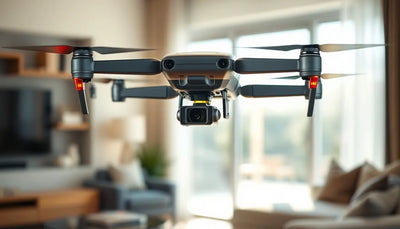
Prodrone’s PD4B-MS: A Fully Domestic Industrial Drone with Supply Chain Implications
Prodrone unveils PD4B-MS prototype, built with all-Japanese components under its new SAMURAI TECH brand. The move signals supply chain shifts that could influence pre-owned DJI drone demand and fleet planning.

Prodrone, the Aichi-based industrial drone developer, has introduced the PD4B-MS prototype — the first model under its newly created SAMURAI TECH brand. The company states that this quadcopter is assembled with core components sourced entirely from domestic Japanese suppliers, making it a fully all-Japanese industrial drone at this prototype stage. The announcement was published in collaboration with the Japan UAS Industrial Development Association (JUIDA), underscoring the national significance of the project.
For commercial fleet operators and drone buyers, a move toward a fully domestic supply chain in Japan is more than a national pride story. It represents a potential shift in how industrial drones are procured, supported, and resold, especially in markets where availability of OEM parts and local repair services are deciding factors. The PD4B-MS, though still a prototype, puts a marker down for what Japanese manufacturing can deliver in the medium-to-heavy-lift segment. Operators accustomed to the dominant DJI ecosystem should take note: this new entrant could influence pricing, service models, and even the flow of pre-owned equipment in coming years.
What makes the PD4B-MS notable

Prodrone has long been a known name in specialized industrial UAVs, but the PD4B-MS is positioned as the first fruit of a deliberate branding shift. The SAMURAI TECH label signals an emphasis on reliability, domestic sourcing, and perhaps a marketing appeal to clients who prioritize supply chain sovereignty. According to the source article, the PD4B-MS prototype uses core components from Japanese suppliers across the board. The company has not released full technical specifications, so range, payload, and flight endurance figures are not yet public.
Market context
Turn market news into a buy, repair, or trade-in decision.
Compare pre-owned availability, resale timing, and repair economics before the market moves again.
What is clear is that the drone is being developed for industrial applications — inspection, agriculture, surveying, and disaster response are typical use cases for Prodrone’s product line. The all-Japan design philosophy means that every major subsystem, from motors and propellers to flight controllers and possibly batteries, is manufactured within Japan’s borders. For fleet operators who have faced long lead times for certain imported electronic components over the past few years, this approach may offer supply chain peace of mind.
It is important to note that the PD4B-MS remains a prototype. There is no announced production timeline, price, or certification status. Commercial buyers should view this as a strategic development rather than an immediate purchasing option.
What this means for drone buyers

For any commercial UAV buyer evaluating their next industrial platform, the PD4B-MS represents both an opportunity and a question mark. The opportunity lies in having a domestically built alternative that could eventually come with local warranty support, faster parts availability, and perhaps simpler compliance with regional procurement rules in Japan or other Asia-Pacific markets. The question mark is timing — prototypes can take 12 to 24 months to reach serial production, and early batches often carry a price premium.
In the near term, buyers should not rush to postpone purchases. DJI’s current industrial fleet — models like the Matrice 350 RTK and Matrice 30 series — remain widely available and deeply integrated into operational workflows. However, this announcement is a reminder that the drone hardware market is not static. If Prodrone successfully scales the PD4B-MS, the pre-owned DJI drone market may see increased supply as some operators begin to diversify. For those looking to upgrade or expand their fleet today, the smartest move may be to keep an eye on supply chain developments while capitalizing on current availability of pre-owned DJI drones. A well-timed purchase — especially of an inspected pre-owned DJI drone — can hedge against potential future price fluctuations as new competitors enter the market.
For operators evaluating their next industrial platform, monitoring Japanese supply chain maturation may be as important as tracking DJI’s product cycle. The PD4B-MS is not a reason to delay a buying decision, but it is a reason to include supply chain resilience in any drone investment analysis.
Supply chain independence and operational reliability

The PD4B-MS is built entirely with domestic suppliers. That detail carries weight for fleet managers who have experienced component shortages, export restrictions, or long shipping delays. When a drone’s structural parts, electronics, and software stack all originate within one country, procurement cycles can be compressed and logistics risks reduced.
For repair operations, an all-Japanese supply chain could mean faster turnaround for genuine OEM spare parts. Instead of waiting for cross-continent shipping, repair centers in Japan — and potentially in nearby regions with strong distribution agreements — could stock locally made parts. This is a meaningful consideration for operators who depend on professional DJI repair services using genuine OEM parts: if a new domestic alternative emerges with equally reliable service, buyers gain leverage in negotiating service contracts and turnaround times.
However, the flip side is that new supply chains often start with limited spare part availability and higher per-unit costs until volume ramps up. Prodrone will need to invest in distribution networks and repair training. For now, the most reliable path for operators requiring minimal downtime remains the well-established ecosystem of DJI repair services and the ability to source OEM-pulled parts from inspected pre-owned units. The PD4B-MS prototype is a proof of concept, not a replacement for existing support infrastructure.
The long-term impact on the second-hand market

Whenever a significant new industrial drone platform is announced, the second-hand market feels an indirect effect. If the PD4B-MS gains traction, some enterprise operators and government agencies in Japan and beyond may begin to convert part of their fleet, selling off DJI units that still have strong residual value. This would increase the supply of pre-owned heavy-lift DJI drones, potentially softening prices and giving smaller operators access to capable hardware at lower cost.
Conversely, if Prodrone’s all-Japanese approach drives higher demand for domestically sourced drones in Japan, the effect could be regionally contained. Buyers in North America or Europe may see little immediate change. But for fleet managers who already rely on drone trade-in programs to refresh their equipment, an uptick in pre-owned inventory from Japanese sources could create favorable buying opportunities within 18 to 24 months.
One important variable is the aftermarket. The PD4B-MS will need a network of certified repair facilities and a steady supply of genuine OEM spare parts before operators treat it as a mainstream option. DJI’s global service infrastructure is currently deeper and more proven. For buyers considering a long-term fleet transition, the most prudent approach is to maintain flexibility: keep current DJI equipment in good condition, leverage trade-in value when ready to upgrade, and watch Prodrone’s production progress before committing to a new platform.
Should I wait to buy an industrial drone until the PD4B-MS is available?
Probably not. The PD4B-MS is a prototype with no announced price or release date. DJI industrial drones are proven, widely supported, and available now. If you have a current need, the best strategy is to acquire a platform you can service and support today. Monitor PD4B-MS development for your next planning cycle, but do not delay operational purchases.
How could the PD4B-MS affect pre-owned DJI drone prices?
If Prodrone successfully launches and scales production, some operators — especially in Japan and Asia-Pacific — may sell off DJI units, increasing supply in the pre-owned market. This could moderate prices for buyers of inspected pre-owned DJI drones. However, regional effects may take time to materialize. In the next 12 months, no significant price impact is expected.
Does the all-Japanese supply chain mean better repair support for this drone?
Potentially yes, once production is established. A domestic supply chain can shorten parts lead times and simplify logistics. But for now, the prototype has no service network. For guaranteed repair turnaround, DJI’s global network and the availability of OEM-pulled parts from pre-owned units remain the safer choice for fleet operators.