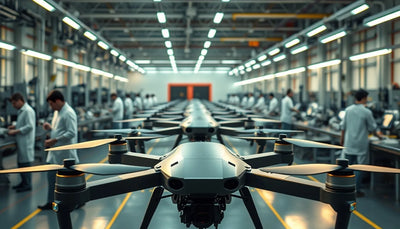
Korean Air Showcases In-House AI Drone Swarm Technology
Korean Air has publicly demonstrated an in-house AI drone swarm capable of coordinated flight and strike operations, according to a Chosunbiz report. The showcase signals accelerating defense investment in autonomous swarm systems and may reshape how commercial operators and fleet buyers think about multi-drone coordination, procurement, and long-term platform value.

Quick answer
Korean Air showcased an in-house AI drone swarm that flies and strikes in Korea, as reported by Chosunbiz.
- The demonstration involved coordinated flight and strike capabilities using AI-controlled drone swarms.
- The system was developed in-house by Korean Air, signaling deeper aerospace investment in autonomous swarm technology.
- The report frames the event as a showcase of domestic defense technology capability in Korea.
- Commercial operators should watch how military swarm coordination research influences enterprise multi-drone fleet tools.
Evidence: Defense.gov official source
Market context
Turn market news into a buy, repair, or trade-in decision.
Compare pre-owned availability, resale timing, and repair economics before the market moves again.

Korean Air has publicly showcased an in-house AI drone swarm capable of coordinated flight and strike operations in Korea, according to a report published by Chosunbiz and distributed through Google News. The demonstration places one of Asia's established aerospace carriers directly in the middle of a fast-moving defense technology race, where autonomous swarm coordination is becoming a strategic priority for military planners and a long-term signal for the broader commercial drone ecosystem.
The report is limited in operational detail, and Reboot Hub has not independently verified specific flight parameters, payload configurations, or deployment scenarios. What is clear from the source is that Korean Air is positioning itself as a developer of AI-enabled swarm systems rather than simply an integrator or operator of third-party platforms. That distinction matters for anyone tracking how aerospace incumbents are absorbing autonomy into their product roadmaps.
Why an airline is investing in AI drone swarms
The Chosunbiz report frames the Korean Air demonstration as an in-house development effort, which suggests the company is building internal engineering capacity around autonomous multi-aircraft coordination. For a commercial carrier with deep aerospace maintenance, logistics, and systems integration experience, moving into AI swarm technology is a logical extension of existing competencies rather than a complete departure from its core business.
From a market perspective, this is part of a broader pattern in which established aerospace and defense firms are absorbing autonomy startups, hiring software engineers, and testing swarm behaviors that were experimental only a few years ago. The operational implication for commercial drone buyers is that coordinated multi-aircraft flight is moving from research labs toward practical deployment, even if the immediate use case is military. Fleet managers who currently operate single-aircraft workflows should treat this as an early indicator of where enterprise drone software is heading over the next several years.
What the demonstration signals about defense procurement
The Korean Air showcase arrives at a time when defense agencies in multiple regions are evaluating swarm capabilities for reconnaissance, electronic warfare, and strike missions. A domestic aerospace company demonstrating this technology publicly is often a signal to procurement officials that the capability exists within national industry, which can influence future tender requirements and funding priorities.
For commercial operators, defense procurement trends have historically been a leading indicator for enterprise drone features. Technologies such as obstacle avoidance, thermal imaging, and autonomous return-to-home all matured in military or industrial contexts before becoming standard in commercial platforms. AI swarm coordination may follow a similar path, with defense investment funding the underlying autonomy software that later appears in simplified form for inspection, agriculture, mapping, and logistics fleets.
What this means for drone owners and the market
The Korean Air report does not mention DJI, consumer platforms, or the pre-owned drone market directly. However, the development still carries implications for commercial drone owners and buyers. When defense-focused firms demonstrate autonomous swarm capabilities, it accelerates the broader conversation about multi-drone operations, airspace coordination, and the software layer that manages fleets. Operators who currently fly individual aircraft for surveying, inspection, or agricultural work may find that coordinated multi-aircraft tools become a differentiator in competitive bidding within a few years. For owners evaluating service and lifecycle risk, Drone Wiki explains the relevant repair, parts, resale, or operational path.
For buyers evaluating pre-owned DJI drones and fleet planning, the key takeaway is that platform value increasingly depends on software and coordination capability rather than hardware alone. A well-maintained airframe remains important, but the long-term usefulness of any commercial drone purchase will be shaped by how well it integrates with evolving autonomy and fleet management tools. Operators researching platform longevity and parts availability can consult the Drone Wiki to understand how hardware condition, OEM-pulled parts, and repair decisions affect the useful life of a commercial drone investment.
Fleet managers should also watch whether AI swarm demonstrations lead to new regulatory conversations about multi-aircraft operations. If defense agencies normalize coordinated autonomous flight in controlled airspace, civilian regulators may eventually create pathways for commercial multi-drone missions. That would shift procurement calculations toward platforms with robust software ecosystems and away from hardware-only purchase decisions.
What to watch next
The Chosunbiz report does not specify a timeline for further demonstrations, production contracts, or export opportunities. Reboot Hub analysis suggests that the most important follow-up signals will be whether Korean Air pursues government procurement contracts, partners with defense electronics firms, or licenses its swarm coordination software to other aerospace manufacturers. Any of those moves would indicate that the technology is transitioning from demonstration to a revenue-generating product line.
Commercial operators should also monitor whether similar swarm demonstrations appear from other aerospace carriers in Asia and Europe. If multiple incumbents begin showcasing in-house autonomous swarm systems, it would confirm that the technology is becoming a standard capability expectation rather than a niche experiment. For drone buyers, repair customers, and fleet planners, that would reinforce the importance of selecting platforms with strong software support and clear upgrade paths.
FAQ
Frequently asked questions
What did Korean Air demonstrate?
According to a Chosunbiz report, Korean Air showcased an in-house AI drone swarm capable of coordinated flight and strike operations in Korea. Specific technical parameters were not detailed in the source.
Does this affect commercial drone buyers?
Not directly in the short term, but defense investment in autonomous swarm technology often precedes commercial adoption of similar coordination features. Fleet managers should treat this as an early signal of where multi-drone software is heading.
Should I change my drone purchasing plans because of this news?
No immediate change is warranted based on this single demonstration. However, operators planning long-term fleet investments should prioritize platforms with strong software ecosystems and consider how multi-aircraft coordination might affect future operational requirements.
Which sources support this update?
The visible evidence links identify Defense.gov official source; each source is used only for the claim it directly supports.
What remains subject to change?
Retail pricing, availability, product bundles and regulatory timelines can change. Readers should verify the latest terms with the named retailer, manufacturer or regulator before acting.
How should buyers or operators use this analysis?
Use the verified facts as a starting point, then compare mission fit, lifecycle support, maintenance needs and current procurement terms before making a purchase or fleet decision.
參考來源
- CHOSUNBIZ via Google News - primary source
- Defense.gov official source - official government source
Reboot Hub 編輯部為無人機所有者提供購買、維修、轉售及營運分析。若發現錯誤,請根據我們的編輯政策聯絡我們進行更正審查。