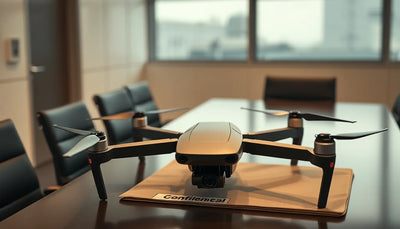
Germany Opens Counter-Drone Test Center After Leipzig Explosive Drone
Germany has opened a dedicated counter-drone security technology center at Cochstedt airport, two weeks after an explosives-laden drone struck a Ukrainian An-124 cargo aircraft at Leipzig. The timing signals faster European investment in detection, mitigation, and airport defense testing.

Quick answer
Germany opened the DLR Drone Security Technology Center at Cochstedt airport two weeks after an explosives-laden drone struck a Ukrainian An-124 at Leipzig, according to DroneXL.co.
- The center is operated at Cochstedt airport and focuses on counter-drone security technology testing.
- The opening follows a reported explosive drone strike on a Ukrainian An-124 cargo aircraft at Leipzig.
- The timing points to accelerated European investment in airport counter-drone detection and mitigation.
- Commercial operators should monitor how new testing standards affect airport-proximal flight rules and security procurement.
Evidence: DroneXL.co · AeroVironment unmanned systems solutions · FAA UAS official guidance
Market context
Turn market news into a buy, repair, or trade-in decision.
Compare pre-owned availability, resale timing, and repair economics before the market moves again.

Germany has opened a dedicated counter-drone security technology center at Cochstedt airport, according to reporting by DroneXL.co. The facility, identified as the DLR Drone Security Technology Center, began operations roughly two weeks after an explosives-laden drone reportedly struck a Ukrainian An-124 cargo aircraft at Leipzig. The sequence of events is difficult to ignore: a high-profile airport drone incident followed quickly by a state-backed testing facility aimed at counter-drone defense.
The development matters beyond the immediate security story. European airports, logistics hubs, and aviation regulators have been under pressure to harden airspace against unauthorized drone activity for years. What is changing now is the speed and institutional weight behind counter-drone testing. For commercial drone operators, fleet buyers, and repair customers, the Cochstedt opening is an early signal that airport-proximal operations and security compliance will likely face tighter scrutiny in the months ahead.
What the Cochstedt center represents
DroneXL.co reports that the DLR Drone Security Technology Center is located at Cochstedt airport and is designed to support counter-drone security technology work. The center's stated purpose, as covered in the source, is to test and evaluate systems that detect, track, and mitigate unauthorized drones. Cochstedt offers a controlled airport environment, which is significant because real-world airport testing is difficult to arrange without disrupting scheduled traffic.
The practical implication for security technology vendors and integrators is clear: a dedicated European test range lowers the barrier to validating counter-drone hardware under airport-like conditions. For commercial drone operators, the same facility may become a reference point for what regulators consider acceptable detection and mitigation performance. If a counter-drone system is validated at Cochstedt, it could influence procurement decisions at other European airports and logistics centers.
Reboot Hub analysis suggests the center is less about a single product launch and more about institutional capacity. Germany is building a repeatable testing pipeline, not a one-off demonstration. That kind of infrastructure tends to produce standards, test protocols, and eventually compliance expectations that filter down to everyday drone operations.
The Leipzig incident and the urgency behind the opening
The reported strike on a Ukrainian An-124 at Leipzig is the immediate backdrop for the Cochstedt opening, according to DroneXL.co. An explosives-laden drone hitting a large cargo aircraft at a major European logistics hub would represent a serious escalation in drone-related security incidents. The source does not provide independent confirmation from German authorities, so the operational details should be treated as reported rather than officially verified.
Reboot Hub analysis: Even with that caution, the commercial signal is strong. Airports and cargo operators are likely to accelerate counter-drone investments after any incident involving an aircraft on the ground. The An-124 is a heavy transport aircraft, and Leipzig is a central European cargo node. A successful strike there would push airport operators, insurers, and logistics companies to reassess perimeter security and low-altitude airspace monitoring.
For drone buyers and fleet managers, the lesson is not about panic but about planning. Operations near airports, logistics parks, and critical infrastructure are already restricted in most jurisdictions. What may change is enforcement intensity and the deployment of active mitigation systems that can disrupt a drone in flight. A pilot flying near a hardened airport perimeter could face faster detection and more aggressive response than in previous years.
What this means for drone owners and the market
The Cochstedt opening and the Leipzig incident together point toward a more security-conscious operating environment in Europe. Commercial operators who fly near airports, seaports, rail yards, or large logistics facilities should expect additional scrutiny, whether through expanded geofencing, more frequent authorization checks, or new local restrictions tied to counter-drone deployment. The pre-owned DJI market is not immune to these shifts. Buyers who purchase inspected pre-owned drones for commercial work should consider how security-driven airspace changes may affect resale value, mission flexibility, and insurance costs. Our Drone Wiki tracks evolving operational and ownership considerations for pilots and fleet buyers. For owners evaluating service and lifecycle risk, Drone Wiki explains the relevant repair, parts, resale, or operational path.
For repair customers, the market implication is subtler but real. If European authorities push for more aggressive counter-drone measures, operators may face increased demand for firmware-compliant hardware, geofencing updates, and airspace awareness tools. Drones that cannot receive current security-related firmware or that lack reliable remote identification support could become harder to operate commercially in sensitive areas. That raises the value of keeping aircraft in good repair with genuine OEM spare parts and current software.
Fleet managers should also watch procurement signals. A state-backed test center at an airport is a leading indicator of where public money will flow. Counter-drone detection and mitigation vendors will likely use Cochstedt to validate products for airport and critical infrastructure buyers. That spending may not directly affect consumer drone prices, but it can shape the regulatory environment in which commercial drones operate.
What operators should watch next
The most useful near-term action for a drone buyer or operator is to monitor whether Cochstedt testing produces public standards or recommended practices. If the center publishes test results or contributes to European aviation security guidance, those outputs could influence airport-proximal flight rules, insurance underwriting, and enterprise drone procurement. DroneXL.co's reporting does not yet indicate specific standards or timelines, so this remains an area to watch rather than a settled outcome.
Operators should also review their current flight authorization workflows. If you fly near airports or logistics hubs, confirm that your aircraft, firmware, and remote identification setup meet current local requirements. A security-driven enforcement push tends to catch operators who have delayed updates or ignored airspace notices. The cost of compliance is usually lower than the cost of a grounded fleet or a denied authorization.
Reboot Hub analysis: Finally, the second-hand market may see a split between drones that are easy to keep compliant and drones that are not. Pre-owned DJI aircraft with current firmware support and available genuine OEM spare parts are likely to hold value better in a tightening security environment. Older or unsupported models may become less attractive for commercial work near sensitive sites, even if they remain fine for open-area operations.
FAQ
Frequently asked questions
What exactly happened at Leipzig?
According to DroneXL.co, an explosives-laden drone struck a Ukrainian An-124 cargo aircraft at Leipzig. The report does not include independent confirmation from German authorities, so the details should be treated as reported rather than officially verified.
What is the DLR Drone Security Technology Center?
It is a counter-drone security technology center at Cochstedt airport in Germany. DroneXL.co reports that the facility is designed to test detection, tracking, and mitigation systems for unauthorized drones in an airport environment.
How could this affect commercial drone operators?
Operators flying near airports or logistics hubs may face stricter detection, faster enforcement, and new compliance expectations as counter-drone testing becomes more institutionalized in Europe. Keeping aircraft firmware current and maintaining proper authorization workflows will become more important.
Which sources support this update?
The visible evidence links identify DroneXL.co and AeroVironment unmanned systems solutions and FAA UAS official guidance; each source is used only for the claim it directly supports.
What remains subject to change?
Retail pricing, availability, product bundles and regulatory timelines can change. Readers should verify the latest terms with the named retailer, manufacturer or regulator before acting.
How should buyers or operators use this analysis?
Use the verified facts as a starting point, then compare mission fit, lifecycle support, maintenance needs and current procurement terms before making a purchase or fleet decision.
參考來源
- DroneXL.co - primary source
- AeroVironment unmanned systems solutions - official company source
- FAA UAS official guidance - official regulator source
Reboot Hub 編輯部為無人機所有者提供購買、維修、轉售及營運分析。若發現錯誤,請根據我們的編輯政策聯絡我們進行更正審查。