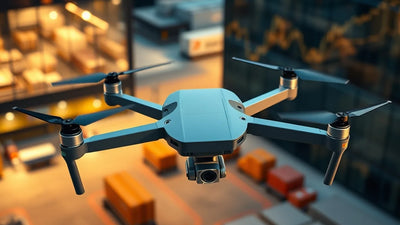
XTEND Drone IPO: The Military Tech Play That's Reshaping the American Defense Industry
Breaking: Israeli defense-tech firm XTEND is already securing multi-million dollar tactical drone contracts before its Nasdaq debut, signaling an explosive U.S. military procurement shift. For Part 107 commercial operators, this means new BVLOS routes for militarized airframes and a tightening supply chain on tactical sensors. Discover what the XTEND IPO means for defense funding, second-hand drone market valuations, and your future operational capabilities. The next frontier isn't consumer photography—it's autonomous battlefield precision.

Редакционные заметки
- Эта статья объединяет данные внешних отчетов с собственным анализом Reboot Hub для покупателей БПЛА, операторов парка, клиентов сервисных центров и наблюдателей за рынком подержанных DJI.
- Факты из источников отделены от интерпретации. Если в отчете недостаточно данных, в статье указывается на это ограничение, а позиция Reboot Hub подается как аналитическая гипотеза.
- Reboot Hub размещает коммерческие ссылки на продукты и услуги по ремонту БПЛА; эти ссылки служат ресурсом для читателей и не определяют выводы статьи.
In a development that signals a paradigm shift in the defense technology landscape, Israeli defense-tech firm XTEND has announced a series of pre-initial public offering (IPO) contract wins, positioning itself as a frontrunner in the booming U.S. tactical drone market. As of today, June 16, 2026, XTEND’s journey to the Nasdaq is not merely a financial event—it is a strategic inflection point for the entire defense drone supply chain.

The company, known for its advanced autonomous drone systems and immersive telepresence platforms, has secured lucrative contracts with allied military forces before its public listing. This aggressive acquisition of government contracts underscores a core thesis: the drone industry has shifted from a speculative technology sector to a critical pillar of national security procurement.
For commercial drone operators, defense contractors, and investors tracking the used drone market, the XTEND IPO offers a stark warning and a massive opportunity. The influx of defense dollars is reshaping the manufacturing pipeline, accelerating the retirement of older commercial platforms, and creating a new tier of high-value, mission-critical hardware that will eventually cascade into the secondary market. At Reboot Hub, we are seeing an uptick in enquiries from firms looking to offload their fleets of top-tier DJI Matrice 30T and Inspire 3 systems to make way for this new generation of tactical hardware.
Enterprise procurement
Turn this market signal into a fleet requirement.
Discuss mission profile, quantities, configuration, delivery, and lifecycle support with Reboot Hub.
The timing could not be more critical. With the FAA pushing forward on BVLOS (Beyond Visual Line of Sight) waivers and the Department of Defense urgently seeking autonomous solutions for contested logistics and surveillance, XTEND’s success story is a harbinger of a defense-led market boom.
Why XTEND’s Pre-IPO Contracts Signal a Defense Tech Tipping Point
XTEND’s business model is unique because it blends off-the-shelf drone hardware with proprietary AI-based autonomy and a “human-on-the-loop” control interface. Unlike traditional drone manufacturers that focus on either hardware or software, XTEND offers a complete tactical operating system. This has allowed them to win contracts in highly competitive environments where reliability and adaptability are paramount.
The company’s primary product, the Wolverine, is a man-portable tactical drone designed for urban warfare. It utilizes a patented immersive control system that allows a single operator to manage multiple drones with minimal training. This capability directly addresses the Pentagon’s critical need for scalable, low-cost mass-effect platforms.
Industry analysts estimate that XTEND’s contract value with an unnamed “major allied military” exceeds $50 million, with options for additional units and software licensing. This is on top of ongoing development contracts with the Israel Defense Forces (IDF) and initial engagements with U.S. Special Operations Command (SOCOM). For a company that hasn't even hit the public market yet, this is an extraordinary vote of confidence.
This rapid contract acquisition is directly tied to the global shift in military tactics toward force multiplication through low-cost drones. The Pentagon has publicly stated its intention to field “thousands of small, attritable drones” by 2028. XTEND is perfectly positioned to fulfill that requirement, and its upcoming IPO is designed to raise capital to scale production to meet this demand.
What does this mean for the regulatory landscape? The Biden administration and subsequent defense appropriations have heavily favored American-made and allied defense technology. With XTEND’s Israeli parentage, the company fits the “trusted partner” model perfectly. This contrasts sharply with the ongoing restrictions on Chinese-made drones like DJI, which continue to face scrutiny under Section 848 of the National Defense Authorization Act (NDAA). As defense dollars flow to XTEND, we can expect further erosion of market share for non-allied platforms in federal and state-funded programs.
Ready to Upgrade Your Fleet?
Browse our collection of inspected pre-owned DJI drones — inspected, flight-tested, and backed by a 6-month warranty. Save up to 40% versus retail.
How the XTEND IPO Disrupts the Commercial and Second-Hand Drone Market
While the defense angle is dominant, the ripple effects of the XTEND IPO and its contract wins will be felt strongly by commercial operators and the broader drone ecosystem. The second-hand market, in particular, is facing a structural shift. When defense contractors win massive scale-up contracts, they often consume the available supply of premium components—particularly sensors, motors, and high-endurance battery packs.
This component squeeze is already driving up the prices of older, high-end commercial drones. For example, a used DJI Matrice 350 RTK, which often shares sensor technology with less militarized platforms, is seeing its residual value hold firm because the supply of new hardware is being diverted to military contracts like those won by XTEND. For small-to-medium enterprises (SMEs) looking to enter the aerial inspection or surveying market, this means the second-hand route is becoming the only affordable path to high performance.
Furthermore, the defense focus on autonomous swarming and tactical accuracy is creating a skills gap. Commercial pilots trained under Part 107 are now in high demand as test pilots and training instructors for these new military platforms. This drives up labor costs across the industry, making the adoption of refurbished hardware—which is already certified and flight-ready—even more economically attractive for civilian applications.
For operators who are looking to enter the defense supply chain, purchasing professional DJI repair services and maintaining a meticulously serviced fleet is essential. The days of flying a stock drone are over; the market now demands military-grade reliability and data security.
Comparing XTEND’s Autonomous Technology to Current Market Standards
To understand the magnitude of XTEND’s achievement, one must compare its technology to existing leaders. DJI’s flagship enterprise series, such as the Mavic 3 Enterprise and Matrice 30 Series, offer advanced obstacle avoidance and AI tracking, but they are fundamentally designed for passive data collection (photogrammetry, inspection). XTEND’s systems are built for active engagement and fluid human-machine teaming.
The core differentiator is XTEND’s “Operator XR” platform, which integrates augmented reality (AR) overlays and real-time autonomous decision-making. This allows a single operator to control multiple drones simultaneously while maintaining situational awareness equivalent to being on the ground. For military applications, this reduces the cognitive load on the operator and increases mission success rates. For commercial applications, it could mean the difference between a routine survey and a complex search-and-rescue operation.
In practical terms, for a BVLOS pipeline inspection or a 3D mapping project that requires rapid data acquisition over a large area, the ability to manage a coordinated swarm autonomously is a game-changer. Currently, most Part 107 operators are limited to single-drone, line-of-sight operations. The industry is watching closely to see if XTEND’s technology will trickle down to civilian variants after the IPO, and what that might mean for FAA certification.
What Does the XTEND IPO Mean for Drone Investors and Operators?
Q: How does the XTEND IPO affect stock market valuations in the drone sector?
The XTEND IPO is likely to act as a catalyst for the entire defense drone index. We expect to see increased valuations for companies like AeroVironment, Kratos Defense & Security Solutions, and Red Cat Holdings. Investors should watch for companies with direct ties to tactical autonomy and munition-carrying quadcopters. The “drone as a service” model is also gaining traction, and XTEND’s success validates this business model.
Q: Should commercial operators be worried about increased regulation due to military drone proliferation?
Yes and no. The FAA is accelerating airspace integration, but the presence of military drones operating under different rules (public aircraft operations) can create temporary airspace closures. However, the technology transfer (such as better anti-collision systems) will eventually benefit all operators. For now, compliance with Part 107 and staying updated on airspace advisories is non-negotiable.
Q: Is now a good time to buy refurbished drones?
Absolutely. The market is flooded with late-model DJI products as enterprises upgrade to meet defense-compatible specifications. We are currently seeing excellent deals on pre-owned DJI drones such as the Phantom 4 RTK and Matrice 210 V2. These platforms are more than capable of handling high-precision mapping and inspection tasks, and they come with significant cost savings.
In conclusion, the XTEND pre-IPO contract wins are not just a story of one company’s success—they are a signal that the drone industry is maturing, consolidating, and aligning with the highest-stakes sector of the global economy: defense. For the savvy operator at Reboot Hub, this trend means that investing in reliable, professional-grade hardware and maintenance is the surest path to profitability in an increasingly competitive landscape.
Frequently Asked Questions
What is the XTEND Wolverine drone?
The XTEND Wolverine is a man-portable tactical drone designed for urban and complex environments. It features an immersive control system that allows one operator to manage multiple drones with minimal training, using AI-driven autonomy and augmented reality interfaces.
How does the XTEND IPO impact FAA Part 107 operations?
While the IPO itself doesn't directly change FAA rules, the focus on military contracts may accelerate the development of advanced BVLOS technologies and airspace integration standards. Commercial operators should expect increased investment in automated collision avoidance systems, which will likely become a requirement for future Part 135 operations.
What is the NDAA's 'Section 848' and why does it matter for drone buyers?
Section 848 of the National Defense Authorization Act prohibits the Department of Defense from procuring foreign-made drones deemed a national security risk, effectively banning DJI products. This has shifted military spending toward allied companies like XTEND, creating a two-tier market where defense-grade hardware is separated from civilian hardware. Second-hand DJI drones remain legal and excellent for civilian use.
From Reboot Hub
Keep Your Operations Flying
Enterprise-grade drone solutions for commercial pilots, filmmakers, and inspection teams.
Pre-owned Fleet
Fully inspected DJI drones with 6-month warranty. Save up to 40%.
Browse Inventory ->