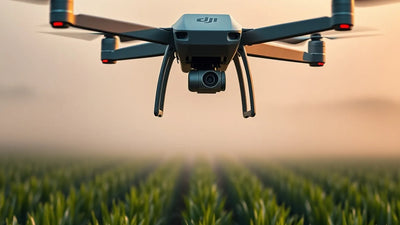
Marines Turn Helicopter Into a Flying Drone Command Center: The Future of Mobile Drone Warfare
The US Marine Corps has successfully tested a Neros Archer FPV drone controlled from a helicopter miles away, transforming rotorcraft into mobile drone command centers. This breakthrough in BVLOS operations and tactical networking creates immediate implications for defense contractors, commercial operators eyeing Part 107 waivers, and the second-hand drone market. As the military pushes for distributed air combat, the demand for ruggedized, network-capable UAVs will skyrocket, reshaping procurement and resale values across the industry.

Notas editoriais
- Este artigo combina reportagens externas nomeadas com a análise própria do Reboot Hub para compradores de drones, operadores de frotas, clientes de reparação e observadores do mercado de DJI usados.
- Os factos das fontes são separados da interpretação. Quando um relatório fornece dados limitados, o artigo indica essa limitação e enquadra a visão do Reboot Hub como análise.
- O Reboot Hub possui links comerciais para produtos de drones e serviços de reparação; estes links são recursos para o leitor e não determinam a conclusão do artigo.
The United States Marine Corps has quietly achieved a breakthrough in tactical drone operations, successfully using a helicopter as a mobile command center for a First-Person View (FPV) drone. In a test conducted recently, troops launched a Neros Archer FPV drone from the ground, then seamlessly transferred control to operators aboard a helicopter orbiting miles away. This development, reported on May 23, 2026, signals a profound shift in how the military-and potentially commercial operators-will integrate drones into complex, mobile airspace.
For an industry already grappling with rapid technological evolution and tightening regulations, this test is more than a military curiosity. It represents a proof-of-concept for true Beyond Visual Line of Sight (BVLOS) operations in contested environments, leveraging existing rotorcraft as airborne networking nodes. The implications for defense contractors, drone manufacturers, and even the second-hand drone market are immediate and far-reaching.
The Test: How the Marines Turned a Helicopter into a Drone Mothership
According to the source article, the test involved a standard Marine Corps helicopter-likely a CH-53K King Stallion or UH-1Y Venom, though the exact platform was not specified-orbiting at a considerable distance from the launch point. On the ground, troops deployed a Neros Archer FPV drone, a small, agile UAV designed for reconnaissance and precision strikes. Once airborne, control was handed off to operators inside the helicopter, who then piloted the drone via a secure data link.
Fleet readiness
Keep DJI hardware available without overbuying new units.
Use this news as a planning signal for inspected DJI aircraft, repair support, and trade-in timing.
The Neros Archer is a lightweight, expendable quadcopter known for its speed and maneuverability, often used in "swarm" or "loitering munition" configurations. By transferring control to a helicopter, the Marines effectively extended the drone's operational range far beyond its standard radio horizon. The helicopter itself becomes a high-altitude relay station, providing a stable, mobile platform for command and control (C2).

This approach solves a critical military problem: how to operate drones deep inside enemy territory without exposing ground-based controllers to direct fire. It also allows for rapid redeployment of the C2 node, as the helicopter can reposition mid-mission. For the Marine Corps, which emphasizes expeditionary and distributed operations, this capability is a game-changer.

What This Means for Tactical Drone Operations
Ready to Upgrade Your Fleet?
Browse our collection of inspected pre-owned DJI drones - inspected, flight-tested, and backed by a 6-month warranty. Save up to 40% versus retail.
The core innovation here is not the drone itself, but the networking architecture. The test validates that a standard tactical helicopter can serve as a C2 hub for multiple UAVs, potentially orchestrating swarms of FPV drones in real-time. This is a direct evolution of the Pentagon's "Advanced Battle Management System" (ABMS) and "Joint All-Domain Command and Control" (JADC2) concepts, which aim to connect every sensor and shooter across air, land, sea, space, and cyber domains.
For commercial drone operators, this test offers a glimpse into the future of BVLOS operations. While the military can bypass civilian airspace restrictions, the underlying technology-secure, low-latency data links, handoff protocols, and mobile ground stations-directly parallels the infrastructure needed for commercial BVLOS flights under FAA Part 107 waivers. If the military can achieve reliable C2 handoff from a helicopter, the same principles could one day allow a delivery drone to be controlled from a moving truck or a maritime vessel.
Ready to Upgrade Your Fleet?
Browse our collection of inspected pre-owned DJI drones - inspected, flight-tested, and backed by a 6-month warranty. Save up to 40% versus retail.
Q&A: What Does the Marine Corps Helicopter Drone Test Mean for Different Audiences?
For Defense Contractors and Drone Manufacturers
Q: How does this test impact the defense drone market?
The test signals a clear requirement for drones that can be controlled from moving platforms. This will drive demand for UAVs with robust, encrypted C2 links that support dynamic handoffs. Expect increased funding for programs like the Marine Corps' "Organic Precision Fires" and the Army's "Future Tactical Unmanned Aircraft Systems" (FTUAS). Companies like Kratos, AeroVironment, and Anduril, which already produce tactical drones with BVLOS capabilities, will likely see accelerated procurement cycles. The Neros Archer itself, produced by Neros Technologies, will gain significant attention as a proven platform for this use case.
For Commercial Drone Operators and Part 107 Pilots
Q: Should commercial operators care about a military test?
Absolutely. The technology validated here-secure, long-range C2 handoff-is the same infrastructure required for commercial BVLOS operations. The FAA has been slowly approving BVLOS waivers for specific use cases like pipeline inspection and agriculture. The military's success in a real-world test provides a powerful precedent for the reliability of such systems. Commercial operators should watch for dual-use technologies emerging from these programs, including mobile ground stations and advanced relay systems, which could eventually become available for civilian use.
For the Second-Hand and Refurbished Drone Market
Q: How will this affect used drone prices and demand?
This development will likely accelerate the retirement of older, non-networked drones from military and government fleets. As the Pentagon pushes for JADC2-compatible systems, legacy platforms like the RQ-11 Raven or even early DJI Matrice models may be phased out faster than expected. This will flood the used drone market with capable but outdated hardware, driving down prices for basic models. Conversely, demand for drones with robust C2 and BVLOS capabilities will spike, increasing the value of higher-end platforms like the DJI Matrice 350 RTK or Autel EVO Max 4T. For buyers, now may be an excellent time to acquire older military-grade drones for commercial mapping or training, while sellers should hold onto any network-capable units.
Commercial Implications: How This Reshapes the Drone Industry
Beyond the military sphere, the Marine Corps test has direct commercial implications. The ability to control a drone from a moving vehicle-whether a helicopter, a truck, or a boat-unlocks new business models. Imagine a search-and-rescue operation where a drone is launched from a fire truck and controlled from a command vehicle miles away. Or a precision agriculture scout launched from a tractor and handed off to a central farm office. The underlying technology is now proven at the highest level of reliability: the US military.
For everyday drone pilots, this means that training and certification will increasingly need to cover BVLOS operations and mobile C2 handoffs. The FAA's current Part 107 framework does not fully address these scenarios, but pressure from both military and commercial stakeholders will force updates. Pilots who invest in understanding networking protocols, data link security, and mobile ground stations will be ahead of the curve.
From a market perspective, the shift toward mobile command centers will drive demand for ruggedized, portable ground control stations (GCS) and high-gain antennas. Companies like Pixhawk, Microhard, and FreeWave, which specialize in long-range data links, will see increased interest. The drone itself becomes less important than the network it connects to. This is a fundamental change from the current model, where the drone's onboard capabilities are the primary differentiator.
For the refurbished drone market, this creates a clear bifurcation. Older drones without network handoff capabilities will depreciate rapidly, while newer models with built-in LTE, 5G, or military-grade encryption will hold their value. At Reboot Hub, we are already seeing this trend in our inventory of pre-owned DJI drones. Models like the DJI M30T, which supports LTE connectivity and RTK positioning, are in high demand, while older Phantom 4 RTK units are becoming more affordable as their capabilities are overtaken by newer networking standards.
Regulatory and Airspace Implications
The test also raises important regulatory questions. If a helicopter can serve as a drone command center, what happens when that helicopter is operating in civilian airspace? The FAA currently requires a visual observer for most drone operations, but a helicopter crew could theoretically serve as that observer. This could pave the way for new waivers allowing "airborne visual observers" for BVLOS flights. However, it also introduces complexity: the helicopter itself must comply with Part 91 or Part 135 regulations while simultaneously acting as a drone C2 node.
For now, the Marine Corps test was conducted in restricted military airspace, so civilian airspace rules were not a factor. But the technology will inevitably migrate to civilian applications. The FAA's BEYOND program and the upcoming BVLOS rulemaking are already considering similar concepts. Operators should expect to see proposed rules addressing mobile C2 platforms within the next 12-18 months.
Technical Deep Dive: The Neros Archer and Helicopter Integration
The Neros Archer FPV drone is a small, fast quadcopter with a flight time of approximately 20 minutes and a range of several kilometers when operating on standard radio frequencies. However, by using the helicopter as a relay, the effective range can be extended to the helicopter's own communication horizon-potentially hundreds of kilometers. The key technical challenge is maintaining a stable, low-latency data link during handoff. The test reportedly used a mesh networking protocol, likely based on the military's "Link 16" or a derivative, which allows multiple nodes to share the data stream seamlessly.
From a hardware perspective, the helicopter was equipped with a specialized C2 terminal, likely a ruggedized version of a standard GCS, mounted inside the cabin. The operator used a tablet or joystick interface to control the drone, with the FPV video feed displayed on a helmet-mounted display or a panel screen. This setup is not fundamentally different from a commercial FPV pilot's kit, but the encryption, reliability, and range are military-grade.
Future Outlook: Swarms, Autonomy, and the Next Decade
The Marine Corps test is just the beginning. The next logical step is to control multiple drones-a swarm-from a single helicopter. This would allow a single airframe to launch and direct dozens of FPV drones for surveillance, electronic warfare, or kinetic strikes. The Pentagon has already invested heavily in swarm technology through programs like "Golden Horde" and "OFFSET." The helicopter C2 concept provides a practical platform for deploying these swarms in contested environments.
For the commercial sector, the same principles apply. A single mobile command center could manage a fleet of delivery drones, inspection drones, or agricultural sprayers. This would dramatically reduce the number of pilots needed and increase operational efficiency. However, it also requires robust fail-safe mechanisms, redundant data links, and sophisticated deconfliction algorithms to prevent mid-air collisions.
At Reboot Hub, we are closely monitoring these developments. As the industry shifts toward network-centric operations, the value of hardware will increasingly depend on its ability to integrate with mobile C2 systems. Our professional DJI repair services already see a growing number of requests for data link upgrades and antenna replacements, as operators retrofit older drones for BVLOS operations. If you are planning for the future, now is the time to invest in network-capable hardware and ensure your fleet is ready for the mobile command center era.
Frequently Asked Questions (FAQ)
Is the helicopter drone command center concept ready for commercial use?
Not yet. The Marine Corps test was conducted in restricted military airspace with specialized hardware. However, the underlying technology-secure data links, handoff protocols, and mobile C2 terminals-is directly applicable to commercial BVLOS operations. Commercial adoption will require FAA rulemaking and certification of the specific hardware, which could take 2-5 years.
What drones are compatible with mobile command center operations?
Currently, military drones like the Neros Archer are purpose-built for this role. On the commercial side, drones with robust API support and LTE/5G connectivity, such as the DJI Matrice 350 RTK, Autel EVO Max 4T, and Skydio X10, are the most adaptable. Older drones without network handoff capabilities will require aftermarket upgrades or replacement.
How will this affect the resale value of my current drone?
It depends on the model. Drones with built-in network capabilities will hold their value or even appreciate, as demand for BVLOS-capable hardware increases. Older drones without these features will depreciate faster as the market shifts toward network-centric operations. Check Reboot Hub's current listings for the most up-to-date pricing on pre-owned DJI drones to gauge the market.
This analysis was prepared by the Reboot Hub Editorial team on May 23, 2026. Reboot Hub is the leading marketplace for inspected pre-owned drones, offering inspection, flight testing, and a 6-month warranty on all inventory. Visit reboot-hub.com for the latest inventory and repair services.
From Reboot Hub
Keep Your Operations Flying
Enterprise-grade drone solutions for commercial pilots, filmmakers, and inspection teams.
Pre-owned Fleet
Fully inspected DJI drones with 6-month warranty. Save up to 40%.
Browse Inventory ->