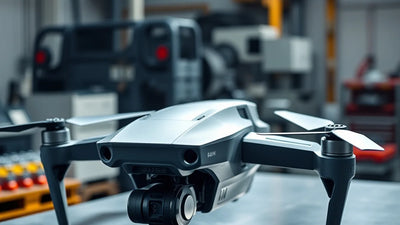
AI in Drones Market to Explode by 2034: Top Trends in Autonomous Navigation and Computer Vision
Discover the AI-driven drone market trends reshaping commercial UAV operations by 2034. Autonomous navigation and computer vision unlock BVLOS routes, slash mapping costs, and demand smarter fleet upgrades. For Part 107 pilots and enterprise operators, ignoring this shift risks obsolescence. Reboot Hub analyzes the data and what it means for your refurbishment-labeled fleet investment today.

Notas editoriais
- Este artigo combina reportagens externas nomeadas com a análise própria do Reboot Hub para compradores de drones, operadores de frotas, clientes de reparação e observadores do mercado de DJI usados.
- Os factos das fontes são separados da interpretação. Quando um relatório fornece dados limitados, o artigo indica essa limitação e enquadra a visão do Reboot Hub como análise.
- O Reboot Hub possui links comerciais para produtos de drones e serviços de reparação; estes links são recursos para o leitor e não determinam a conclusão do artigo.
Reboot Hub Editorial - June 3, 2026
The global drone industry is entering a new intelligence phase. According to a detailed analysis published by vocal.media, trends in the AI in drone market through 2034 point to a decisive shift toward fully autonomous navigation and computer vision systems that will redefine commercial UAV operations. As of June 2026, the convergence of machine learning models, onboard perception algorithms, and affordable compute power is already enabling capabilities that were confined to military-grade systems just five years ago. For Pilots flying under FAA Part 107 or EASA regulations, the takeaway is clear: the next wave of drone technology will not just assist the operator-it will fly the mission autonomously, sense its environment in real-time, and adapt to changing conditions without human input.
This forecast arrives at a critical moment for the second-hand and refurbished drone market. As AI capabilities become standard in new models, older generation drones rapidly lose resale value unless they can be upgraded or integrated with aftermarket AI modules. Reboot Hub, the industry's leading marketplace for inspected pre-owned commercial drones, sees this trend accelerating the turnover of fleets, creating both risk and opportunity for operators worldwide.
Reader resources
Turn this drone news into a practical next step.
Compare inspected pre-owned DJI drones, repair options, and trade-in timing before the market moves again.
1. Autonomous Navigation: From Assisted Flight to True Autonomy
The vocal.media report highlights autonomous navigation as the most disruptive AI trend in the drone market. By 2034, the ability to plan complex BVLOS (Beyond Visual Line of Sight) missions without constant pilot intervention will be a baseline expectation for enterprise drones. Advances in sensor fusion-combining LiDAR, stereo cameras, and ultrasonic rangefinders-allow drones to build and update 3D obstacle maps in real-time. This enables safe navigation through dense urban corridors, beneath bridges, and inside partially collapsed structures for inspection and search-and-rescue.
For commercial operators, this translates to dramatic efficiency gains. A single operator can manage multiple autonomous drones simultaneously, reducing labor costs by up to 70% on large-scale surveying projects. The report notes that AI-powered navigation also reduces human error, which is responsible for over 80% of drone crashes today. Insurance premiums for fleets equipped with Level 5 autonomous navigation are expected to drop significantly by 2030.
2. Computer Vision: The Eyes That Never Blink
Computer vision is the second pillar of the AI-driven drone revolution. Unlike earlier systems that merely recorded video for post-flight analysis, modern computer vision algorithms perform real-time object detection, segmentation, and classification. The report emphasizes applications such as power line inspection, where drones detect corrosion and insulator damage at high speed, and agriculture, where they identify early signs of crop stress from multispectral imagery.
This capability is transforming the accuracy of GSD (Ground Sampling Distance) mapping. Drones with integrated AI can maintain consistent altitude and adjust camera settings autonomously to deliver survey-grade orthomosaics without ground control points. According to the forecast, the computer vision segment of the AI drone market will grow at a CAGR of over 26% through 2034, making it the fastest-growing niche.
Ready to Upgrade Your Fleet?
Browse our collection of inspected pre-owned DJI drones - inspected, flight-tested, and backed by a 6-month warranty. Save up to 40% versus retail.
3. Market Forecast: $47 Billion by 2034
The vocal.media analysis projects the global AI in drone market to reach $47.6 billion by 2034, up from an estimated $8.9 billion in 2025. This represents a compound annual growth rate of 21.5%. The report segments the market by component (hardware, software, services), by application (surveying, inspection, agriculture, delivery, defense), and by region. North America currently holds the largest share, driven by the FAA's progressive BVLOS rulemaking and major investments from companies like Amazon Prime Air and Wing. However, the Asia-Pacific region is expected to overtake North America by 2030, led by Chinese OEMs DJI and Yuneec, and aggressive adoption in Japan and South Korea.
For commercial operators, this growth signals a rapidly maturing ecosystem. Software platforms that integrate AI, such as Pix4Dreact and Auterion, are becoming standardized. The hardware side is seeing fierce competition, with DJI's latest Matrice 400 model offering onboard AI inference at the edge, and Autel Robotics countering with the EVO Max series featuring 4K dual-camera computer vision. The report warns that operators who delay adopting AI-enabled drones will face a widening productivity gap compared to competitors.
4. What This Means for Drone Pilots and the Second-Hand Market
The immediate impact of these AI trends on everyday drone pilots and commercial operators cannot be overstated. For Part 107 certificate holders who own older models like the DJI Phantom 4 Pro or Mavic 2 Enterprise, the lack of integrated AI means they will be increasingly excluded from high-value contracts that demand real-time data processing and autonomous flight logs. The used drone market is already witnessing a bifurcation: AI-equipped second-hand units like the DJI Matrice 300 RTK (which can run third-party AI apps) retain value, while older non-AI drones see steep depreciation.
Reboot Hub's inventory reflects this shift. We are seeing strong demand for pre-owned DJI drones that offer upgrade paths-models that can be retrofitted with AI modules or that already include onboard computer vision capabilities. Operators who want to stay competitive without buying new at full retail price can leverage the used drone market to acquire late-model units that still support the latest firmware and AI features. Additionally, our professional DJI repair services ensure that even older drones can be brought up to reliability standards, though we recommend evaluating the cost-benefit of AI retrofits carefully.
The report also underscores a fundamental shift in pilot training. As autonomous navigation becomes more capable, the role of the pilot changes from manual stick-and-rudder to mission planning and system oversight. The FAA is expected to release updated Part 107 guidance in late 2026 addressing AI-powered autopilot certifications. Operators should invest in training courses that cover AI system behavior, emergency overrides, and data integrity protocols.
For small and medium-sized surveying firms, the decision to upgrade to AI-enabled drones is no longer optional. A single autonomously- navigated mapping flight can collect in one hour what previously took a four-person ground crew a full day. At current market rates, that translates to a return on investment in under six months for most commercial fleets.
FAQ: AI Drone Market Trends
When will autonomous drone flights become fully legal under Part 107?
The FAA is currently evaluating waivers for autonomous BVLOS operations under the BEYOND program. By 2028, the agency is expected to finalize rules allowing certain certified AI-equipped drones to operate autonomously over people and moving vehicles, pending reliability data from manufacturers.
Can I retrofit my existing DJI drone with computer vision AI?
Some third-party modules, such as the DJI Manifold 2 or Nvidia Jetson integration kits, can add AI processing to certain models (e.g., Matrice 200 series). However, retrofitting is complex and often voids warranties. Reboot Hub offers pre-tested pre-owned DJI drones that already include native AI capabilities, ensuring compliance and performance.
How will the AI drone market affect the resale value of my current fleet?
Non-AI drones are depreciating faster than ever. A DJI Phantom 4 Pro V2.0 that sold for $1,500 new in 2020 is now worth around $400-$500 if upgraded with a 3G antenna, but under $300 without AI support. In contrast, a used DJI Matrice 300 RTK with AI payload can still fetch $6,000-$8,000. We recommend checking our weekly used drone market reports at Reboot Hub to time your sale or upgrade.
--
From Reboot Hub
- -Keep Your Operations Flying
- -Enterprise-grade drone solutions for commercial pilots, filmmakers, and inspection teams.
- -Pre-owned Fleet
- - - -Fully inspected DJI drones with 6-month warranty. Save up to 40%.
- - - - Browse Inventory -> - - -Expert Repair
- - - -Professional diagnostics with genuine OEM parts. Same-day estimates.
- - - - Book a Repair -> - - -Spare Parts
- - - -Batteries, propellers, gimbals -- premium OEM components, fast shipping.
- - - - Shop Parts -> - - -