MQ-28 Ghost Bat Now Flying Over the Pacific from U.S. Navy Base: What It Means for the Global Drone Market
The MQ-28 Ghost Bat is now operational from a U.S. Navy base in California, signaling a major leap in collaborative autonomous systems. For commercial drone operators, this means accelerated BVLOS approvals, tighter defense-linked airspace restrictions, and a surge in demand for inspected pre-owned UAVs as military surplus hits the used drone market. Reboot Hub analyzes the disruption.

Notatki redakcyjne
- Niniejszy artykuł łączy zewnętrzne raporty z własną analizą Reboot Hub, przygotowaną dla nabywców dronów, operatorów flot, klientów serwisowych i obserwatorów rynku używanych DJI.
- Fakty źródłowe są oddzielone od interpretacji. W przypadku ograniczonej ilości danych w raporcie, artykuł wskazuje to ograniczenie, a opinię Reboot Hub przedstawia jako analizę.
- Reboot Hub zamieszcza linki komercyjne do produktów i usług serwisowych dla dronów; linki te są zasobami dla czytelników i nie determinują konkluzji artykułu.
On May 30, 2026, the global unmanned aerial vehicle (UAV) landscape shifted decisively. Boeing confirmed that its MQ-28 Ghost Bat, a collaborative combat aircraft originally developed for the Royal Australian Air Force, is now conducting flight operations over the Pacific Ocean from a U.S. Navy base in California. This is not a test of a prototype-it is a demonstration of maturity, a sales pitch to the Pentagon, and a clear signal that the era of loyal wingman drones has arrived.
For the commercial drone industry, this development carries implications far beyond military strategy. The MQ-28's integration into U.S. Navy operations from a mainland base signals a new phase in airspace integration, autonomous systems certification, and the eventual trickle-down of defense-grade technology into the civilian and second-hand drone markets. At Reboot Hub, we assess what this means for operators, investors, and fleet managers today.
The MQ-28 Ghost Bat: From Australian Concept to U.S. Navy Asset
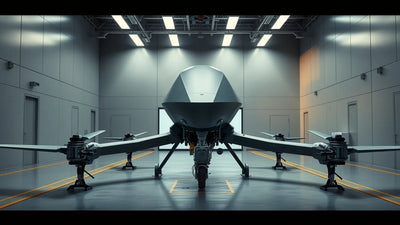
The MQ-28 Ghost Bat, named after the Australian native bat species known for its advanced echolocation, was first unveiled by Boeing Australia in 2020 as a "loyal wingman" for crewed fighters like the F-35 and F/A-18. Its design is a tailless, flying-wing configuration with a length of approximately 11.7 meters, a wingspan of 7.3 meters, and a maximum takeoff weight of around 3,000 kilograms. Powered by a single turbofan engine, it can reach high subsonic speeds and has a range exceeding 2,000 nautical miles.
Fleet readiness
Keep DJI hardware available without overbuying new units.
Use this news as a planning signal for inspected DJI aircraft, repair support, and trade-in timing.
What makes the MQ-28 unique is its artificial intelligence-driven autonomy. It is designed to operate as a team with crewed aircraft, performing sensing, electronic warfare, and strike missions. The aircraft uses a modular payload bay that can be reconfigured for different mission sets-surveillance, reconnaissance, or kinetic engagement. According to Boeing, the current flights from the U.S. Navy base in California are focused on demonstrating the system's maturity, reliability, and interoperability with U.S. command-and-control networks.
The move to operate from a U.S. mainland base is strategic. It signals to the Pentagon that the MQ-28 is ready for deployment in the Indo-Pacific theater, where the U.S. Navy and Air Force are increasingly relying on unmanned systems to counter near-peer adversaries. It also positions Boeing to compete directly with other loyal wingman programs, including Kratos' XQ-58 Valkyrie and General Atomics' Gambit series.
What the MQ-28 Ghost Bat Means for Commercial Drone Operators and the Second-Hand Market
While the MQ-28 is a military asset, its operational debut from a U.S. Navy base has direct and indirect consequences for the commercial UAV sector. First, consider the regulatory environment. The Federal Aviation Administration (FAA) is already under pressure to integrate larger unmanned aircraft into the National Airspace System (NAS). The MQ-28's presence in California airspace-likely operating under special military flight rules and restricted airspace-will accelerate discussions about BVLOS (Beyond Visual Line of Sight) waivers and airspace segregation.
For commercial drone operators flying DJI Matrice 300 RTKs or Autel EVO Max 4Ts on surveying, inspection, or agricultural missions, the immediate impact is increased airspace complexity. Expect more Temporary Flight Restrictions (TFRs) and Notices to Air Missions (NOTAMs) in coastal and military-proximate regions. Operators using pre-owned DJI drones for precision agriculture or infrastructure inspection should plan for longer lead times on flight approvals and consider geofencing updates.
Second, the MQ-28's modular payload architecture-a design philosophy that allows rapid swapping of sensors and mission systems-is now a proven concept. This directly validates the business model of the used drone market, where modularity and upgradability are key value drivers. Commercial operators increasingly seek airframes that can accept new payloads without full replacement, a trend the MQ-28's success will amplify.
Third, the MQ-28 program is generating a pipeline of military surplus components and test assets. As Boeing and the U.S. Navy ramp up production, older test articles and support systems will enter the secondary market. This includes high-endurance ground control stations, encrypted datalinks, and sensor turrets that, after declassification and demilitarization, could be repurposed for civilian applications. Reboot Hub tracks this pipeline closely, offering professional DJI repair services that can integrate legacy components into modern fleet operations.
Ready to Upgrade Your Fleet?
Browse our collection of inspected pre-owned DJI drones - inspected, flight-tested, and backed by a 6-month warranty. Save up to 40% versus retail.
What Does the MQ-28 Ghost Bat Mean for the Global Defense Drone Market?
The MQ-28's debut from a U.S. Navy base is a watershed moment for the defense drone sector. According to a 2025 report by the Teal Group, the global military UAV market is projected to reach $26.5 billion by 2030, with loyal wingman platforms representing the fastest-growing segment. The MQ-28 is now the most advanced and most visible entry in this category, ahead of Kratos' XQ-58A Valkyrie and the European Neuron program.
Boeing's strategy is clear: demonstrate operational maturity from a U.S. Navy base to de-risk the platform for international customers. Australia has already committed to an initial batch of 10 aircraft, with plans for up to 30. The United Kingdom, Japan, and several Middle Eastern nations are reportedly evaluating the system. The MQ-28's modular payload bay-capable of carrying electronic warfare suites, radar systems, or kinetic munitions-makes it attractive for nations seeking multi-role unmanned combat air vehicles without the cost of developing indigenous platforms.
For commercial drone manufacturers like DJI, Autel, and Skydio, the MQ-28's success has a dual effect. On one hand, it validates the long-term trajectory toward autonomous, AI-driven operations, which will eventually trickle down to commercial platforms. On the other hand, it increases regulatory scrutiny on all large unmanned aircraft, including those used for civilian purposes. The FAA's upcoming Part 108 rulemaking for large UAS is expected to incorporate lessons from military integration, potentially imposing stricter certification requirements for commercial operators flying aircraft over 55 pounds.
Q&A: How the MQ-28 Ghost Bat Affects Different Stakeholders
Q: What does the MQ-28 Ghost Bat mean for commercial drone pilots operating under FAA Part 107?
A: In the short term, expect increased airspace restrictions in coastal areas and near military installations. The MQ-28's flights from a U.S. Navy base in California will generate more NOTAMs and TFRs. Pilots flying DJI Mavic 3 Enterprise or Matrice 350 RTK platforms for mapping or inspection should check airspace status daily. In the medium term, the MQ-28's success will accelerate FAA efforts to create a dedicated regulatory framework for large UAS operations, which could introduce new certification pathways for commercial BVLOS flights.
Q: How will the MQ-28 impact the second-hand drone market?
A: Military programs like the MQ-28 generate a steady supply of surplus test equipment, ground stations, and sensor systems. While the MQ-28 itself is not entering the used market, its supporting infrastructure-including high-endurance batteries, encrypted radios, and ruggedized computing platforms-will eventually become available after demilitarization. Commercial operators looking to upgrade their fleets should monitor the secondary market for these components. Reboot Hub's inventory of pre-owned DJI drones already includes models that can accept upgraded payloads from defense surplus channels.
Q: Will the MQ-28's AI autonomy technology be available for commercial drones?
A: Not directly. The MQ-28's AI is classified and optimized for combat operations. However, the underlying principles-sensor fusion, obstacle avoidance, and autonomous decision-making-are already being commercialized by companies like Skydio and DJI. The MQ-28's operational success will increase investor confidence in autonomous UAV startups, potentially accelerating the release of advanced autonomy features in commercial platforms within 3-5 years.
Strategic Implications for the Pacific Theater and Beyond
The MQ-28's flights from California are not merely a technical demonstration; they are a geopolitical signal. The U.S. Navy is positioning unmanned systems as force multipliers in the Pacific, where vast distances and contested airspace make crewed-only operations risky. The MQ-28, with its 2,000+ nautical mile range and modular payload, can serve as a forward sensor node, a communications relay, or a strike platform-all without risking a pilot.
For allied nations in the Indo-Pacific-Japan, South Korea, Australia, and the Philippines-the MQ-28 represents an affordable path to advanced combat capability. At an estimated unit cost of $15-20 million, the Ghost Bat is a fraction of the price of an F-35 ($80-100 million) and can be operated in larger numbers. This cost dynamic is crucial: it mirrors the same value proposition that drives the second-hand commercial drone market, where operators seek maximum capability per dollar.
Boeing's decision to base testing in California also reflects the company's desire to leverage the U.S. defense industrial base. California is home to major Boeing facilities, Edwards Air Force Base, and a concentration of aerospace talent. The proximity to Silicon Valley also facilitates integration of cutting-edge AI and software capabilities, which are increasingly central to modern UAV operations.
What This Means for the Commercial UAV Ecosystem
For the commercial drone industry, the MQ-28 Ghost Bat's operational debut is a double-edged sword. On one hand, it validates the long-term viability of autonomous UAVs, which will eventually benefit commercial operators through improved technology and lower costs. On the other hand, it introduces new regulatory and operational complexities that must be navigated carefully.
Commercial operators should prepare for the following near-term changes:
- Airspace restrictions: Expect more TFRs and restricted zones near military installations, particularly in California, Florida, and the Pacific Northwest. Use apps like AirMap or Kittyhawk to stay updated.
- Regulatory evolution: The FAA will likely accelerate its rulemaking for large UAS, including requirements for ADS-B Out, detect-and-avoid systems, and operator certification. Operators flying DJI Matrice 600 or heavy-lift drones should monitor Part 108 developments.
- Technology transfer: Military-grade sensors, datalinks, and autonomy algorithms will gradually become available for commercial use, often through the used market. Reboot Hub's professional DJI repair services can help integrate these advanced components into existing fleets.
- Market consolidation: As defense contractors like Boeing and Lockheed Martin push into the UAV space, expect consolidation among commercial drone manufacturers. Smaller players may be acquired or forced to specialize in niche applications.
The MQ-28 Ghost Bat is not just a military aircraft-it is a harbinger of the autonomous future. For commercial operators, investors, and fleet managers, the time to adapt is now. Whether you are flying a DJI Mini 4 Pro for real estate photography or a Matrice 350 RTK for industrial inspection, the technologies and regulations shaped by the MQ-28 will affect your operations within the next 12-24 months.
At Reboot Hub, we continue to monitor these developments closely. Our platform offers the largest selection of pre-owned DJI drones in North America, along with repair services that keep your fleet operational and compliant. As the drone industry evolves, we remain your trusted partner for quality, affordability, and expertise.
FAQ: MQ-28 Ghost Bat and the Drone Market
Q: Is the MQ-28 Ghost Bat available for commercial purchase?
A: No. The MQ-28 is a military-specific platform developed for the Royal Australian Air Force and now being marketed to the U.S. Department of Defense and allied nations. It is not available for commercial or civilian use.
Q: Will the MQ-28 affect DJI drone operations in the U.S.?
A: Indirectly, yes. The MQ-28's presence in U.S. airspace will lead to more restricted zones and may influence FAA policy on large UAS. However, DJI drones used for commercial purposes under Part 107 are unlikely to be directly affected in the immediate term.
Q: Can I buy MQ-28 surplus parts for my commercial drone?
A: Not yet. Military surplus from the MQ-28 program will only become available after the platform reaches full operational capability and older test articles are decommissioned, likely in 2028-2030. Reboot Hub will monitor this pipeline and offer relevant components when they become available.
-
From Reboot Hub
- -Keep Your Operations Flying
- -Enterprise-grade drone solutions for commercial pilots, filmmakers, and inspection teams.
- -Pre-owned Fleet
- - - -Fully inspected DJI drones with 6-month warranty. Save up to 40%.
- - - - Browse Inventory -> - - -Expert Repair
- - - -Professional diagnostics with genuine OEM parts. Same-day estimates.
- - - - Book a Repair -> - - -Spare Parts
- - - -Batteries, propellers, gimbals -- premium OEM components, fast shipping.
- - - - Shop Parts -> - - -