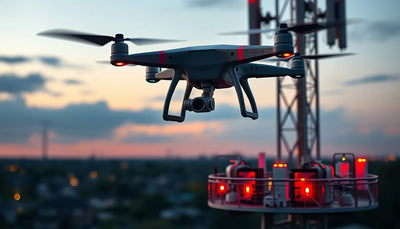
Wuhan Low-Altitude Economic Park Phase 2 Tops Out, Expanding to 130,000 Square Meters
The main structure of Wuhan Low-altitude Economic Industrial Park's second phase has topped out, expanding total construction area to 130,000 square meters. This signals growing infrastructure investment in China's low-altitude economy, with implications for drone fleet operators and the pre-owned DJI market.

The main body of the second phase of Wuhan Low-altitude Economic Industrial Park has officially topped out, according to a report from Guandian.cn. The completion of the main structure marks a significant construction milestone, with the total construction area of the park set to expand to 130,000 square meters. This development, reported as a market trend, signals continued physical infrastructure investment in China's low-altitude economy, a sector that encompasses commercial drone operations, logistics, and aerial services.
For commercial UAV buyers, fleet operators, and repair customers, this is not just a construction update. It represents a broader commitment to building dedicated spaces for drone testing, operations, and maintenance. As regional industrial parks expand, the ecosystem around drone ownership—from procurement to repair and resale—becomes more structured. This analysis breaks down what the Wuhan expansion means for the market, how it affects pre-owned DJI drone buyers, and what operators should watch in the coming quarters.
What the Wuhan phase 2 topping-out actually confirms
The core verified fact from the Guandian.cn report is straightforward: the main structure of the second phase has been capped, and the total construction area will be expanded to 130,000 square meters. This is a physical, measurable expansion of a dedicated low-altitude economic industrial park in Wuhan, a major central Chinese city. The report does not specify a completion date for the entire phase 2 build-out, nor does it name specific tenants, drone models, or operational capabilities that will occupy the space.
Market context
Turn market news into a buy, repair, or trade-in decision.
Compare pre-owned availability, resale timing, and repair economics before the market moves again.

What this confirms is that the low-altitude economy—a policy priority in China that includes drone delivery, aerial surveying, and urban air mobility—continues to receive real estate and infrastructure backing. A 130,000 square meter industrial park is a substantial footprint for drone-related enterprises. For fleet operators considering expansion into China or for those already operating there, this signals that dedicated facilities for drone logistics and maintenance are becoming more available, not less.
The practical implication for drone buyers is about supply chain and service density. When industrial parks grow, they typically attract component suppliers, repair shops, and training centers. That density can reduce downtime for commercial operators because parts and expertise are geographically closer. For international buyers looking at the pre-owned DJI market, this also hints at a steady flow of enterprise-grade drones entering the secondary market as Chinese operators upgrade their fleets to align with new park-based operations.
How industrial park expansion affects the pre-owned DJI market
For readers focused on the pre-owned DJI market, the Wuhan park expansion is a signal worth tracking. When a dedicated low-altitude economic park expands, it often indicates that commercial drone adoption is moving from pilot projects to scaled operations. Scaled operations typically mean higher fleet turnover. Companies that bought new Matrice or Mavic Enterprise units for pilot programs may offload them as they standardize on newer hardware or as their operational requirements shift.
This dynamic is relevant for buyers considering pre-owned DJI drones. A growing industrial park footprint in China does not directly flood the global secondary market, but it does increase the overall volume of enterprise drones in circulation. More drones in commercial service means more units eventually reaching the resale market, often with documented flight hours and maintenance logs. For buyers, this is an opportunity to acquire inspected pre-owned units at a lower entry cost than new enterprise models.
Operators should also consider the repair implications. As parks like Wuhan's phase 2 come online, they typically host authorized service centers or third-party repair facilities. This increases the availability of professional DJI repair services in the region. For fleet managers, this means that sourcing genuine OEM spare parts and getting professional repairs may become faster and more reliable, reducing aircraft downtime and extending the useful life of existing fleets. The expansion of physical infrastructure is a proxy for service maturity, and service maturity directly benefits anyone who owns or operates DJI hardware.
What this means for drone buyers
For drone buyers, the Wuhan phase 2 topping-out is a reminder that the low-altitude economy is being built on physical foundations, not just policy documents. The expansion to 130,000 square meters of total construction area represents a significant commitment to housing drone-related businesses. If you are a commercial operator planning fleet growth, this kind of infrastructure development should factor into your market timing and procurement strategy.
The first actionable takeaway is to monitor fleet turnover in regions with active industrial park development. When parks expand, existing operators often consolidate or upgrade, which can lead to a supply of well-maintained pre-owned enterprise drones entering the market. Buyers should compare the cost of new enterprise units against inspected pre-owned models, especially if the pre-owned units come with service records. The price difference can be substantial, and for operators who do not need the absolute latest sensor technology, pre-owned DJI drones offer a practical path to fleet expansion.
The second takeaway is about repair planning. As industrial parks mature, they attract repair specialists and parts distributors. For fleet managers, this means it is worth reviewing your current repair and parts sourcing strategy. If you rely on a single repair channel, consider diversifying. The growth of dedicated drone parks in China suggests that the global repair ecosystem will continue to professionalize, but that does not mean every region will see the same level of service density. Operators should build relationships with repair providers that use genuine OEM parts and have documented processes, regardless of where the park is located.
The third takeaway is about the broader market trajectory. The low-altitude economy is not a niche experiment; it is receiving industrial-scale investment. For buyers, this means drone technology will continue to evolve, and older models will depreciate faster as new capabilities emerge. That depreciation is an opportunity for buyers who are willing to purchase pre-owned units and accept that they are not getting the latest features. For sellers, it means timing matters. If you are considering upgrading your fleet, the window for getting a good trade-in value on older enterprise drones may narrow as new park-based operations accelerate hardware refreshes.
Regional infrastructure and the global drone supply chain
The Wuhan park expansion is a regional development, but its implications extend beyond central China. The low-altitude economy is a global theme, and infrastructure like this influences how drone manufacturers, service providers, and second-hand markets develop. When a city commits 130,000 square meters to drone-related businesses, it sends a signal to manufacturers that demand is expected to grow. That signal can influence production planning, spare parts inventory, and even the availability of enterprise-grade components.
For international buyers, the practical effect is indirect but real. As Chinese industrial parks expand, the domestic market for new drones grows, which can keep the supply of new units focused on domestic demand. At the same time, the secondary market for pre-owned units becomes more active as domestic operators cycle through hardware. This can create a steady, if not always predictable, supply of used enterprise drones for international buyers. The key is to work with sellers who provide accurate condition reports and honest flight hour documentation.
Fleet operators should also consider the logistics angle. Industrial parks like Wuhan's are often designed to host logistics and delivery drone operations. As these operations scale, they generate real-world data on drone reliability, battery life, and maintenance intervals. That data, while not always public, eventually influences the repair market. Parts that prove durable in high-use logistics environments become more sought after in the secondary market. Buyers of pre-owned DJI drones should pay attention to which components are commonly replaced in commercial fleets, as that informs what to inspect before purchase and what to budget for in maintenance.
For now, the verified facts are limited to the construction milestone and the expanded square footage. Guandian.cn reports the phase 2 main structure has topped out, and the total construction area will be 130,000 square meters. We do not have verified details on tenants, operational start dates, or specific drone services that will be housed there. That uncertainty is normal for a construction-stage announcement, and it is worth acknowledging rather than speculating beyond the source.
What operators can do today is straightforward. Review your fleet plan in light of continued infrastructure investment in the low-altitude economy. If you are in the market for enterprise drones, consider whether a pre-owned unit with documented service history meets your operational needs at a lower cost. If you are holding older hardware, check the current trade-in value and decide whether upgrading now or later aligns with your revenue projections. The drone trade-in guide can help you structure that decision, but the core question is about timing and utilization, not about chasing the latest model.
When will the second phase of the Wuhan Low-altitude Economic Industrial Park be fully operational?
The Guandian.cn report confirms that the main structure has topped out and the total construction area will expand to 130,000 square meters, but it does not provide a verified operational start date. Completion of the main structure is a milestone, not a full commissioning date, so operators should expect further announcements before the park is fully active.
How does this park expansion affect the price of pre-owned DJI drones?
There is no direct price data in the source report. However, as industrial parks expand and commercial drone operations scale, fleet turnover tends to increase, which can raise the supply of pre-owned enterprise drones. Buyers should monitor the secondary market for well-documented units, but the Wuhan announcement alone does not establish a specific price movement.
What should a fleet operator do differently after reading this news?
Fleet operators should treat this as a signal of continued low-altitude economy investment and review their procurement and repair strategies accordingly. This is a practical time to compare new enterprise drone costs against inspected pre-owned units, verify that your repair provider uses genuine OEM parts, and assess whether your current fleet will meet demand as infrastructure-driven commercial operations expand.
参照ソース
公開時点で、追加の公式ドキュメントは入手できませんでした。
Reboot Hub編集部は、ドローン所有者のために購入、修理、再販、および運用の分析を提供します。誤りを発見した場合は、編集方針に基づき修正レビューを依頼してください。