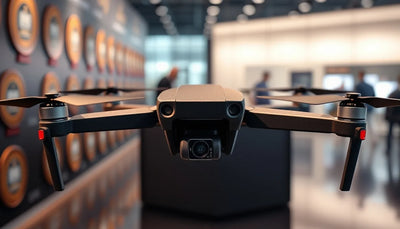
Sinotrans Launches Hunan's First Zone-Port Drone Seal Project
Sinotrans has launched Hunan Province's first zone-port linkage drone sealing application, a logistics milestone that points to faster cargo inspection workflows and growing commercial drone roles in Chinese freight operations.

Quick answer
Sinotrans has launched Hunan Province's first zone-port linkage drone sealing application project, according to the Low-altitude Economy Resource Network.
- The project is reported as Hunan Province's first zone-port linkage drone seal application.
- It involves China Sinotrans, a major state-linked logistics operator.
- The development signals growing commercial drone use in Chinese port and cargo logistics workflows.
- Reboot Hub analysis: logistics drone adoption may gradually shift fleet demand toward inspection and sealing support roles.
China Sinotrans has launched what is being reported as Hunan Province's first "zone-port linkage" drone seal application project, according to the Low-altitude Economy Resource Network. The development marks another step in the country's broader push to integrate low-altitude aircraft into commercial logistics, customs-linked cargo handling, and port-area inspection workflows.
Market context
Turn market news into a buy, repair, or trade-in decision.
Compare pre-owned availability, resale timing, and repair economics before the market moves again.

The announcement matters beyond the immediate logistics milestone. Zone-port linkage programs are designed to connect bonded zones or special customs supervision areas with nearby port operations. Adding drones to the sealing and inspection process suggests that logistics operators are testing whether unmanned aircraft can reduce manual checks, shorten cargo dwell times, and create auditable digital records for sealed shipments. For commercial drone buyers, repair customers, and fleet planners, the project is a useful signal about where enterprise drone demand may be heading in China's freight sector.
What the reported project involves
The primary reporting from the Low-altitude Economy Resource Network describes the initiative as Hunan Province's first zone-port linkage drone seal application project. The phrase "zone-port linkage" refers to coordination between a customs-supervised zone and a port facility, where cargo moves under controlled conditions. In conventional operations, sealing and verification often require ground staff to inspect containers, trailers, or transfer points manually.
By introducing a drone-based sealing application, Sinotrans appears to be exploring a workflow where unmanned aircraft support or partially replace some of those ground-level verification steps. The source does not provide operational specifics such as flight frequency, drone model, sensor payload, or data integration details. Reboot Hub analysis should therefore treat the announcement as a directional signal rather than a fully documented technical deployment.
Still, the project's existence is commercially meaningful. Sinotrans is one of China's largest integrated logistics providers, and its willingness to pilot drone sealing in Hunan suggests that enterprise logistics buyers are evaluating low-altitude tools for regulated cargo movement, not just last-mile delivery or aerial photography. For operators watching the enterprise drone market, that distinction matters.
Why logistics operators are testing drone sealing
Sealing and inspection workflows are repetitive, documentation-heavy, and often time-sensitive. A drone that can capture visual evidence, verify seal integrity, or transmit location-tagged data could reduce the number of manual touchpoints between a bonded zone and a port. In theory, that translates into faster cargo release, fewer personnel movements inside restricted areas, and stronger audit trails.
The Low-altitude Economy Resource Network report does not confirm specific efficiency gains, cost savings, or regulatory approvals tied to the Hunan project. Those details remain unverified. However, the broader commercial logic is consistent with what logistics analysts have observed across China's low-altitude economy initiatives: companies are testing drones in controlled, high-documentation environments before scaling them to more complex cargo routes.
For fleet operators, the takeaway is that drone procurement in logistics may increasingly focus on inspection, monitoring, and compliance support rather than payload delivery alone. That has implications for the types of airframes, sensors, and maintenance plans that logistics buyers prioritize.
What this means for drone owners and the market
For independent operators and small fleet owners, a state-linked logistics company adopting drone sealing does not immediately change daily flight operations. But it does reinforce a longer-term trend: enterprise logistics buyers are becoming a more visible demand segment for commercial UAVs, particularly in Asia. When large logistics firms validate drone workflows in regulated environments, it can accelerate standardization, parts availability, and service expectations across the wider market. For owners evaluating service and lifecycle risk, Drone Wiki explains the relevant repair, parts, resale, or operational path.
That dynamic also touches the pre-owned DJI market. As enterprise and logistics programs expand, more operators enter the ecosystem, and some will upgrade or rotate airframes as mission requirements shift. That rotation can feed supply into inspected pre-owned channels, where buyers look for well-documented platforms at lower acquisition cost. For readers tracking drone resale and repair economics, the Sinotrans project is a reminder that commercial adoption cycles influence fleet turnover far more than consumer hobby trends do. Reboot Hub maintains a Drone Wiki covering practical ownership and repair topics for operators evaluating those decisions.
Repair and parts demand may also shift gradually. Inspection-oriented logistics drones accumulate flight hours in industrial environments, often near ports, warehouses, and transport corridors. Those conditions can accelerate wear on motors, gimbals, landing gear, and sensor housings. A fleet manager planning for logistics inspection work should budget for more frequent OEM-pulled parts replacement and professional DJI repair intervals than a typical mapping or photography operator would expect.
The Hunan project also highlights a procurement lesson: buyers should not assume that all logistics drone deployments require maximum-range or heavy-lift platforms. Sealing and inspection missions may favor reliable, easily serviceable aircraft with strong camera or sensor integration rather than exotic payload capacity. For operators building a commercial fleet, that means evaluating total maintenance cost and parts availability alongside headline performance figures.
What to watch next in low-altitude logistics
The Sinotrans announcement is one data point in a much larger Chinese low-altitude economy push. Provincial governments and logistics firms have been testing drone corridors, port inspection flights, and bonded-zone monitoring programs. The Hunan project stands out because it ties drones to a specific customs-adjacent workflow: seal application and verification.
Future developments worth monitoring include whether the project expands to other Hunan ports or bonded zones, whether Sinotrans publishes operational metrics, and whether regulators issue specific guidance for drone use in seal verification. Those details would help fleet operators understand whether the model is replicable outside China or remains a region-specific pilot.
For now, the practical step for buyers, pilots, and repair customers is to treat logistics inspection as a growing mission category. That means watching which platforms logistics firms actually deploy, how quickly those fleets accumulate hours, and what service and parts demand follows. The Hunan project may be early-stage, but it signals that commercial drone use is moving deeper into regulated freight operations, where reliability and documentation matter as much as flight performance.
FAQ
Frequently asked questions
What did Sinotrans launch in Hunan?
Sinotrans launched what is reported as Hunan Province's first zone-port linkage drone seal application project, according to the Low-altitude Economy Resource Network.
Why does the project matter for commercial drone operators?
It signals growing enterprise demand for drones in logistics inspection and customs-adjacent workflows, which may influence fleet planning, parts demand, and pre-owned equipment turnover over time.
Does the report confirm specific drone models or performance data?
No. The source does not provide verified details on drone models, flight frequency, sensor payloads, or operational metrics, so those specifics should be treated as unconfirmed.
Which sources support this update?
The article distinguishes reported information from analysis and does not present an unverified source as official confirmation.
What remains subject to change?
Retail pricing, availability, product bundles and regulatory timelines can change. Readers should verify the latest terms with the named retailer, manufacturer or regulator before acting.
How should buyers or operators use this analysis?
Use the verified facts as a starting point, then compare mission fit, lifecycle support, maintenance needs and current procurement terms before making a purchase or fleet decision.
参照ソース
- Source material - primary source
公開時点で、追加の公式ドキュメントは入手できませんでした。
Reboot Hub編集部は、ドローン所有者のために購入、修理、再販、および運用の分析を提供します。誤りを発見した場合は、編集方針に基づき修正レビューを依頼してください。