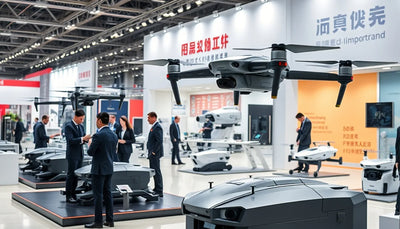
Shandong Pushes Vertical AI Model for Low-Altitude Drone Operations
A Shandong-based initiative is applying a vertical large model to low-altitude drone operations, aiming to equip aircraft with more autonomous decision-making. The development signals how regional AI infrastructure could reshape commercial drone workflows, fleet planning, and aftermarket service expectations across China's fast-growing low-altitude economy.

Quick answer
A Shandong initiative is developing a vertical large model for low-altitude drone operations, aiming to give drones a smarter decision-making layer for commercial and industrial use.
- The project focuses on low-altitude airspace applications in Shandong, China.
- The model is described as equipping drones with a smart brain for autonomous operations.
- Qilu Network reported the development as part of Shandong's vertical large model push.
- Commercial operators should watch how regional AI infrastructure affects fleet automation and service requirements.
A regional push in Shandong is bringing vertical-domain artificial intelligence into low-altitude drone operations. According to a report from Qilu Network, the Ruihang low-altitude large model is being positioned as a way to equip drones with what the source describes as a "smart brain," giving aircraft a more capable decision-making layer for commercial and industrial missions.
Market context
Turn market news into a buy, repair, or trade-in decision.
Compare pre-owned availability, resale timing, and repair economics before the market moves again.

The development sits inside a broader Shandong effort to apply vertical large models to specific economic sectors. Rather than building general-purpose AI, the approach focuses on domain-specific training and deployment, which in this case targets the operational realities of low-altitude airspace. For drone buyers, fleet operators, and repair customers, the announcement is a signal that regional infrastructure investment in China is moving beyond hardware and into software-defined flight operations.
What the Shandong low-altitude model actually signals
Qilu Network's reporting frames the Ruihang low-altitude large model as part of Shandong's vertical large model strategy. The core idea is straightforward: a model trained on low-altitude operational data could handle tasks that currently require human pilots, ground control staff, or fragmented software tools. The source does not provide technical specifications, training data volumes, or deployment timelines, so the exact capabilities remain source-limited.
What matters commercially is the direction of travel. When a provincial government or regional industrial group invests in vertical AI for drones, it suggests that low-altitude operations are being treated as infrastructure rather than as a collection of standalone aircraft purchases. That distinction has consequences for how fleets are procured, how aircraft are maintained, and how used equipment is valued over time.
Reboot Hub analysis: regional AI models like this tend to accelerate standardization. If a low-altitude model becomes the default operational layer for commercial missions in a given region, operators may face pressure to align their aircraft, sensors, and maintenance workflows with whatever data formats and decision outputs that model expects. That could shift repair demand toward shops that understand software integration, not just hardware replacement.
Why vertical AI changes fleet and repair economics
A drone with a "smart brain" is still a physical aircraft with motors, gimbals, batteries, and sensors. The introduction of a vertical large model does not remove the need for maintenance, but it may change what maintenance looks like. If more flight decisions are made by an AI layer, the failure points that matter most could shift from pilot error toward data integrity, sensor calibration, and software-to-hardware communication.
For commercial operators, that means repair partners need to understand both the mechanical condition of an aircraft and the operational software environment it flies in. A drone that passes a physical inspection but cannot integrate cleanly with a regional AI model may be less useful than one that can. This is especially relevant for buyers in the pre-owned DJI market, where aircraft condition is often assessed through flight logs, battery cycles, and physical wear, but rarely through compatibility with emerging operational software layers.
The source does not specify whether the Ruihang model is designed to work with particular drone brands or airframes. Without verified spec context, Reboot Hub cannot confirm compatibility with DJI platforms or any other manufacturer. Operators should treat integration questions as open until official documentation appears.
What this means for drone owners and the market
The most immediate takeaway for drone owners is that software-defined operations are becoming a procurement factor, not just a pilot preference. A fleet manager evaluating aircraft today may need to ask questions that were not part of the standard buying checklist a few years ago: Does the aircraft generate data in a format that a regional AI layer can consume? Can the flight controller accept external decision inputs? Will the maintenance provider understand software integration issues as well as mechanical ones?
For repair customers, the implication is that service documentation should increasingly include software health alongside hardware health. A drone that has been physically repaired but not properly calibrated or updated may underperform in an AI-assisted operational environment. Buyers evaluating pre-owned DJI drones should consider whether the aircraft's firmware, sensor calibration, and data output remain aligned with the operational standards emerging in their region. Reboot Hub's Drone Wiki can help owners understand the hardware and maintenance factors that affect long-term aircraft value as software expectations evolve. For owners evaluating service and lifecycle risk, Drone Wiki explains the relevant repair, parts, resale, or operational path.
The pre-owned market may also feel the effect over time. If regional AI models become common, aircraft that are easier to integrate with those systems could hold value better than aircraft that require manual workarounds. That does not mean older drones become worthless, but it does mean that software compatibility may join battery health, gimbal condition, and flight hours as a factor in resale pricing.
What operators should watch next
The Qilu Network report does not include deployment dates, model parameters, or named commercial partners. That leaves several open questions for the market. Will the Ruihang model be offered as a service, a licensed platform, or a public infrastructure layer? Will it require specific onboard hardware, or will it operate from ground stations and cloud connections? Will it apply to agricultural, logistics, inspection, or security missions first?
Until those details emerge, the prudent move for commercial operators is to monitor regional AI announcements alongside traditional hardware and regulatory news. A vertical model that starts in Shandong could influence procurement patterns in other Chinese provinces, and eventually shape how international operators think about software-defined drone fleets.
For now, the development is best understood as a market signal rather than a product launch. It shows that the low-altitude economy is attracting the same vertical AI investment that has already reshaped finance, manufacturing, and logistics. Drone operators who treat their aircraft as part of a broader data and software stack, rather than as standalone tools, will be better positioned as that investment matures.
FAQ
Frequently asked questions
What is the Ruihang low-altitude large model?
According to Qilu Network, the Ruihang low-altitude large model is a vertical-domain AI initiative in Shandong designed to give drones a smarter decision-making layer for low-altitude operations.
Does this development affect DJI drone owners?
The source does not confirm compatibility with DJI or any specific drone brand. However, if regional AI models become standard, software integration could become a factor in how commercial aircraft are procured, maintained, and resold.
What should fleet managers do after this announcement?
Fleet managers should monitor whether regional AI platforms create new data or integration requirements for commercial drones, and consider whether their current aircraft and maintenance providers can support software-defined operations.
Which sources support this update?
The article distinguishes reported information from analysis and does not present an unverified source as official confirmation.
What remains subject to change?
Retail pricing, availability, product bundles and regulatory timelines can change. Readers should verify the latest terms with the named retailer, manufacturer or regulator before acting.
How should buyers or operators use this analysis?
Use the verified facts as a starting point, then compare mission fit, lifecycle support, maintenance needs and current procurement terms before making a purchase or fleet decision.
参照ソース
- Source material - primary source
公開時点で、追加の公式ドキュメントは入手できませんでした。
Reboot Hub編集部は、ドローン所有者のために購入、修理、再販、および運用の分析を提供します。誤りを発見した場合は、編集方針に基づき修正レビューを依頼してください。