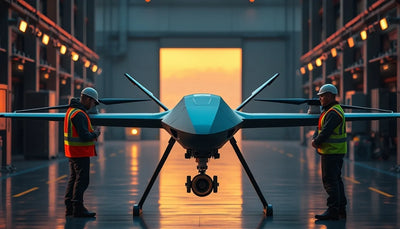
DJI Teases Matrice 30 Successor: What Fleet Operators Need to Know
DJI’s latest teaser, “For The Priceless Below,” hints at a Matrice 30 successor. Fleet operators and buyers should consider the impact on pre-owned inventory, repair planning, and procurement timing. We analyze the implications.

DJI has released a cryptic teaser campaign headlined “For The Priceless Below,” and every signal in the industry points toward a successor to the popular Matrice 30 enterprise drone. The campaign, widely reported by DroneXL.co and syndicated through Google News, has generated immediate discussion among fleet operators, repair specialists, and pre-owned drone buyers who have relied on the Matrice 30 series for inspection, public safety, and utility work since its launch. While DJI has not confirmed specifications, launch dates, or pricing, the teaser is strong enough that commercial drone buyers should begin preparing for a market shift.
For operators who manage mixed fleets of enterprise drones, a new Matrice model means more than just an upgrade path. It influences spare parts availability, trade-in values for existing Matrice 30 units, and the timing of major procurement decisions. The second-hand market for pre-owned DJI drones is particularly sensitive to product announcements of this scale. The Matrice 30 series has been a workhorse for many teams, and a successor could either lower resale prices on current models or create a spike in demand for OEM-pulled parts as operators choose to refurbish existing units instead of buying new. Understanding what this teaser means—and what it doesn’t yet confirm—is essential for making commercially intelligent decisions in the coming weeks.
Decoding the “For The Priceless Below” Teaser
DJI’s teaser phrase “For The Priceless Below” is intentionally broad, but in enterprise drone contexts it strongly echoes the Matrice 30’s positioning as a tool for critical infrastructure, search and rescue, and hazardous environment inspection where data is irreplaceable. The original Matrice 30 was built around IP55 weather resistance, a modular payload system, and robust obstacle avoidance—features that justified its price point for professional fleets. A successor would likely build on that foundation, but without official specs, it is premature to claim specific upgrades.
Industrial drone procurement
Source a brand-new industrial drone for this mission.
Discuss mission fit, aircraft model, quantities, configuration, pickup, and lifecycle support with Reboot Hub.

The source report from DroneXL.co notes that “everything points at a Matrice 30 successor,” but does not provide engineering details or leaked specifications. This means commercial buyers should treat the teaser as a strong directional signal, not a buying trigger. For fleet managers, the responsible move is to begin evaluating current Matrice 30 performance and maintenance cycles. If a unit is approaching the end of its planned service life, waiting a few months could yield better options. However, if immediate operational needs cannot be delayed, the existing Matrice 30 remains a proven, supported platform.
A key operational implication: when DJI teases a direct successor, it often adjusts firmware support timelines and spare parts availability for the outgoing model. While no such changes have been announced, proactive fleet managers can mitigate risk by stocking critical genuine OEM spare parts now—especially gimbal assemblies, propellers, and battery systems that may become harder to source after a launch. For repair customers, this teaser is a reminder to verify parts supply before committing to a rebuild of an older Matrice 30.
What this means for drone buyers
For drone buyers evaluating enterprise-grade equipment, the “For The Priceless Below” teaser introduces a timing dilemma. The safest path is to assess whether a current Matrice 30 meets mission needs for the next 12 to 18 months. If it does, purchasing a pre-owned DJI Matrice 30 from the second-hand market at a potential discount could be a cost-effective play. As anticipation builds for a successor, many fleet operators may begin offloading Matrice 30 units to free up capital, creating a buyer’s market for inspected pre-owned examples.
However, buyers should avoid assuming that the successor will be backward-compatible with existing Matrice 30 accessories. DJI has a history of changing payload mounts, battery interfaces, and software ecosystems with new generations. That means accessories like battery chargers, RTK modules, and speaker systems may not transfer. A prudent buyer should keep accessory investment minimal until official compatibility details emerge.
The second-hand market for pre-owned DJI drones is already showing early signs of movement. Based on typical patterns after similar teasers in the Mavic and Inspire lines, resale listings for Matrice 30 units may see increased volume within 30 to 60 days. For buyers who can wait, that could be an opportunity to acquire a well-maintained, high-mileage Matrice 30 at a compelling price point. For sellers, the window to get top resale value is likely narrowing. Anyone planning to trade in a Matrice 30 should consider acting soon, ideally before DJI releases official specs that could depress trade-in offers.
Fleet managers should also review their repair and maintenance schedule. If a Matrice 30 is due for a major service—such as gimbal calibration, motor replacement, or shell repair—it may be worth using a professional DJI repair service with access to genuine OEM parts to ensure the aircraft remains reliable as a backup or secondary unit after a successor arrives. Keeping a well-serviced Matrice 30 in the fleet provides operational redundancy without committing to a new purchase prematurely.
Implications for the pre-owned Matrice 30 market
The second-hand segment for enterprise drones is directly influenced by product lifecycle announcements. When DJI signals a new model, the pre-owned market typically splits into two phases: an initial period of uncertainty where prices hold, followed by a correction once official details land. Right now, with no confirmed specs or launch date, the Matrice 30 market is in the first phase. Buyers can still find strong prices from sellers who are waiting to upgrade, but the window is narrow.
Operators looking to acquire Matrice 30 units should prioritize aircraft with documented maintenance histories, low flight hours, and intact payload ecosystems. Units that have been serviced with OEM-pulled parts and have clean sensor calibration reports will hold value better in a future resale. For repair customers, the Matrice 30’s modular construction means that individual components—such as the downward vision sensor array, the RTK module, or the main logic board—are likely to remain available as genuine OEM spare parts for at least a few more years. But early planning ensures better pricing and availability.
Another important consideration is trade-in programs. Some drone dealers and service platforms offer drone trade-in guides that help operators exchange older units toward new purchases. With a successor telegraphed, now is a logical time to explore trade-in options before official trade-in values adjust downward. Operators who wait until the new model is announced may find their Matrice 30 valued significantly lower, especially if the successor includes a sensor or flight performance leap that makes the outgoing model feel dated.
For pre-owned drone buyers, the message is clear: if you need a Matrice 30 for your fleet and your budget is constrained, the next 30 to 45 days may offer the best combination of selection and pricing. After that, the market could shift sharply depending on DJI’s announcement schedule. A well-considered purchase today, guided by careful inspection and a reputable source of pre-owned DJI drones, can still serve mission-critical roles for years.
Planning for repair and parts continuity
Repair shops and fleet maintenance teams should take this teaser as a strategic signal to review their current inventory of Matrice 30 parts. Because the Matrice series uses a semi-modular chassis design, common failure points like gimbal flex cables, landing gear actuators, and antenna modules are often sourced from OEM channels. A product transition can disrupt supply if DJI shifts production line capacity to the successor’s components. Repair customers who rely on quick turnaround for Matrice 30s should consider pre-ordering high-wear, long-lead items such as mainboards, RTK antenna modules, and battery management boards.
Operators who manage multiple Matrice 30 units may also want to standardize on a common maintenance schedule before a successor launch. Performing proactive firmware updates, compass calibrations, and propulsion system checks now reduces the likelihood of emergency repairs during the transition period when parts may be less available. For those with insurance or service contracts that include expedited repair, confirming that coverage remains valid for the Matrice 30 after a successor announcement is a prudent step.
The repair ecosystem for DJI enterprise drones is robust, but it depends heavily on OEM part supply chains. A professional DJI repair service with genuine parts can help extend the life of a Matrice 30 fleet well beyond a product transition. That is especially valuable for operators whose missions are tied to specific payload integrations—such as thermal cameras, LiDAR, or methane detectors—that may not be immediately supported on a new platform. Maintaining a well-serviced Matrice 30 fleet allows operators to deploy the successor at their own pace, without pressure to retire functional aircraft prematurely.
Frequently asked questions
Should I buy a Matrice 30 now or wait for the successor?
If your operation has an immediate, critical need for an enterprise drone, a well-inspected pre-owned Matrice 30 remains a reliable choice. If you can afford to wait 60 to 90 days, the successor may offer upgrades worth the delay, provided it fits your payload and software ecosystem. In either case, avoid large accessory investments until compatibility is confirmed.
Will the Matrice 30 successor use the same batteries and payloads?
DJI has not announced any compatibility details. Based on past product transitions, it is common for DJI to change battery shape, voltage, and communication protocols between enterprise generations. Payload mounts may also be redesigned. Plan to evaluate the successor’s ecosystem independently rather than assuming backward compatibility.
How will this teaser affect the resale value of my Matrice 30?
Resale values for Matrice 30 units typically begin to soften as a successor announcement approaches. If you are considering selling or trading in your Matrice 30, acting before official specs are released may help you secure a higher price. After a launch, values often drop 15 to 25 percent depending on the new model’s capabilities and pricing.
参照ソース
- Source - primary source
公開時点で、追加の公式ドキュメントは入手できませんでした。
Reboot Hub編集部は、ドローン所有者のために購入、修理、再販、および運用の分析を提供します。誤りを発見した場合は、編集方針に基づき修正レビューを依頼してください。