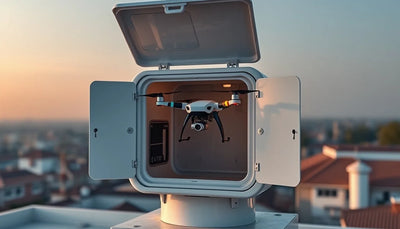
Amazon Prime Air Faces State Review in Westborough, Massachusetts
Massachusetts transportation officials say Amazon's proposed Prime Air facility in Westborough needs state-level approval, while residents organize for more community input. The review adds another regulatory layer to commercial drone delivery expansion in the United States.

Quick answer
MassDOT says Amazon's proposed Prime Air drone delivery facility in Westborough, Massachusetts, requires state approval, while a grassroots resident group is pushing for more community involvement in drone delivery decisions.
- MassDOT has indicated Amazon needs state approval for the Westborough facility
- A grassroots organization is organizing residents around commercial drone flight impacts
- The development adds another regulatory layer to Amazon Prime Air expansion
- The report comes from DRONELIFE coverage dated October 23, 2026
Evidence: DRONELIFE · FAA UAS official guidance
Market context
Turn market news into a buy, repair, or trade-in decision.
Compare pre-owned availability, resale timing, and repair economics before the market moves again.

Verified facts
What the available evidence confirms
| Factor | Reported detail | Market implication |
|---|---|---|
| Regulatory body | MassDOT reviewing Westborough facility | State-level approval may add time to launch timelines |
| Community action | Grassroots group organizing residents | Local opposition can shape siting and operational conditions |
| Operator | Amazon Prime Air | Commercial drone delivery expansion faces layered oversight |
Amazon's proposed Prime Air drone delivery operation in Westborough, Massachusetts, is now facing an additional layer of regulatory scrutiny. According to reporting from DRONELIFE, the Massachusetts Department of Transportation, commonly known as MassDOT, has indicated that Amazon needs state approval for its Westborough facility. The development was reported on October 23, 2026, and it arrives as a grassroots organization in the area works to push for greater community involvement in decisions about commercial drone flights.
The situation in Westborough highlights a recurring pattern in the commercial drone logistics sector: even when a company has federal approvals and operational experience, state and local processes can reshape timelines, operating conditions, and public acceptance. For drone buyers, fleet operators, and service providers watching the delivery market, the Massachusetts review is a useful signal about how state-level oversight may influence where and how drone delivery networks expand.
What the Westborough review involves
DRONELIFE reported that MassDOT says Amazon needs state approval for its Westborough facility. The reporting does not specify the exact permit type, the statutory basis for the state review, or a formal decision deadline. What is clear is that the state transportation agency has asserted a role in the approval process for the proposed Prime Air operation. This matters because it suggests that Amazon's facility planning in Massachusetts cannot proceed solely on the strength of federal aviation clearances or local zoning decisions alone.
For commercial operators, the practical lesson is that state transportation agencies can become a gatekeeper for drone delivery infrastructure even when the aircraft themselves operate under federal airspace rules. A company preparing to site a drone hub, maintenance facility, or logistics node should map state-level transportation requirements early. Waiting until after a local announcement or community meeting can create avoidable delays and public friction.
Community organizing and the local approval environment
The DRONELIFE report also notes that a grassroots organization is working to address the impact of commercial drone flights on Westborough communities. The group is pushing for greater community involvement in drone delivery decisions. The reporting does not name the organization, detail its membership size, or describe specific demands. What it does establish is that residents are organizing around the question of how commercial drone operations will affect their neighborhoods.
Community organizing of this kind can influence the pace and shape of drone delivery expansion. When residents raise concerns about noise, privacy, visual impact, or flight frequency, companies and regulators often respond with operational conditions, adjusted routes, or expanded public comment periods. For fleet operators and logistics planners, the Westborough case is a reminder that community acceptance is not a communications afterthought. It is an operational variable that can affect launch dates, facility siting, and the cost of compliance.
What this means for drone owners and the market
The Massachusetts review does not directly change the rules for individual drone owners, pre-owned DJI buyers, or repair customers today. But it does reinforce a broader market pattern: commercial drone logistics is expanding through a patchwork of federal, state, and local approvals. Each layer adds time and uncertainty. For operators who fly under Part 107 or who support delivery, inspection, or agricultural missions, the Westborough story is a signal that state-level oversight is becoming a more visible part of the commercial UAS landscape. For owners evaluating service and lifecycle risk, Drone Wiki explains the relevant repair, parts, resale, or operational path.
For buyers evaluating pre-owned DJI drones or planning fleet investments, the key takeaway is to separate the aircraft purchase decision from the regulatory environment where the aircraft will operate. A drone that is airworthy and well-maintained can still face operational limits if a state or municipality imposes new conditions on commercial flights. This is why many operators now treat regulatory due diligence as part of procurement planning, not as a separate legal task. For those researching drone models, maintenance, and ownership considerations, Reboot Hub maintains a Drone Wiki covering practical ownership and repair topics.
The second-hand market for commercial drones tends to respond to regulatory signals in predictable ways. When a high-profile delivery program faces review, some operators pause expansion plans and hold off on new purchases. Others look for value in inspected pre-owned aircraft that can support non-delivery missions such as mapping, inspection, or public safety. The Westborough development is unlikely to move DJI resale prices on its own, but it adds to a climate in which fleet managers weigh regulatory timing alongside hardware availability.
What operators should watch next
Operators and buyers should watch for three things in the coming weeks. First, whether MassDOT issues a formal order, guidance document, or public comment window for the Westborough facility. A formal process would give companies and residents a clearer picture of what state approval requires. Second, whether Amazon adjusts its proposed operating parameters, flight corridors, or facility plans in response to state or community input. Third, whether other Massachusetts municipalities or neighboring states adopt similar review expectations for drone delivery infrastructure.
The Westborough case is not an isolated regulatory event. It sits inside a longer trend of states asserting more authority over drone operations that touch local airspace, ground infrastructure, and community life. For commercial operators, the smart response is to build state and local review into project timelines from the start. For individual buyers and repair customers, the immediate impact is limited, but the direction of travel is worth noting: drone delivery expansion is becoming more contested, more layered, and more dependent on local acceptance.
FAQ
Frequently asked questions
Does the Massachusetts review stop Amazon Prime Air in Westborough?
The DRONELIFE report does not say the operation is halted. It indicates that MassDOT says state approval is required, which adds a regulatory step. The timeline and outcome remain open.
What does this mean for commercial drone operators outside Massachusetts?
The case signals that state transportation agencies may play a larger role in approving drone delivery infrastructure. Operators planning hubs, maintenance sites, or logistics nodes should account for state-level review in their project timelines.
Should drone buyers change their purchasing plans because of this news?
Not directly. The review affects a specific Amazon facility proposal. However, buyers evaluating commercial drone investments should treat state and local regulatory conditions as part of their operational planning, especially for delivery or infrastructure-adjacent missions.
Which sources support this update?
The visible evidence links identify DRONELIFE and FAA UAS official guidance; each source is used only for the claim it directly supports.
What remains subject to change?
Retail pricing, availability, product bundles and regulatory timelines can change. Readers should verify the latest terms with the named retailer, manufacturer or regulator before acting.
How should buyers or operators use this analysis?
Use the verified facts as a starting point, then compare mission fit, lifecycle support, maintenance needs and current procurement terms before making a purchase or fleet decision.
参照ソース
- DRONELIFE - primary source
- FAA UAS official guidance - official regulator source
Reboot Hub編集部は、ドローン所有者のために購入、修理、再販、および運用の分析を提供します。誤りを発見した場合は、編集方針に基づき修正レビューを依頼してください。