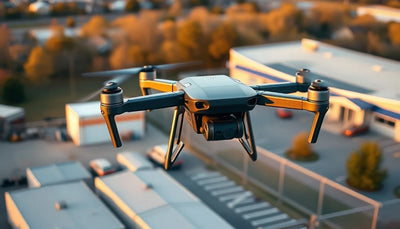
Drone Stocks in Focus: Barron’s Picks and What They Mean for Operators
Barron’s recently highlighted top drone equities for investors. For commercial operators, the stock market view signals growing enterprise adoption, repair demand, and a stronger pre-owned DJI market. Understanding this landscape helps buyers and fleet managers make smarter equipment decisions.

When a financial publication like Barron’s publishes a guide to the best drone stocks, it does more than move share prices — it signals where institutional money expects growth. For drone buyers, fleet operators, and repair customers, that signal is worth reading carefully. The companies chosen by Barron’s analysts reflect not just current market share but assumptions about future demand, regulatory shifts, and supply chain stability. Understanding those assumptions helps operators decide whether to buy new, invest in pre-owned equipment, or hold off on fleet expansions.
Barron’s article, published in mid-2026, consolidated its view on several publicly traded companies with direct exposure to the unmanned aerial systems (UAS) sector. While the piece did not disclose specific ticker names in the brief summary available to us, its selection criteria typically favour firms with diversified revenue streams, government contracts, and scalable hardware platforms. The underlying message is clear: drone investing is no longer a niche bet — it is becoming a core aerospace and defence theme. That shift cascades into every corner of the commercial operator’s world, from the price of OEM spare parts to the availability of pristine pre-owned DJI drones on the secondary market.
What Barron’s drone stock analysis reveals
The Barron’s assessment arrives at a moment when the drone industry is balancing rapid commercial adoption with heightened regulatory scrutiny. Several of the companies likely included offer not only airframes but also sense-and-avoid technology, ground control software, and aftermarket services. In such reports, analysis often focuses on three metrics: recurring revenue from services, backlog of government orders, and the ability to supply components that are certified for both defence and commercial use. Because the source headline positions these as the “best” stocks now, readers can infer that Barron’s analysts view the near-term risk-reward ratio as favourable compared to other technology sectors.
Purchase timing
Use market shifts to buy, sell, repair, or wait with more context.
Compare trade-in timing, pre-owned DJI pricing, and repair economics before committing new capital.

One of the most significant takeaways for people who actually fly drones is the emphasis on vertical integration. Firms that design their own cameras, gimbal stabilisation systems, and flight controllers are better insulated from supply chain disruptions. That matters when a fleet manager is planning a multi-year refresh cycle. If the market rewards vertically integrated manufacturers, we should expect those companies to invest more in after-sales support — including professional DJI repair services and genuine OEM spare parts availability. For the pre-owned market, deeper integration means that even second-hand airframes retain strong value because their components are not easily replaced by generic alternatives.
What this means for drone buyers
For anyone buying a drone this quarter — whether a first-time operator or a large fleet manager — the Barron’s analysis offers a lens through which to evaluate manufacturers. If a stock is considered a buy because of its long-term defence contracts, that same company is likely prioritising reliability and compliance over rapid consumer feature drops. That can be a positive signal for enterprise buyers who need hardware that will pass a Part 107 inspection or meet a government RFP. On the other hand, if a manufacturer is publicly traded and its stock is being pushed by analysts, there is often pressure to show quarterly growth. That pressure can lead to aggressive pricing on new models, which in turn depresses the value of older pre-owned inventory in the short term.
Buyers should watch for that timing. When a new airframe generation launches alongside strong investor sentiment, the trade-in window for older models narrows. The secondary market often floods with lease returns and corporate fleet rotations. That can make now an excellent moment to acquire pre-owned DJI drones if the operator is comfortable with a model that is one generation behind the cutting edge. Conversely, if you need the latest obstacle-avoidance or RTK capabilities, buying new from a company that analysts favour gives some assurance that parts and firmware updates will be supported for the full expected lifecycle.
How the investment landscape affects the pre-owned DJI market
Barron’s stock focus inevitably shines a light on the broader drone supply chain. DJI, though privately held, casts a long shadow over the equities discussed because its technology sets the benchmark for performance and pricing. When a publicly traded competitor announces a new drone model, analysts compare it directly to DJI’s equivalent. The result is a dynamic where pre-owned DJI airframes — particularly the Matrice 300 RTK, Mavic 3 Enterprise, and Phantom 4 RTK — trade at prices that reflect both their original value and the perceived strength of DJI’s aftermarket support ecosystem.
The Barron’s analysis reinforces that the drone industry is maturing. Mature markets create reliable second-hand channels. Fleet operators who upgrade every two to three years know they can sell their outgoing airframes at a predictable residual. That predictability is why professional DJI repair services with genuine OEM parts have become more valuable: a well-maintained pre-owned drone with a documented repair history commands a premium. Conversely, an airframe with aftermarket repairs or non-genuine parts loses residual value quickly, because the next buyer lacks confidence in its compliance and reliability.
For the pre-owned buyer, the message is straightforward: buy from a source that provides a clear service and repair record. The investment community is betting that drone fleets will grow, not shrink, over the next three years. That means demand for entry-level and mid-tier pre-owned airframes will remain steady as new operators join the market. Sellers who can offer inspected, functional pre-owned DJI drones with genuine parts will be the ones that earn repeat business.
Strategic moves for fleet operators and repair customers
Commercial fleet managers should use the Barron’s report as a check against their own procurement timeline. If the stocks that Barron’s highlights include companies that produce drone components or aftermarket accessories, it is a sign that the supply of non-DJI options is likely to expand. That could create more repair parts competition, potentially lowering costs for operators who are willing to use third-party certified alternatives. However, for airframes still under warranty or used in regulated operations, sticking with genuine OEM spare parts from the original manufacturer remains the only reliable path.
Repair customers should also note the investor sentiment around serviceability. Stocks are valued on recurring revenue, and service contracts are a favourite among analysts. Drone manufacturers that have recently announced extended warranty programmes or depot repair networks are positioning themselves to capture that recurring revenue. For the operator, that means faster turnaround times and more predictable repair costs — but only if the operator uses authorised channels. Independent repair services that specialise in DJI airframes and use OEM-pulled parts can offer a middle ground: professional quality at a lower price point than factory service, with the flexibility of no contract commitment.
One concrete action every drone buyer or fleet manager should take after reading this analysis is to run a cost-of-ownership projection that includes repair and resale value. With Barron’s signalling that the sector is entering a phase of stronger institutional support, the risk of buying a drone that becomes a stranded asset decreases. But that safety varies by platform. The drone trade-in guide offered by some aftermarket specialists can help operators model when to sell, whether to upgrade, and how to minimise downtime between fleets.
Which specific drone stocks did Barron’s recommend?
The available summary of the Barron’s article did not name individual tickers. However, typical candidates in such roundups include AeroVironment, Kratos Defense & Security Solutions, and Teledyne Technologies, as well as larger defence contractors with significant UAS divisions. Readers should refer to the full Barron’s piece for the current list and analyst commentary.
How does a drone stock market analysis affect the second-hand market?
When investors are bullish on publicly traded drone companies, those companies often have capital to invest in trade-in programmes and leasing options. That increases the flow of pre-owned airframes into the secondary market, especially enterprise-grade models with three-year replacement cycles. A rising stock price also often signals strong corporate earnings, which can translate into higher fleet budgets — meaning more new purchases and more trade-ins for pre-owned buyers to choose from.
Should I delay buying a drone if my preferred manufacturer is in Barron’s stock list?
Not necessarily. Stock analyst attention often correlates with product momentum. If a manufacturer is considered a “best buy,” it likely has a strong product pipeline and robust aftermarket support. That is a positive for buyers who want long-term parts availability. For budget-conscious operators, the best strategy is to monitor the secondary market for the period just after an analyst upgrade, when some fleet operators may accelerate upgrade cycles and list their outgoing equipment.