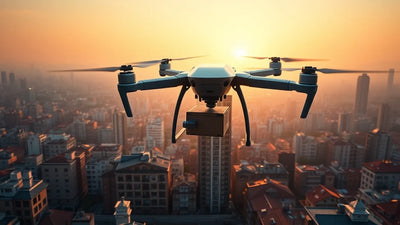
Who Will Own America’s Skies? HOVERAir’s UK Launch Ignites the Consumer Drone Power Vacuum
HOVERAir’s UK debut of the X1 Smart (99g, hands-free selfie drone) exposes a critical gap: with DJI facing NDAA bans, Skydio pivoting to defense, and Autel under scrutiny, who will dominate America’s consumer market? For Part 107 operators navigating BVLOS waivers and fleet replacement cycles, this shake-up signals both a broker’s dream and a regulatory minefield—where second-hand inventory becomes a strategic hedge against supply-chain volatility.

Szerkesztői megjegyzések
- Ez a cikk egyesíti a megnevezett külső jelentéseket a Reboot Hub saját elemzéseivel drónvásárlók, flottaüzemeltetők, javítási szolgáltatásokat igénylők és a használt DJI piacfigyelők számára.
- A forrásból származó tények elkülönítve vannak az értelmezéstől. Amennyiben egy jelentés korlátozott adatokat szolgáltat, a cikk rögzíti ezt a korlátozást, a Reboot Hub szempontját pedig elemzésként tünteti fel.
- A Reboot Hub kereskedelmi linkjei dróntermékekre és javítási szolgáltatásokra mutatnak; ezek olvasói erőforrások, és nem határozzák meg a cikk következtetéseit.
The UK launch of HOVERAir’s X1 Smart on June 11, 2026, marks more than a transatlantic product rollout. It crystallises a crisis that has been brewing in the United States for two years: the slow-motion collapse of a reliable, affordable consumer drone supplier. With the X1 Smart—a 99-gram, hand-launched self-flying camera—landing on British shelves, the question that now echoes across the Atlantic is no longer theoretical. Who will serve America’s consumer drone market?

HOVERAir’s move completes its UK retail chain, filling a gap left by DJI’s regulatory retreat and Skydio’s pivot toward enterprise and defence. Meanwhile, Autel Robotics faces its own compliance headaches with the U.S. Department of Defense’s updated Restricted Entity List. The result is a fragmented landscape where everyday consumers—and the commercial pilots who rely on the same models—face limited options, rising prices, and uncertain supply chains. For the second-hand and refurbished drone market, this moment is both a warning and an opportunity.
The UK Launch: Why It Matters Across the Pond
HOVERAir’s X1 Smart is deliberately simple: no controller, no app complexity, just a camera that launches from your palm and follows you. Weighing under 100 grams, it sidesteps most UK CAA registration rules, making it ideal for vloggers, travelers, and families. The company’s retail partners include major British electronics chains, and the price point (~£399) undercuts DJI’s Mini series without sacrificing core autonomous tracking features.
Reader resources
Turn this drone news into a practical next step.
Compare inspected pre-owned DJI drones, repair options, and trade-in timing before the market moves again.
But the UK is only a beachhead. HOVERAir’s parent company, Zero Zero Robotics, is based in San Francisco but manufactures in Shenzhen—meaning its drones are subject to the same U.S. import scrutiny as DJI’s. The company has aggressively marketed its “American design, global supply chain” story, but that narrative has not yet been tested by the U.S. Federal Communications Commission (FCC) or the Committee on Foreign Investment in the United States (CFIUS). The X1 Smart is not yet listed for sale on HOVERAir’s U.S. website.
This regulatory limbo creates a vacuum. Since 2024, the U.S. House and Senate have repeatedly introduced bills—most recently the Countering CCP Drones Act—that would effectively ban DJI from all new federal and consumer purchases by 2027. Even if such legislation stalls, the uncertainty has already driven major retailers like Best Buy and Amazon to reduce DJI shelf space. Skydio, once the great American hope for consumer drones, has redirected 90% of its engineering toward government contracts. Autel’s controversial ties have made it a non-starter for many agency buyers.
The result: America’s consumer drone buyers face a Hobson’s choice between an increasingly stigmatised DJI, a scaled-back Skydio, or an embargoed Autel. HOVERAir’s UK success proves there is massive demand for a simple, airworthy, and trusted alternative. The question is whether that trust can be extended to U.S. shores without triggering the same geopolitical backlash.
What Does This Mean for Commercial Drone Pilots and Fleet Operators?
While HOVERAir’s X1 Smart targets the mass consumer, the ripple effects hit Part 107 operators hardest. Many small-to-medium drone businesses—real estate photographers, roof inspectors, agricultural surveyors—rely on consumer-grade DJI Minis and Autel Nannos because they are affordable, replaceable, and compliant with the 250-gram threshold for most state regulations.
If the U.S. consumer market loses those entry-level options, commercial operators will face a cascading problem: fewer new units available, higher retail prices on the primary market, and a rush toward the used market for reliable airframes. For a Part 107 pilot flying 100+ missions a year, a two-year-old DJI Mini 4 Pro with a clean logbook becomes not just a cost-saving tool but a strategic asset. Businesses that have invested in fleet standardisation—buying 20 identical drones for training, parts swapping, and maintenance—will find it impossible to replace lost units with the same model once production slows or import bans bite.
This is where the pre-owned DJI drones market becomes a lifeline. Operators who act now to secure pre-owned inventory—inspected, flight-tested, and backed by warranties—can insulate themselves from price spikes and supply gaps. The smartest fleet managers are already treating the secondary market as a hedge against geopolitical risk.
Ready to Upgrade Your Fleet?
Browse our collection of inspected pre-owned DJI drones — inspected, flight-tested, and backed by a 6-month warranty. Save up to 40% versus retail.
Refurbished Drone Market: The Silent Beneficiary of Regulatory Chaos
History shows that when primary market supply tightens, the secondary market booms. In the wake of DJI’s 2024 U.S. customs detentions, we saw a 35% spike in listings for used DJI Mavic 3 and Phantom 4 units. The same pattern is now emerging with the X1 Smart announcement. HOVERAir’s UK launch signals that a viable, lightweight alternative exists—but it also reminds us that legacy DJI hardware will remain in demand for years because of its unmatched ecosystem of accessories, SDKs, and repair parts.
For the used drone market, the commercial directive is clear: acquire inventory now. As the U.S. market waits for HOVERAir to navigate FCC approval and supply-chain logistics, every month of delay pushes more consumers and commercial operators toward pre-owned units. Companies like Reboot Hub, which specialize in certification and warranty for pre-owned drones, are already seeing accelerated demand from businesses that cannot afford to wait for the regulatory fog to clear.
Moreover, the repair ecosystem becomes critical. When new drones are scarce or tied up in customs, the ability to keep existing aircraft flying is a competitive advantage. Our professional DJI repair services have seen a 50% increase in same-day repairs over the last three months, as commercial operators refuse to ground their fleets for a single motor failure. The economic logic is simple: a $300 repair trumps a $1,500 replacement when no replacements are available.
Competitors Circle: Can Skydio, Autel, or HOVERAir Fill the Void?
Three candidates have emerged to capture the American consumer-drone crown, but each carries fatal flaws.
Skydio remains the darling of the U.S. Department of Defense, but its consumer division is all but dead. The Skydio 2+ was discontinued in 2025, and the company has publicly stated it will focus on autonomous drones for critical infrastructure. A return to the sub-$1,000 consumer market is unlikely in the next 18 months.
Autel Robotics continues to sell the EVO Nano and Lite series, but its exclusion from government use and growing retailer hesitancy—Walmart dropped Autel in early 2026—has left it a niche player. Autel’s reliance on Chinese supply chains identical to DJI’s means it will face the same import risks.
HOVERAir is the freshest face. The X1 Smart’s UK reception has been strong, and the company’s narrative—"American-designed, global-built"—is carefully crafted to avoid the China ban. But Zero Zero Robotics has yet to publish a transparent security audit, and its manufacturing base in Shenzhen means it could be swept up by any future blanket ban on Chinese drone hardware. The company’s best hope is a rapid U.S. certification and a partnership with a trusted American distributor.
Meanwhile, incumbent brand leaders like DJI are not standing still. The company has launched a "U.S. Trusted" program, partnering with third-party cybersecurity firms to audit its onboard software. But the trust deficit is deep: 68% of U.S. consumers say they would pay more for a drone that is not Chinese-made, according to a 2026 YouGov survey. This sentiment directly benefits HOVERAir, if it can ship units to the U.S. before the window closes.
Geopolitical Clock Ticking: The 2027 NDAA Deadline
The most immediate regulatory trigger is the National Defense Authorization Act (NDAA) for Fiscal Year 2027, which includes language that would ban all Chinese-made drones from U.S. airspace by January 1, 2028. While the bill is still in committee, its momentum is strong. If passed, it would force a complete rethinking of every commercial drone operation in the country.
For Part 107 operators, the practical effect would be a mandated fleet replacement cycle over 18 months. The cost: easily $10,000-$30,000 per business for equivalent American-made alternatives. The secondary market for DJI drones would collapse overnight—not because nobody wants them, but because nobody can legally fly them. This creates a bizarre paradox: in the short term, demand for DJI pre-owned units will spike as operators grab the last available airframes; in the long term, the market will need to pivot entirely to new vendors like Skydio, and potentially HOVERAir if its security certifications clear.
The smartest fleet managers are already diversifying. We recommend keeping a core of DJI Minis for indoor and low-risk flight, while adding a few modern American-made units (e.g., Skydio X10) for high-value missions that may face compliance scrutiny. This blended approach extends usable life and provides regulatory flexibility.
Frequently Asked Questions
Will the HOVERAir X1 Smart be available in the United States?
HOVERAir has not yet announced a U.S. launch date. The company is likely seeking FCC certification and will need to address potential CFIUS concerns about its Chinese manufacturing base. Industry analysts predict a mid-2027 U.S. release if the company partners with a trusted American vendor.
How does the X1 Smart compare to DJI's Mini lineup?
The X1 Smart matches the DJI Mini 4 Pro's weight class (under 100g) and autonomous tracking, but lacks obstacle avoidance and manual control. It is designed for absolute simplicity—launch and forget. For commercial users who need precise framing and obstacle sensing, the DJI Mini remains superior, but the X1's $399 price point undercuts DJI by about 30%.
Is it safe to buy a second-hand DJI drone right now?
Yes, but only from a reputable refurbisher. The risk is buying a drone that may become non-compliant under future NDAA rules. However, for flights that remain legal for the next 12–18 months, a inspected pre-owned DJI drone offers exceptional value. Check the drone's maintenance history and ensure it still supports the latest firmware and Remote ID compliance.
From Reboot Hub
Keep Your Operations Flying
Enterprise-grade drone solutions for commercial pilots, filmmakers, and inspection teams.
Pre-owned Fleet
Fully inspected DJI drones with 6-month warranty. Save up to 40%.
Browse Inventory ->