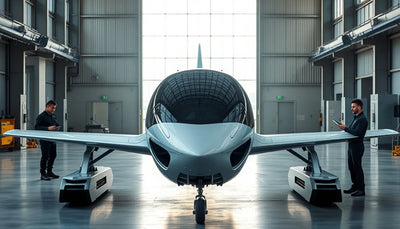
Vision Aerial puts US-built Vulcan drones into production
Vision Aerial has moved its American-built Vulcan drone family into production while its acquisition by Mobix Labs advances. The shift signals fresh capital and supply chain intent in the US commercial drone segment, with revenue growth projected over the next two years.

Quick answer
Vision Aerial has started production of its American-built Vulcan drone family while its planned acquisition by Mobix Labs moves forward, according to DroneDJ.
- Production of the Vulcan drone family is now underway in the US
- The Mobix Labs acquisition remains on track
- Vision Aerial projects sharp revenue growth over the next two years
- The move points to stronger domestic commercial drone manufacturing capacity
Evidence: DroneDJ
Purchase timing
Use market shifts to buy, sell, repair, or wait with more context.
Compare trade-in timing, pre-owned DJI pricing, and repair economics before committing new capital.

DroneDJ reported on September 1 that Vision Aerial has moved its new American-built Vulcan drone family into production, only months after announcing a planned acquisition by Mobix Labs. The production start is a concrete operational step for a company that has spent years positioning itself as a domestic alternative in the commercial drone market.
The timing matters. Rather than waiting for the Mobix Labs transaction to close, Vision Aerial is pushing forward with manufacturing and projecting a sharp jump in revenue over the next two years. For commercial operators, fleet buyers, and repair planners, that suggests a supplier trying to build continuity and capacity at a moment when domestic sourcing remains a live procurement question.
The production signal and the Mobix context
According to DroneDJ, the Vulcan drone family is now entering production in the United States. The report frames this as the next step in Vision Aerial's growth strategy following the Mobix Labs acquisition announcement. Mobix Labs, a connectivity and semiconductor company, would bring a different kind of financial and technical backing to a drone manufacturer that has historically served industrial, agricultural, and public-sector customers.
The projected revenue increase over the next two years is notable because it implies that Vision Aerial expects the Vulcan line to move beyond early orders into repeatable commercial volume. For operators who have been waiting for a credible non-Chinese enterprise platform, the production start is a signal that the product is no longer a concept or a limited pilot run. It is a manufacturing commitment.
Reboot Hub analysis: a production start does not by itself confirm delivery timelines, unit pricing, or service network readiness. Those details remain unverified in the source data. What the report does establish is that Vision Aerial is investing in output before the acquisition closes, which reduces the risk of a post-deal pause while the two companies integrate.
Why domestic production still matters to commercial buyers
US commercial drone procurement has been shaped for years by concerns over data security, supply chain visibility, and federal funding restrictions on certain foreign-made platforms. Vision Aerial has built its brand around American manufacturing, and the Vulcan production start reinforces that positioning at a practical level.
For enterprise fleet managers, a domestically produced airframe can simplify compliance reviews, especially for customers that operate under federal, state, or critical infrastructure procurement rules. It can also shorten some repair and spare parts conversations, assuming the manufacturer maintains component inventory and service documentation in the United States.
That said, operators should not assume that domestic assembly automatically means every subcomponent is sourced domestically. The source data does not specify the Vulcan supply chain mix. Buyers evaluating the platform should ask directly about component origin, lead times, and repair turnaround commitments before committing fleet budgets.
What this means for drone owners and the market
The most immediate market effect is psychological and structural. A US manufacturer moving a new enterprise drone family into production while an acquisition is pending tells buyers that the company is not in a holding pattern. It also puts pressure on competing domestic and international suppliers to clarify their own production capacity and delivery confidence.
For owners of existing Vision Aerial platforms, the production announcement suggests that the company is planning for continuity rather than winding down. That can matter for long-term maintenance planning, because a manufacturer that stops producing a model often becomes a weaker source of proprietary parts. Operators with current Vision Aerial fleets should monitor whether Vulcan production affects support for older airframes, and whether the Mobix integration changes service terms.
For the broader pre-owned DJI market, the Vulcan story is a useful benchmark rather than a direct competitor. Most commercial operators still run DJI platforms because of their mature ecosystem, wide repair network, and predictable resale value. A stronger domestic enterprise alternative does not immediately change that, but it does give larger fleets another reference point when they evaluate total cost of ownership. Buyers who want a domestic option may begin comparing new Vulcan pricing against inspected pre-owned DJI enterprise units, especially if budget cycles tighten. Reboot Hub tracks these ownership and repair dynamics in its Drone Wiki for operators weighing new domestic platforms against proven pre-owned equipment. For owners evaluating service and lifecycle risk, Drone Wiki explains the relevant repair, parts, resale, or operational path.
The practical takeaway for a fleet manager is to treat the Vulcan production start as a reason to request formal delivery estimates, service-level commitments, and parts availability data from Vision Aerial or its channel partners. Production is not the same as delivery, and commercial drone programs live or die on support consistency after the first unit ships.
What to watch as the Mobix deal progresses
The next meaningful data points will be the closing of the Mobix Labs acquisition, any public filing that quantifies the transaction, and the first confirmed Vulcan deliveries to commercial customers. DroneDJ's report does not provide a closing date or financial terms, so operators should treat the timeline as open until either company issues a formal statement.
Revenue projections over a two-year window are also worth watching. If Vision Aerial hits early milestones, it could attract more channel partners and service providers, which would improve the ownership experience for buyers. If the projections slip, the market will likely read that as a sign that domestic manufacturing economics remain difficult even with new capital behind them.
For now, the Vulcan production start is best understood as a supply-side development with long-term implications for US commercial drone procurement. It does not change the day-to-day reality for most operators, but it adds a credible domestic manufacturing thread to a market that has been dominated by a single foreign supplier for more than a decade.
FAQ
Frequently asked questions
Is Vision Aerial's Vulcan drone now available to buy?
DroneDJ reports that the Vulcan drone family has entered production, but the source does not confirm retail availability, delivery dates, or pricing. Interested buyers should contact Vision Aerial or its channel partners directly for order and delivery specifics.
Does the Vulcan production start affect DJI drone owners?
Not directly. DJI remains the dominant commercial platform, and the Vulcan line is a separate domestic enterprise option. The announcement is more relevant to fleet managers evaluating long-term procurement strategy than to individual DJI owners.
What should fleet operators do after this announcement?
Fleet managers should request formal delivery timelines, parts availability commitments, and service terms from Vision Aerial before committing budget. Production is a meaningful step, but support consistency after delivery is what determines real-world operating cost.
Which sources support this update?
The visible evidence links identify DroneDJ; each source is used only for the claim it directly supports.
What remains subject to change?
Retail pricing, availability, product bundles and regulatory timelines can change. Readers should verify the latest terms with the named retailer, manufacturer or regulator before acting.
How should buyers or operators use this analysis?
Use the verified facts as a starting point, then compare mission fit, lifecycle support, maintenance needs and current procurement terms before making a purchase or fleet decision.
This article is market commentary for drone operators and buyers, not investment advice. Reboot Hub does not recommend securities transactions.
Konzultált források
- DroneDJ - primary source
A közzététel időpontjában további hivatalos dokumentáció nem állt rendelkezésre.
A Reboot Hub szerkesztősége vásárlási, javítási, viszonteladási és üzemeltetési elemzéseket nyújt dróntulajdonosok számára. Ha hibát észlel, kérjük, jelezze nekünk a szerkesztői irányelvünknek megfelelően a javítás érdekében.
Ez a cikk piaci elemzés drónüzemeltetők és vevők számára, nem jelent befektetési tanácsot. A Reboot Hub nem nyújt pénzügyi tanácsadást és nem javasol értékpapír-tranzakciókat.