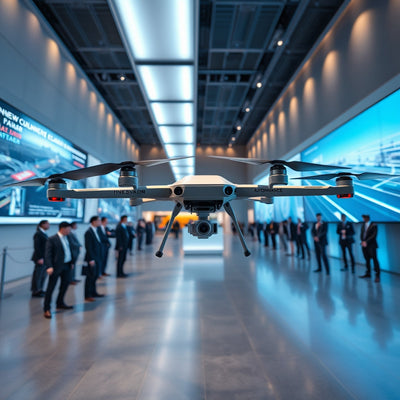
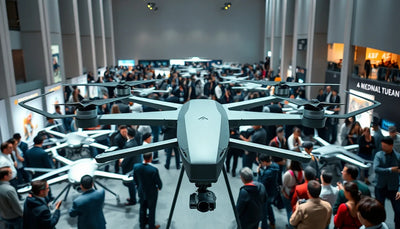
China's Low-Altitude Economy Shifts From Concept to Commercial Use
The low-altitude economy is moving past concept competition and into practical commercial deployment, according to a new Chinese market report. For drone buyers and fleet operators, the shift signals more focus on real operational value, service infrastructure, and long-term asset planning rather than speculative technology demos.

Quick answer
A Chinese market report indicates the low-altitude economy is transitioning from concept competition to practical commercial deployment.
- The shift moves industry focus from technology demonstrations to operational value.
- Commercial buyers should prioritize service infrastructure and long-term asset planning.
- The change signals maturing demand for repair, parts, and fleet support services.
Evidence: DJI ROMO official robot vacuum page · DJI Support ROMO beginner guide
Market context
Turn market news into a buy, repair, or trade-in decision.
Compare pre-owned availability, resale timing, and repair economics before the market moves again.

Eastern Wealth reports that China's low-altitude economy is moving from "taking off" to "putting to use," signaling a structural shift away from concept competition and toward practical commercial deployment. The report frames this as an industry inflection point: the novelty phase of drone demonstrations and pilot programs is giving way to measurable operational use across logistics, inspection, agriculture, and urban services.
For commercial operators and fleet buyers, the implication is significant. When a market stops competing on concepts and starts competing on utility, the purchasing calculus changes. Buyers begin to evaluate drones less as experimental assets and more as revenue-generating equipment that must deliver uptime, serviceability, and predictable operating costs. That shift has direct consequences for how fleets are financed, maintained, and eventually resold.
The transition from demonstration to deployment
The Eastern Wealth report describes a low-altitude economy that has matured beyond its early promotional phase. Early-stage activity in China's drone sector often centered on high-profile demonstrations, concept vehicles, and pilot zones designed to prove what was technically possible. The current phase, according to the report, is defined by actual deployment: drones carrying real payloads, serving real customers, and operating within real commercial workflows.
This is not merely a semantic distinction. Concept competition rewards engineering ambition and media attention. Deployment competition rewards reliability, cost per flight hour, spare parts availability, and the ability to keep aircraft in service. Reboot Hub analysis suggests that operators who entered the market during the demonstration phase may now need to reassess their fleets against these more demanding operational criteria.
Why operational value now leads the conversation
The report indicates that the low-altitude economy's stakeholders are increasingly focused on whether drone programs deliver tangible economic returns. That means logistics providers are measuring delivery cost per kilometer, inspection companies are tracking coverage per flight hour, and agricultural operators are calculating input savings per hectare. In each case, the drone is no longer the story; the operational outcome is.
For fleet managers, this emphasis on operational value has a practical consequence: aircraft downtime becomes more expensive. A drone that is grounded waiting for a repair part is not generating revenue. As the market matures, the availability of genuine OEM spare parts and professional repair services becomes a competitive factor in fleet planning. Operators who treat maintenance as an afterthought may find themselves at a disadvantage compared to those who build serviceability into their procurement decisions from the start.
What this means for drone owners and the market
The shift toward practical commercial use has implications for the entire ownership lifecycle of commercial drones. When drones are deployed in revenue-critical roles, buyers place greater value on predictable maintenance, genuine parts availability, and the residual value of their aircraft. A well-maintained drone with documented service history becomes a more liquid asset in the secondary market. This is where the commercial bridge becomes relevant: operators evaluating the long-term cost of ownership can consult the Drone Wiki to better understand maintenance practices and parts sourcing for their aircraft. For owners evaluating service and lifecycle risk, Drone Wiki explains the relevant repair, parts, resale, or operational path.
Reboot Hub analysis: The pre-owned DJI market is likely to feel this shift as well. As more Chinese operators move from pilot programs to full commercial deployment, fleet composition changes. Some operators will upgrade to larger or more specialized aircraft, releasing inspected pre-owned units into the secondary market. Others will seek to acquire additional aircraft at lower capital cost to scale operations quickly. Both dynamics support a more active and more professionally managed pre-owned drone market, where service history and genuine OEM-pulled parts matter more than cosmetic condition.
Reboot Hub analysis also suggests that the maturing low-altitude economy will place greater scrutiny on repair economics. In a concept-driven market, a damaged drone might simply be replaced. In a deployment-driven market, the cost of repair versus replacement becomes a financial decision. Professional DJI repair services that can restore an aircraft to reliable service at a fraction of replacement cost become more valuable to operators who are managing tight operating margins.
What buyers and fleet managers should watch next
The Eastern Wealth report does not provide specific operational data, but the directional signal is clear enough to inform procurement strategy. Buyers and fleet managers should watch for evidence that the low-altitude economy's commercial use cases are scaling beyond pilot volumes. That evidence may appear in the form of expanded delivery routes, larger inspection contracts, or increased demand for enterprise drone support services.
Operators should also pay attention to how the shift toward commercial deployment affects parts and service infrastructure. A market that is serious about operational use must invest in the support ecosystem that keeps aircraft flying. That includes genuine OEM spare parts distribution, professional repair capacity, and transparent service documentation. For individual buyers, the practical takeaway is to evaluate any drone purchase not just on its flight performance, but on the total cost of keeping it operational over its service life.
Reboot Hub analysis: One operator-facing action emerges from this analysis: before expanding a fleet or entering a new commercial drone application, assess the support infrastructure behind the aircraft you plan to fly. Ask where genuine parts come from, how quickly repairs can be completed, and what the aircraft is likely to be worth when you are ready to sell it. In a market that has moved beyond concepts, these questions are no longer secondary. They are central to whether a drone program succeeds.
FAQ
Frequently asked questions
What is the main finding of the Eastern Wealth report?
The report indicates that China's low-altitude economy is moving from concept competition to practical commercial deployment, with greater emphasis on real operational use rather than technology demonstrations.
How does this shift affect commercial drone buyers?
Buyers should now evaluate drones based on operational value, including reliability, maintenance costs, parts availability, and residual value, rather than focusing primarily on technical novelty or demonstration capabilities.
Why does the pre-owned drone market matter in this transition?
As operators scale commercial deployment, fleet turnover increases. Some will upgrade aircraft and sell inspected pre-owned units, while others will buy pre-owned drones to expand capacity at lower capital cost, making service history and genuine parts more important in resale value.
Which sources support this update?
The visible evidence links identify DJI ROMO official robot vacuum page and DJI Support ROMO beginner guide; each source is used only for the claim it directly supports.
What remains subject to change?
Retail pricing, availability, product bundles and regulatory timelines can change. Readers should verify the latest terms with the named retailer, manufacturer or regulator before acting.
How should buyers or operators use this analysis?
Use the verified facts as a starting point, then compare mission fit, lifecycle support, maintenance needs and current procurement terms before making a purchase or fleet decision.
Konzultált források
- Source material - primary source
- DJI ROMO official robot vacuum page - official product page
- DJI Support ROMO beginner guide - official support guide
A Reboot Hub szerkesztősége vásárlási, javítási, viszonteladási és üzemeltetési elemzéseket nyújt dróntulajdonosok számára. Ha hibát észlel, kérjük, jelezze nekünk a szerkesztői irányelvünknek megfelelően a javítás érdekében.